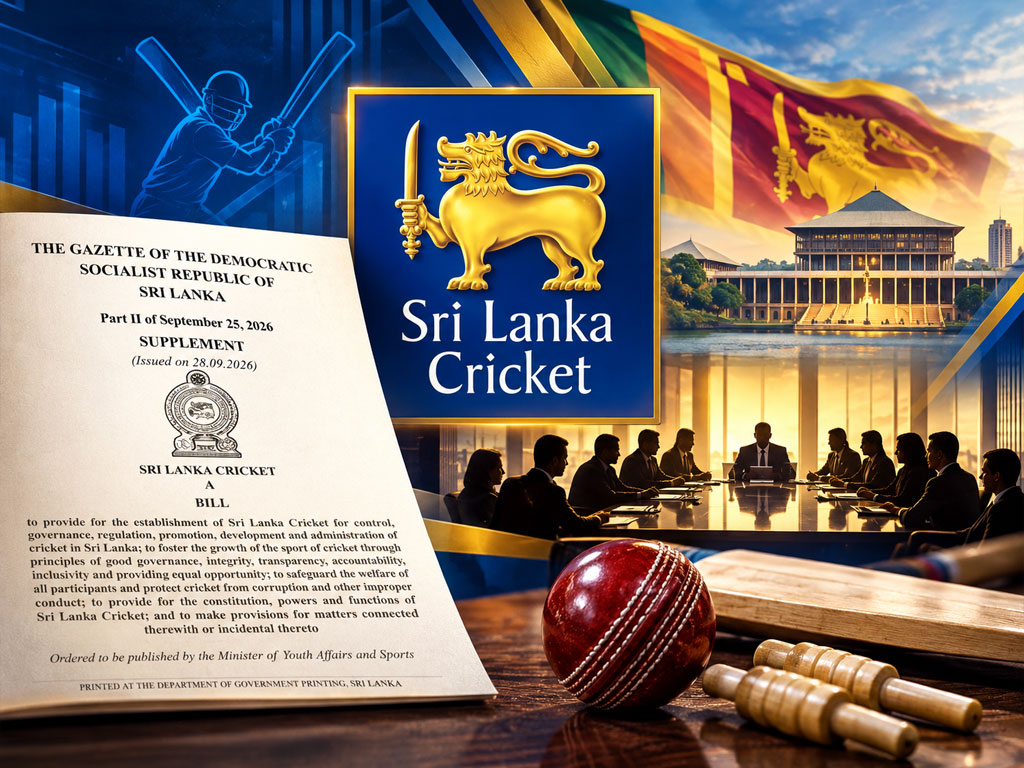
Sri Lanka Cricket Bill proposes a 14-member board, new voting structure, term limits, parliamentary reporting and stronger oversight.
COLOMBO — A Bill proposing a new statutory framework for the governance of Sri Lanka Cricket has been published in the Government Gazette, setting out major changes to the composition of its board, voting rights, financial accountability and oversight.
The Sri Lanka Cricket Bill proposes establishing Sri Lanka Cricket as a body corporate responsible for regulating, promoting and developing cricket in the country.
Published in a Gazette supplement dated September 25 and issued on September 28, the legislation follows Cabinet approval for a restructuring of cricket administration. The Cabinet Office previously confirmed that the Bill was prepared by the Legal Draftsman and had received clearance from the Attorney General.
It has been published but is not yet law. The proposed legislation must proceed through Parliament before it can take effect.

Seven Independent and Seven Elected Directors
Under the proposed structure, Sri Lanka Cricket would be governed by a 14-member board comprising seven Independent Directors and seven Elected Directors.
At least two of the seven Independent Directors would have to be women.
A significant change concerns the distribution of leadership. The chairperson would be selected from among the Independent Directors, while the deputy chairperson would come from the Elected Directors.
Elected Directors would serve four-year terms, with a cumulative limit of eight years.
The Bill also establishes disqualification criteria for board positions. Restrictions would apply to people holding certain political or cricket-related roles, as well as journalists and media owners, and player agents or managers.
These provisions would substantially change the framework governing who can hold decision-making positions within Sri Lanka Cricket.
Three-Tier Membership and Voting System
Another major feature is a three-tier membership structure carrying different voting rights.
Tier A members would receive two votes each. Tier B members and Provincial Cricket Associations would have one vote each.
Tier C members would be permitted to attend meetings as observers but would not have voting rights.
The proposed structure therefore retains an electoral component within cricket administration while separating voting privileges according to membership category.
The 14-member board would itself combine the elected component with an equal number of Independent Directors.
Minister Given Audit and Inquiry Powers
Financial accountability and government oversight form another major part of the proposed legislation.
Audited accounts and annual reports would have to be submitted to Parliament and published online, creating a statutory reporting mechanism for Sri Lanka Cricket.
The Bill would also empower the minister to initiate audits and inquiries where there are credible allegations of corruption, financial irregularities or governance failures.
Depending on the circumstances and the applicable provisions of the proposed law, action could include the suspension or removal of individual directors or the board.
The Government has said the broader purpose of the legislation is to establish a framework based on good governance, integrity, transparency, accountability, inclusivity and equal opportunity, while safeguarding participants and protecting cricket from corruption and other malpractice.
What Happens to the Existing Sri Lanka Cricket?
The Bill contains transitional provisions covering the move from the existing administrative structure to the proposed statutory body.
If enacted, the assets, liabilities, contracts, employees and pending proceedings of the existing body would transfer to the new Sri Lanka Cricket.
The legislation would also replace provisions of the existing Sports Law relating to cricket.
That means the Gazette publication does not itself immediately change the present administration. The Bill must first complete the parliamentary process and be enacted before its provisions can take legal effect.