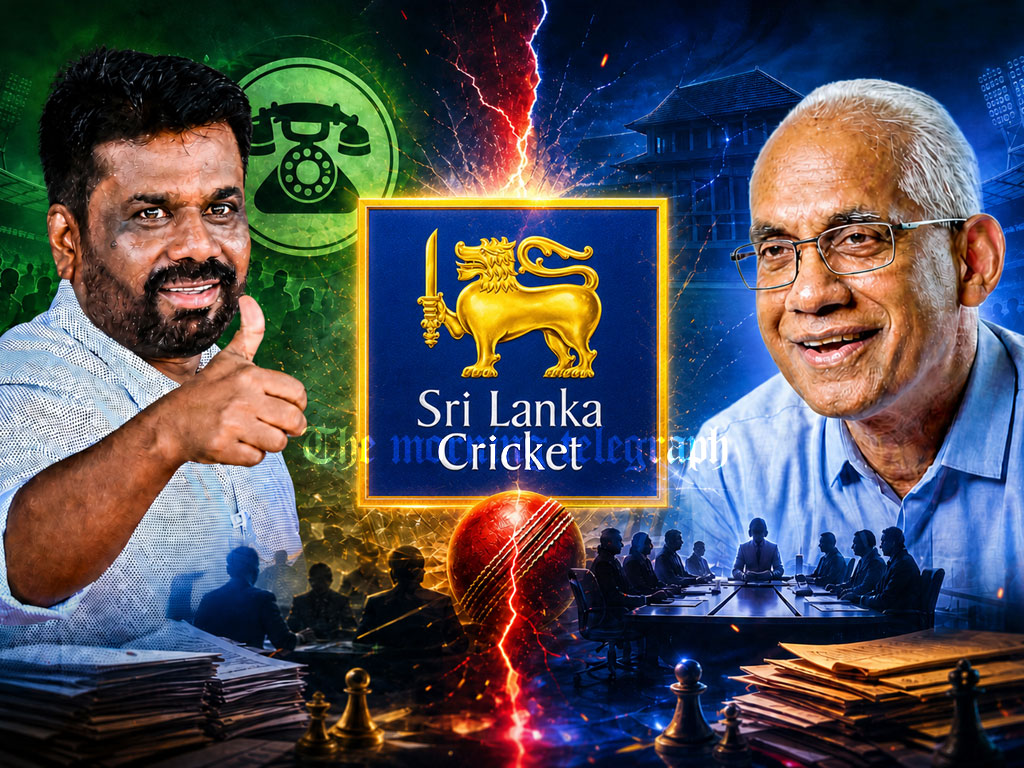
Sri Lanka Cricket faces fresh political scrutiny as Anura’s reported move to appoint Eran revives concerns over power, party rivalry and control.
The Sri Lanka Cricket power struggle has returned to the centre of national politics, with President Anura Kumara Dissanayake reportedly preparing to intervene directly in cricket administration by appointing Eran Wickramaratne, a senior opposition politician, to the Cricket Board Interim Committee.
The move has triggered a wider debate over whether cricket administration is once again being used as a political field, where governments attempt to weaken opponents, manage public anger, and reshape power through sports leadership.

How Government Power And Party Rivalries Shape Cricket
After the Lanka Sama Samaja Party withdrew from Mrs. Bandaranaike’s United Front government in 1975, UNP leader and Opposition Leader J. R. Jayewardene, along with Lanka Sama Samaja Party leaders N. M. Perera and Colvin R. de Silva, frequently held secret discussions on how to overthrow Mrs. Bandaranaike’s government.
Those discussions often took place at the house of prominent businessman Upali Wijewardene, a relative of both J. R. Jayewardene and Mrs. Bandaranaike.
J. R. Jayewardene reportedly planted an idea in N. M. Perera’s mind that if the government went for a parliamentary general election, N. M.’s LSSP and Dr. Wickremesinghe’s Communist Party should join forces but contest separately.
J. R. is said to have promised:
“I will put weak candidates in the places where you and your alliance leaders are contesting and ensure your victory.”
Just as J. R. said, Vincent Perera was fielded in the Yatiyantota seat where N. M. Perera contested.
J. R. was not interested in making Vincent Perera win, but was instead fulfilling the promise he had made to N. M. Perera.
However, knowing this, Premadasa allegedly worked to defeat N. M. Perera. He held meetings throughout the constituency to ensure Vincent Perera’s victory, without J. R.’s knowledge.
N. M. Perera was defeated. Vincent Perera won.
After J. R. Jayewardene came to power and formed the government, N. M. Perera later met him. He said he was contesting for the post of Chairman of the Board of Control for Cricket in Sri Lanka and needed the support of the government and the Sports Minister.
J. R. did not object and agreed.
He instinctively understood that once N. M. took control of cricket administration, the left movement in Sri Lanka would effectively come to an end, which was something J. R. wanted.
In any case, N. M. worked very hard to secure Test cricket status for Sri Lanka. He later fell ill while serving as Chairman of the Board of Control for Cricket in Sri Lanka.
During Premadasa’s time, cricket administration was not directly interfered with. Unlike J. R., he was not particularly focused on cricket.
Premadasa made cricket governance more independent. After J. R.’s time, cricket board chairmen were appointed with government involvement, but Premadasa did not interfere in the election of the Chairman of the Cricket Board.
This is why Lakshman Jayakody, a senior opposition MP, was elected Chairman of the Cricket Board.
Premadasa accepted this result and advised the Sports Minister to work amicably with him.
Lakshman Jayakody was a senior SLFP Member of Parliament when he became chairman. Although he criticized Premadasa and the government in Parliament, Premadasa did not mix politics with cricket administration.
However, questions remain over whether that principle has survived in today’s political climate.
Now, the current President Anura is reportedly preparing to directly intervene in cricket administration and appoint Eran Wickramaratne, an opposition politician, to the Cricket Board Interim Committee.
This is not through an election, as in the cases of N. M. Perera and Lakshman Jayakody, but through a government appointment.
The campaign to dissolve the Cricket Board chairman and restructure the board began during Ranil’s government. It was led by Sports Minister Roshan Ranasinghe and Opposition Leader Sajith Premadasa.
Sajith and Roshan were able to bring together members of the ruling party and opposition in support of the move.
Eventually, a resolution was passed in Parliament to remove Cricket Board Chairman Shammi Silva and the board, making it a historic decision.
President Ranil opposed the resolution.
Anura Kumara and JVP MPs Vijitha Herath and Harini Amarasuriya did not vote in favor of it.
While Sports Minister Roshan claimed there was a deal between Anura and Shammi Silva, Anura was also accused of indirectly supporting Shammi by exposing alleged corruption involving Arjuna Ranatunga, who was heading an interim committee.
Although hardline activists supporting the government expected Shammi Silva’s removal and reforms in cricket administration, Anura did not remove him.
He even entrusted Shammi with responsibility for developing the Jaffna cricket stadium.
Shammi continued to lead the Cricket Board for about a year and a half during this period.
“Then why did Anura want to remove Shammi at all?”
That question has now become central to the debate.
When the government was facing difficulties amid allegations of coal-related corruption and missing treasury funds, and when hardline supporters were publicly criticizing the administration, Anura reportedly chose to appease them by initiating changes in cricket administration.
This was also seen as an attempt to respond to opposition criticism and shift public perception.
Anura reportedly selected Eran Wickramaratne, a senior opposition politician and member of the Samagi Jana Balavegaya Economic Committee, for the interim committee in order to politically weaken the opposition.
This raises concerns about whether Sri Lanka Cricket is being used not only for sports reform, but also as a tool in a wider political strategy.
Similarly, lawyer Upul Kumarapperuma, who was also appointed to the cricket administration body, is a close associate of Anura.
When Upul Kumarapperuma was made President’s Counsel during Ranil’s administration, the JVP launched strong criticism against him, which contributed to his electoral defeat.
Although Anura could not give him a formal government position due to party opposition, he was later accommodated in the cricket interim committee.
Like Eran, Upul is also a defeated candidate in the general election.
The government has not clearly explained how defeated candidates are eligible for such appointments.
Another point is that during the 2024 presidential election, Anura and the JVP strongly criticized Sajith’s economic committee and Eran Wickramaratne, accusing them of being part of a corrupt network.
However, the government has not clearly explained how Eran was later cleared of those allegations.
Traditionally, when governments face crises, leaders such as J. R. Jayewardene, Wijetunga, Chandrika Kumaratunga, Mahinda Rajapaksa, Maithripala Sirisena, and Ranil Wickremesinghe have attempted to weaken the opposition by appointing opposition figures to government positions.
However, Anura cannot fully follow this approach due to the JVP’s policy of not inducting politicians from other parties.
Instead, influencing opposition figures through appointments to sports administration bodies is now being seen as a modern alternative strategy.
There is also a perception among some sections of society that Anura lacks a strong team to manage the country’s economy and governance, while the Samagi Jana Balawegaya is seen as having such a team.
The removal and appointment decisions involving Eran Wickramaratne are therefore seen by some as an attempt to challenge and reshape that perception.
What happens next could be critical, because the Sri Lanka Cricket shake-up is no longer only about the sport. It is now about political control, opposition strategy, government survival, and whether cricket administration will be reformed through genuine independence or pulled deeper into the power games of the state.