Vesak week shift triggers concern as Hajj falls within the same period, raising questions over Kurbani rituals and minority rights.
The Vesak week shift has triggered a sensitive social media debate after concerns emerged that the newly designated Vesak week overlaps with the Hajj celebration, raising questions within the Muslim community over religious rights and traditional rituals.
The government recently took steps to postpone Vesak Poya, which had been scheduled for May 1, to May 30, due to the Visaka Nekatha not aligning with the original date. The decision was made after considering a request submitted to President Anura Kumara Dissanayake by the Most Venerable Prelates.

However, questions remain after members of the Muslim community pointed out that the Hajj celebration also falls within the newly declared Vesak week. This has now created a wider discussion on whether the government considered the impact of the change on Muslim religious practices, especially the Kurbani sacrifice linked to Hajj.
Why Vesak Poya Was Postponed
In a letter sent to President Anura Kumara Dissanayake on December 20, 2025, the Most Venerable Prelates pointed out that the birth, enlightenment, and passing away of the Buddha occurred during a constellation known as Visaka Nekatha.
They noted that Vesak Poya, which had been designated for May 1 according to the calendar issued at that time by the Ministry of Public Administration, Provincial Councils and Local Government, did not carry the above mentioned constellation.
Therefore, the letter stated that it would be appropriate to designate May 30, which had been named Adhiposon Poya, as Vesak Poya.
Furthermore, at the meeting of the All Ceylon Sasana Protection Boards held on January 6, 2026, it was proposed that Vesak week should be named from May 27, 2026 to June 2, 2026.
Regarding this matter, the Commissioner General of Buddhist Affairs, R.M.G. Senarathna, made a request on February 16, 2026, through the Secretary of the Ministry of Buddha Sasana, Religious and Cultural Affairs, to the Secretary of the Ministry of Public Administration, Provincial Councils and Local Government.
Accordingly, the ministers of those two departments submitted a joint cabinet memorandum to the Cabinet on March 16, and cabinet approval was granted on March 30, 2026.
As a result, Vesak week has now been named from May 27, 2026 to June 2, 2026.
Hajj Celebration Now Falls Within Vesak Week
The Hajj celebration falls on May 28, which is within the newly designated Vesak week.
This has sparked discussion among Muslims, particularly over how the overlap may affect the Kurbani sacrifice traditionally performed during Hajj.
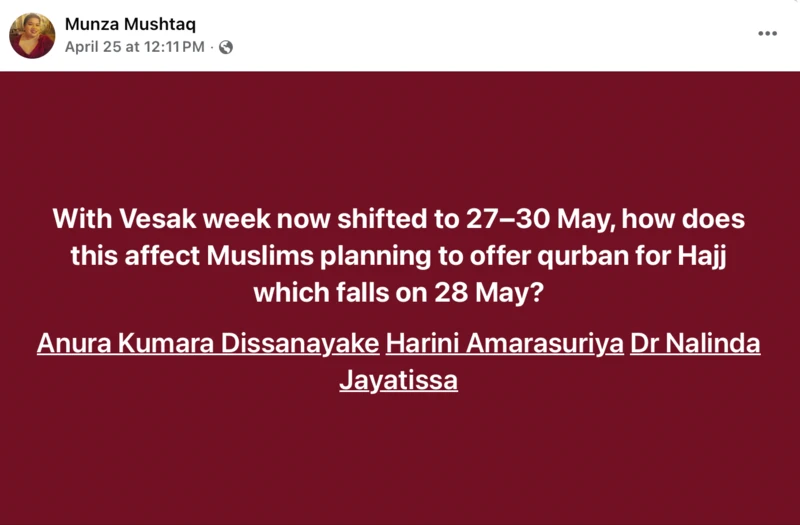
A journalist named Munza Mushtaq posted a note in English on her Facebook account regarding the matter. According to a rough Sinhala translation, she questioned how the shift of Vesak week to May 27 to 30 would affect Muslims planning to perform the Kurbani sacrifice for Hajj on May 28.
Social media activist Arshad Kader also published a lengthy post in English on his Facebook account. He pointed out that there may be obstacles to performing traditional Hajj rituals during a week when certain restrictions, including restrictions on meat, are usually imposed for the Vesak celebration.
He alleged that the situation sends a message to every citizen that minority rights are not protected by the state and are instead subject to the whims and “permission” of the religious majority.
This raises concerns about how the state balances major religious observances when the calendar creates a direct overlap between Buddhist and Muslim religious practices.
Government Responds To The Concern
Deputy Minister of Religious and Cultural Affairs Muneer Mulaffer responded to the issue raised by the Muslim community over the redesignation of Vesak week.
“There is a small discussion in society by now as to whether the Muslim community was considered when announcing the week. This is a sensitive matter. Two beliefs. Two differently held beliefs. As a government, we believe that we must act carefully in this regard,” the Deputy Minister said.
He said discussions are now taking place through the Commissioner of Buddhist Affairs, under the ministry, in consultation with Public Administration, to find an amicable and respectful way to address the matter.
“The Commissioner of Buddhist Affairs, under our ministry, in consultation with Public Administration, we are now discussing what can be done to resolve the matter very amicably and with understanding, and we are preparing to take the necessary steps,” he said.
According to the Deputy Minister, a circular will be issued regarding the closure of liquor stores and meat stalls on Poya days and the following days.
He said that circular would mostly create a situation where it does not conflict with the Hajj day of the Muslim community.
“A circular will be issued regarding liquor stores and meat stalls being closed on Poya days and the following days. That circular will mostly create a situation where it does not conflict with the Hajj day of the Muslim community,” the Deputy Minister said.
However, Muneer Mulaffer also said the Muslim community has a responsibility as Hajj approaches near Vesak week.
“As a community, I think we too have a responsibility, as the Muslim community, because our festival comes near Vesak week, we must act very sensitively, with respect towards others and their religions and cultures regarding the Kurbani associated with our Hajj festival. We are also giving that message to the Muslim community,” he said.
When asked whether the Muslim community was consulted when changing Vesak week, given that Hajj also falls within that period, the Deputy Minister said the declaration followed the usual method applied in Sri Lanka.
“The method that existed in our country when declaring Vesak week was that generally there were two days before and three days after the date. It is according to that that it would have been declared,” Deputy Minister Muneer Mulaffer said.
What happens next could be critical, as the government now faces the delicate task of protecting Vesak observances while ensuring that the Muslim community can observe Hajj without unnecessary restrictions or a sense of religious exclusion.