Plantation workers remain trapped between May Day promises and harsh estate realities despite wage pledges, housing plans, and reforms.
Plantation workers in Sri Lanka remain trapped between nearly a century of May Day promises and the harsh daily realities of estate life.
For more than a hundred years, the anthem of international workers’ solidarity, first written in French in 1871, has echoed across the world, urging labourers to unite and demand their rights. In Sri Lanka, that call has been repeated for almost a century through annual May Day commemorations.

Yet for many of the country’s most vulnerable workers, especially those living in plantation communities, the promise of dignity, justice, and equality remains largely unfulfilled.
This year marks nearly the ninety-eighth anniversary of May Day being observed in Sri Lanka. In theory, such a long history of labour activism should have brought meaningful improvements to the lives of workers.
But the reality tells a more painful story. While employment patterns have changed over time, and many modern workers may no longer fit the old image of the struggling labourer, there remains one section of society for whom that description is still painfully accurate.
Among them are the Malay and Tamil plantation workers scattered across the central highlands and other estate regions.
Despite their major contribution to Sri Lanka’s export economy, especially through tea and other plantation industries, their living conditions have improved only slightly across generations.
For these communities, daily life is still shaped by low wages, poor housing, limited access to quality education and healthcare, and insecure land rights.
May Day in Sri Lanka has increasingly become symbolic. What began as a movement rooted in workers’ rights has gradually been overtaken by political rallies, parades, and displays of party power.
These events may attract large crowds and create political visibility. However, they have done little to resolve the deep structural problems faced by plantation workers.
The gap between political speeches and estate realities remains wide.
Even the most basic issues affecting plantation communities have not been systematically addressed. Economic insecurity continues, with many families struggling to meet ordinary household expenses.
Access to quality education and healthcare remains uneven. Housing conditions in some estates remain poor. Land ownership, which is essential for long-term stability, continues to be a disputed and unresolved issue for many families who do not have clear rights to the land they occupy.
Recognition itself has taken too long.
It has required decades of advocacy for plantation communities to be properly acknowledged within national demographic frameworks. That delay reflects a wider pattern of marginalization, even though these workers have been part of Sri Lanka’s social and economic foundation for more than two centuries.
Wage policy is another area where progress remains limited.
The government has moved to increase the daily wage of estate workers from 1,350 rupees to 1,750 rupees. On paper, this appears to be an improvement.
However, its real impact is weakened by inflation, rising food prices, and the general cost of living. For many families, even the revised wage is still not enough to cover monthly expenses, which are estimated to require at least 90,000 to 100,000 rupees.
Even when two members of a household are employed, financial security often remains out of reach.
Not every worker benefits equally from the wage increase either.
Of the approximately 113,000 plantation workers, only around 80,000 are covered under the revised wage structure. This leaves a large section of the workforce, particularly those employed in some state-owned or smaller estates, outside the full benefit of the policy.
Critics argue that the structure of these wage revisions may, in some cases, benefit companies more than workers. This raises concerns about whether such policies truly address the hardships of estate families.
The problems go beyond wages.
Plantation workers continue to face issues involving provident funds, gratuity payments, and wider labour rights. Legal disputes in labour courts and higher judicial institutions have documented many of these unresolved grievances.
These cases point to continuing weaknesses in enforcement, accountability, and worker protection.
Against this background, political messaging often presents a more hopeful picture.
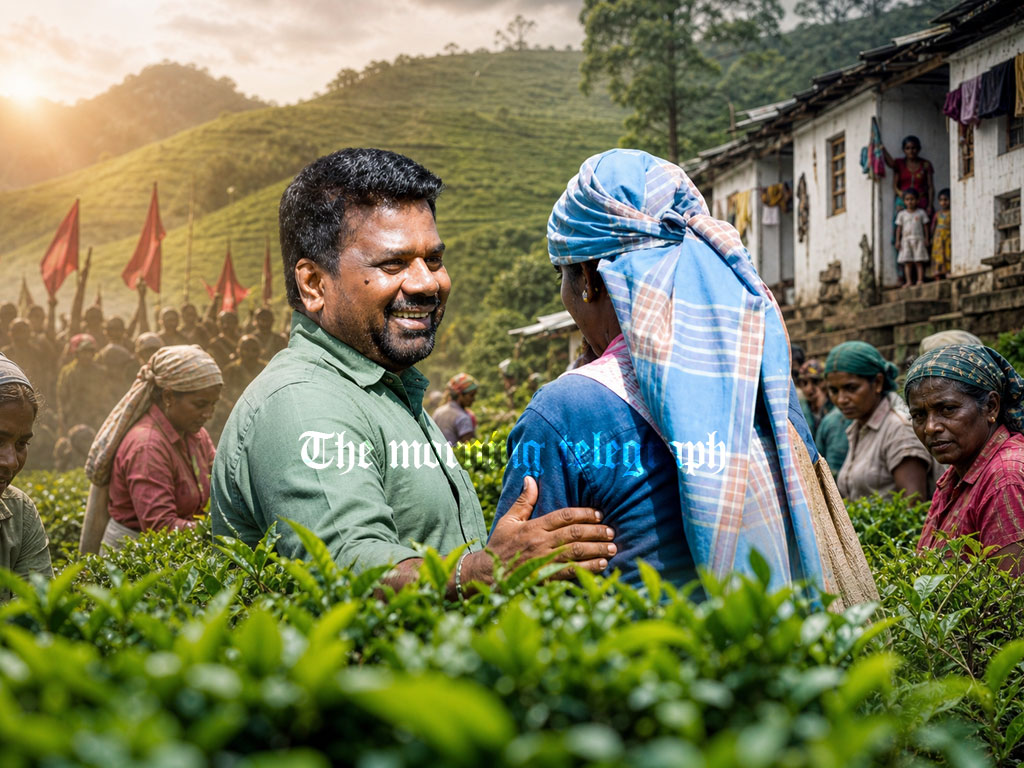
At a recent rally in Nuwara Eliya, President Anura Kumara Dissanayake emphasized his government’s commitment to improving the lives of plantation communities.
He acknowledged past failures and pledged to recognize the Malay and Tamil plantation population as an integral part of Sri Lanka.
His speech included several proposed measures, including wage increases, land distribution programs, better housing, and expanded access to public services.
The President also promised legal protections for vulnerable workers, including domestic employees. He also highlighted plans for youth development, vocational training, and environmental conservation initiatives involving plantation communities.
In addition, he addressed the impact of a recent cyclone, pledging support for displaced families and promising temporary and permanent housing solutions.
These commitments show that long-standing issues are now being acknowledged at the highest political level.
However, questions remain about implementation. Sri Lanka’s past experience has shown that policy announcements do not always become practical results.
For many plantation workers, the urgent issue is not the promise of future reform, but the pressure of present living conditions.
The aftermath of the recent cyclone shows this gap clearly.
Despite government assurances, many affected families continue to live in temporary shelters, including schools, tents, and deteriorating estate buildings.
Access to basic facilities remains limited. Long-term solutions have still not materialized. For communities already living on the edge, such delays deepen vulnerability and frustration.
There is also a larger question about the meaning of May Day itself.
If May Day is to retain its original purpose, it cannot remain only a day of flags, speeches, processions, and political slogans. It must become a platform for genuine dialogue, accountability, and action.
The problems faced by plantation workers, including land rights, housing, wages, education, healthcare, and social integration, require sustained attention beyond one annual celebration.
The decision to hold this year’s main May Day event in Nuwara Eliya, closer to plantation communities, has been welcomed by some as a positive step.
It offers political leaders a chance to speak directly to workers and better understand their struggles.
But physical proximity alone is not enough. What matters is whether that engagement produces meaningful change.
As Sri Lanka marks another May Day, the contrast between celebration and reality remains stark.
The songs of solidarity are still sung. The rallies still draw crowds. The speeches still promise justice.
But for plantation workers who have long carried the weight of Sri Lanka’s export economy, the struggle for dignity and equality is far from over.
What happens next could be critical, because the true measure of commitment will not be found in slogans, banners, or speeches, but in policies that are implemented and lives that are improved.
Until then, May Day risks remaining what it has increasingly become for many plantation families: a powerful symbol that still falls short of the transformation it once promised.