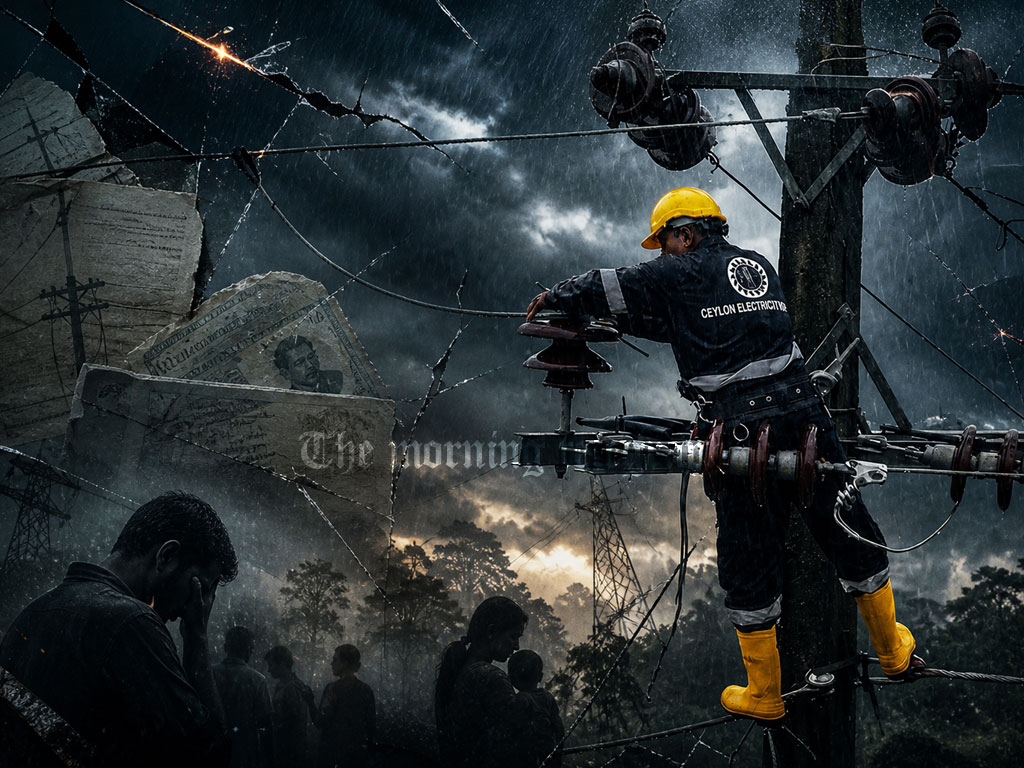
Electricity reform has left nearly 2,000 former CEB workers without promised compensation, income, or clear answers after restructuring.
Electricity reform in Sri Lanka has left nearly two thousand former Ceylon Electricity Board workers facing uncertainty, unpaid compensation, and growing financial hardship.
For decades, the Ceylon Electricity Board remained one of the most important public sector institutions in the country, supplying power to homes, businesses, industries, and livelihoods. Today, that institution no longer exists in its old form. It has been dissolved and replaced by four newly created companies under a major restructuring plan.

What was promoted as an answer to inefficiency, financial losses, and long-standing sectoral problems has now turned into a painful human crisis for many former workers. Nearly two thousand employees who left under the voluntary retirement scheme say they are still waiting for compensation, while their lives have been pushed into uncertainty.
“I haven’t received a single penny for two months after losing my job,” says M. D. S. Sampath, who worked at the institution for 15 years.
His words carry more than anger. They reflect disbelief, exhaustion, and the frustration of a man who says he trusted official promises. Like many others, Sampath voluntarily retired after being assured that he would receive a compensation package worth five million rupees.
He believed that money would help him begin a new chapter in life. He hoped to start a business, support his family, and build a more stable future. Instead, he now finds himself without employment, without compensation, and under pressure from the rising cost of living.
The restructuring of Sri Lanka’s electricity sector was formalized through new legislation that came into effect in early March 2026.
Under that process, the long-standing Electricity Board was dismantled and replaced by four separate entities responsible for generation, transmission, distribution, and system operation.
Authorities argued that dividing the institution would improve efficiency, reduce losses, and eventually reduce the burden on consumers. However, for many former employees, the outcome has been far from what was promised.
Among the worst affected are the 1,898 employees who accepted voluntary retirement. They were given a choice: move into one of the newly formed companies or accept a severance package and seek other opportunities.
Many chose the severance option, encouraged by repeated assurances from government officials that compensation would be paid without delay. Nearly two months later, those promises remain unfulfilled.
Janaka, another former employee, says the uncertainty has become unbearable.
“I can’t sleep at night. We are physically and mentally exhausted,” he says.
His experience reflects the wider distress among many former workers who say they now have no income, mounting debts, and no clear timeline for when the money promised to them will be paid.
For W. A. G. I. Wickramanayake, voluntary retirement was supposed to open the door to a new life. After nearly two decades of service, he planned to use his compensation to start a textile business.
He had already rented a shop, expecting the funds to arrive as promised. He even mortgaged his van to support the business plan.
“We are paying rent for the shop we bought to set up a textile business by mortgaging my van,” he explains.
But the business has not opened. The shop remains empty, expenses continue, and the compensation that was meant to make the plan possible has still not arrived.
Stories like these show how deeply former workers trusted official assurances and how damaging the delay has now become. Before the restructuring, government representatives repeatedly said the voluntary retirement scheme would provide attractive compensation.
Employees were told not to fear. They were told payments would be made on time. Those assurances persuaded many to walk away from secure, long-term employment.
Now, those same employees say they have been left without a clear answer. The institution they served has been dismantled, while responsibility appears to be spread across several new entities and government bodies.
Attempts to obtain clarification have produced little more than shifting timelines. At first, officials reportedly indicated that 50 percent of the compensation would be paid before the Sinhala and Hindu New Year. That deadline passed.
Later, other dates were mentioned. Those dates also passed.
The financial pressure has become worse because of Sri Lanka’s wider economic situation. High living costs have made unemployment more difficult to survive. Many former employees had already made financial decisions based on the expectation that their compensation would arrive soon.
Some took loans. Some began investing in businesses. Others made plans to support families and dependents.
A former worker from Ratnapura says his family’s future plans have collapsed. With three children and several dependents, he had hoped to use the compensation to buy land and begin farming.
“Now all those hopes have disappeared,” he says.
“We are living by borrowing from relatives. They trusted us because they believed we would receive the money soon. Now they are asking for it back.”
His words reveal the emotional toll behind the financial crisis. He speaks of sleepless nights, family pressure, and a growing sense of hopelessness.
The electricity restructuring itself has been controversial for years. Debates around the Ceylon Electricity Board focused on heavy losses, operational weaknesses, generation costs, salaries, staffing levels, and pressure from international financial institutions.
Supporters of reform argued that the sector needed urgent change to reduce financial pressure on the state. Critics warned that restructuring could weaken worker protections and open the path toward privatization.
The government presented the breakup as a necessary reorganization, not outright privatization. By creating specialized companies, it said the sector could become more accountable, efficient, and sustainable.
However, questions remain over whether enough planning was done to protect the welfare of employees who chose to leave.
Public opinion has also become more complicated. Many initially supported reforms that promised improved services and lower electricity costs. But electricity bills have not fallen as some expected, and financial problems within the sector are still being discussed.
For affected workers, these wider policy arguments offer little comfort.
Their central complaint is simple. They say they kept their side of the agreement by retiring voluntarily. In return, they expected the government to keep its promise and pay compensation on time.
Instead, they now face debt, uncertainty, and what they describe as the loss of dignity after years of public service.
Some former workers are now discussing collective action. There are conversations about traveling to the Presidential Secretariat to demand answers.
The tone among them is not merely political. It is shaped by desperation, as families who once expected a secure transition now struggle to manage daily expenses.
What happens next could be critical. Sri Lanka’s electricity reform was meant to mark a turning point toward efficiency and sustainability. But for nearly two thousand former CEB workers and their families, it has become a story of broken promises, delayed compensation, and fragile futures.
The unresolved question now is whether a reform can be called successful if the workers who trusted it are left behind.