Political crisis deepens as Ranga’s death, missing US$2.5 million, Harshana’s citizenship row and Vijay’s rise shake Sri Lanka.
Political crisis deepens in Sri Lanka as the death of Ranga Nishantha Rajapaksha, the missing US$2.5 million Treasury controversy, Harshana Suriyapperuma’s citizenship questions, internal Malima tensions, and Vijay’s rise in Tamil Nadu create fresh pressure on the government.
The disappearance of US$2.5 million from the Treasury has now begun to resemble a Hindi film, moving between suspense, fear, political drama, and unanswered questions. Over the past few months, many issues targeting the government surfaced and faded, but this Treasury dollar disappearance has now moved to the top of the political stage.
A serious public concern emerged mainly because of the government’s conduct from the beginning. Although the incident had reportedly taken place between last December and January, the government remained silent until about two weeks ago, when opposition activist and lawyer Maithri Gunaratne revealed the matter through a letter addressed to the Speaker.

Different Dates Raise Suspicion
Even after Maithri exposed the matter, the government’s differing explanations only deepened public suspicion.
Finance Ministry Secretary Dr. Harshana Suriyapperuma first told the media that the incident had been discovered in January. Later, Deputy Finance Minister Dr. Anil Jayantha stated in Parliament that it was first known on March 21.
However, during the Cabinet media briefing held in the final week of April, when journalists questioned Minister Nalinda Jayatissa, he said he himself had learned about it only after receiving the letter.
These contradictory statements created serious doubts about the government’s handling of the issue.
As the controversy grew, Parliament’s Finance Committee moved to summon Finance Ministry Secretary Harshana Suriyapperuma. However, he initially refused to appear.
Instead, he sent a letter saying that since the President was preparing to make a statement in Parliament on the matter, he would provide his explanation to the committee afterward.
But after strong criticism, he reversed his position within a day and eventually agreed to appear before the committee the following day.
Ranga’s Death Raises New Questions
The next major issue emerged when reports revealed that Ranga Nishantha Rajapaksha, an Additional Director at the Finance Ministry who had been suspended over suspicions linked to the missing funds, had died by suicide.
Former MP Udaya Gammanpila, although no longer in Parliament, was the first to publicly raise serious doubts about the circumstances surrounding the death.
Known for controversial revelations, Gammanpila quickly called a media briefing and claimed there was evidence suggesting the death was suspicious.
He also said Ranga Nishantha’s wife had lodged a complaint saying the death was suspicious, and he presented several details to support his claim.
Government Denies Suspicion Claim
Following this, during Tuesday’s parliamentary session, Ranga Nishantha’s death became a major subject as opposition MPs, including those from the SJB, questioned the government.
As MPs such as Mujibur Rahman continued to press for answers, Justice Minister Harshana Nanayakkara strongly challenged the allegations.
He said statements made by Gammanpila and some opposition figures were false and insisted that Ranga Nishantha’s wife had not made any complaint anywhere claiming the death was suspicious.
The government also stated that Ranga Nishantha’s relatives were preparing to take legal action regarding the matter.
However, SJB MP Ajith P. Perera immediately challenged the Justice Minister’s statement by tabling two letters in Parliament.
The first was a letter sent by Health Ministry Secretary Asela Gunawardena to the coroner, stating that Ranga Nishantha’s wife had indeed claimed the death was suspicious.
The second was a letter sent by the Kurunegala Magistrate to the Health Ministry Secretary, which also referred to the death as suspicious.
In his speech, Ajith P. Perera further stressed that there were serious concerns regarding the manner in which the postmortem investigation had been conducted, as well as concerns over the judicial medical officers involved.
Responding again at the Cabinet media briefing held the same day, Minister Nalinda Jayatissa said that Ranga Nishantha’s wife had not filed a complaint at any police station.
However, he added that after the religious ceremonies and almsgiving were completed, the family was preparing to submit a complaint to the police, after which legal proceedings would continue.
Who Hid the Incident?
Amid these developments, lawyer Maithri Gunaratne, the person who first exposed the Treasury dollar disappearance, revealed another significant detail.
He stated that before the information reached him from inside the Treasury, it had already been passed on to three powerful opposition figures.
According to him, since those individuals failed to bring the matter before the public, he decided to reveal it himself.
What Maithri implied was even more serious: that influential opposition MPs had been informed from within the Treasury itself, yet chose to remain silent.
His statement immediately triggered suspicion, raising questions about whether, just as some opposition MPs had allegedly struck deals with the government of Ranil Wickremesinghe in the past, similar secret arrangements were continuing under the current government.
If that were true, then who were the opposition heavyweights who first received information about the missing US$2.5 million and still chose silence?
When Maithri’s statement was highlighted in the media, Opposition Leader Sajith Premadasa became aware of it.
Since the Samagi Jana Balawegaya had already decided to strongly challenge the government over the issue in Parliament, Sajith immediately called Maithri to ask who those opposition figures were.
Maithri was no stranger to Sajith or the SJB. The two had shared a close political relationship for years.
When Sajith broke away from the United National Party to form the SJB, Maithri was one of the prominent figures standing at the forefront of that movement.
However, due to later disagreements, Maithri eventually left the party and stepped away from active politics, focusing instead on his legal career.
After exchanging pleasantries and discussing old matters, Sajith directly asked the question.
“At the press conference, you said this information was first given to three opposition MPs. I need to know whether one of them was from our party. Because if such a serious matter was handed to one of our own, and that person remained silent without informing either the party or the country, it would be a grave betrayal. If that is the case, then there must be some major deal between that individual and the government…”
As always, Maithri did not mince his words.
He directly told Sajith the name of the opposition MP who had first received the information from inside the Treasury.
He also made it clear that the claim about three or four MPs receiving the information was false. According to him, only one MP had actually been informed.
The moment Sajith heard the name, he was reportedly stunned.
No Surprise for Inside Politics
For us, however, Maithri’s revelation came as no surprise.
For some time, we have been reporting in the “Inside Politics” column about this very MP and his quiet political maneuvers.
We are fully aware that, because of these reports, the MP in question holds considerable resentment toward Mawbima.
Nevertheless, we have continued to expose his past, his links with several former governments, and the true nature of his political dealings, because SJB supporters deserve to know who this MP really is.
The name Maithri revealed to Sajith was the very same MP whose identity we have repeatedly alluded to in the “Inside Politics” column.
Even now, we are choosing not to name him directly in this column.
But we believe our regular readers already know exactly who we are referring to.
The reason for withholding his name is simple: at the right moment, we are prepared to reveal far bigger details.
In particular, we are ready to expose his business dealings with several prominent businessmen, private meetings over lavish dinners in luxury hotels, questionable large-scale transactions, and the manner in which certain major deals were quietly swept under the carpet.
Another Blow for Harshana
Amid the serious allegations surrounding the disappearance of dollars from the Treasury, Harshana Suriyapperuma faced yet another major accusation last week.
The General Secretary of Sarva Jana Balaya claimed at a media briefing that Harshana was a dual citizen holding both Sri Lankan and Australian citizenship.
He even revealed what he said was the number of Harshana’s foreign passport.
Following this, opposition MPs repeatedly raised the issue inside and outside Parliament.
The most serious question is this: if Harshana is indeed a dual citizen, as alleged by the opposition, how was he allowed to take oaths as a Member of Parliament in the past, and how did he function as a minister?
The Legal Question
Under Sri Lankan law, a dual citizen cannot legally serve as a Member of Parliament.
Both Geetha Kumarasinghe and Diana Gamage lost their parliamentary seats under the previous government because they held foreign citizenship while serving as MPs.
However, when journalists questioned the matter during the Cabinet media briefing, Minister Nalinda Jayatissa and Deputy Minister Anil Jayantha strongly denied the allegation, insisting it was completely false.
Despite those denials, neither Harshana nor the government produced documents proving that his dual citizenship had been officially renounced.
Last Wednesday, the General Secretary of Sarva Jana Balaya once again raised the issue publicly, challenging Harshana to release documents showing that he had given up dual citizenship.
He compared the matter to the controversy surrounding Dr. Ashoka Ranwala’s alleged Japanese degree.
With both sides trading accusations, many believe that if someone eventually challenges the matter in court, it could become one of the most controversial legal battles in Sri Lankan political history.
Malima Rebellion
Unlike previous governments, internal disputes, conflicts, and disagreements within the National People’s Power government rarely become public.
Most media outlets have avoided reporting on such tensions, even when they clearly existed.
However, from the beginning, Mawbima has consistently reported not only conflicts within other political parties, but also disagreements and power struggles inside the Malima government itself.
For example, just one and a half months after the government came to power, we first revealed through the “Inside Politics” column that a silent cold war had begun between Malima and the Janatha Vimukthi Peramuna over the Prime Minister’s position.
Last week, we also reported that 12 MPs within the government had sent a letter to the JVP expressing dissatisfaction over the current direction of the administration.
According to that letter, they were preparing to take a serious decision in the future, signaling a major warning from within the government itself.
President Anura Kumara Dissanayake, a seasoned political strategist, appears to have understood the danger immediately.
Although 159 MPs entered Parliament under the Malima banner, only around 60 are considered original party loyalists.
The remaining 90 came from different professions, political backgrounds, and outside movements.
Control Begins to Weaken
Because of this, Pelawatte cannot control them with the same rigid discipline used for traditional JVP members.
Several attempts to strictly manage these MPs have already shown signs of failure.
At the same time, clear behavioural changes are now visible among Malima MPs.
In the early days, they maintained complete distance from opposition MPs, especially from the Samagi Jana Balawegaya.
They would not casually speak, greet, smile, or sit together in Parliament’s dining hall.
They behaved as though they represented a completely new political culture, different from all others.
But that culture has now started to drift away.
Around 15 to 20 backbench MPs in Malima have gradually moved away from that rigid political style and built close personal relationships with SJB MPs.
Today, it is common to see them talking, laughing, and dining together in Parliament regardless of party divisions.
In particular, Opposition Leader Sajith Premadasa is often seen these days having lunch and long conversations with ministers and MPs from Malima.
He frequently shares the same table with them, talking and laughing over meals.
Why the Sudden Change?
Unlike traditional JVP MPs, many of these Malima MPs came from respected professional careers outside politics.
They were doctors, lawyers, academics, and professionals who had lived comfortable, privileged lives.
However, due to the JVP’s long-standing policy against taking parliamentary salaries and privileges, these MPs too have been forced to give up many of those benefits.
As a result, many now find themselves unable to maintain the standard of living they once enjoyed.
The bigger problem is that they have no proper place to voice these frustrations.
Even when they report concerns to Pelawatte, the response is minimal.
When they approach ministries for assistance, priority is often given first to JVP ministers and MPs.
The recent letter signed by 12 Malima MPs exposed what had been quietly building for months inside the government: a growing rebellion from within.
Parliament Groups and Old Lessons
Even in past governments, rebellions and internal unrest among MPs were nothing new.
Because of this, various informal groups such as the “Ginger Group,” the “Chili Group,” and the “Curry Leaf Group” emerged among backbench MPs as ways to collectively solve political problems.
To manage these rebellions, past Presidents used different strategies.
One of the most effective methods was the creation of a powerful position inside Parliament that served as a direct bridge between the President and MPs.
This role was known as the Presidential Coordinating Officer for Parliament.
In most cases, this officer acted as the chief problem-solver for government MPs and ministers, taking grievances directly to the President and finding quick solutions.
During former President Chandrika Kumaratunga’s administration, this post was held by P. Dissanayake, one of her most trusted and closest confidants.
He had direct access to Chandrika at any time, allowing him to immediately communicate the concerns of SLFP MPs and later those of the UPFA as well.
However, the position became truly powerful during the ten-year rule of former President Mahinda Rajapaksa.
At that time, Mahinda’s Parliamentary Coordinating Officer was Kumarasiri Hettige, a former journalist who had built close relationships with MPs and ministers across all parties.
Government MPs frequently visited Hettige’s office to discuss both personal and official problems.
He would then directly inform Mahinda and ensure solutions were found.
Not only government MPs, even opposition MPs used Hettige’s office to get matters resolved through the President.
Because of this, Hettige’s room became a major political power centre, known for deals, negotiations, and political games.
After Mahinda, however, Gotabaya Rajapaksa failed to manage this system properly.
He lacked a strong figure who could effectively coordinate between him and SLPP MPs.
As a result, a major distance grew between Gotabaya and his parliamentary group. MPs had no proper channel to take their concerns directly to him.
Many believe this was one of the key reasons his government became weak.
After Gotabaya, when Ranil Wickremesinghe became President through Parliament, he appointed Professor Ashu Marasinghe as his Parliamentary Coordinating Officer.
Like Hettige, Ashu played a major role in conveying the concerns of ministers and MPs to Ranil and helping resolve their issues.
Anura Finally Moves
During the first one and a half years of President Anura Kumara Dissanayake’s government, there was no one specifically assigned to balance and manage MPs on behalf of the President inside Parliament.
However, due to growing dissatisfaction, frustration, and the unusual closeness between some government MPs and the opposition, the President finally decided on the 27th to appoint someone to this key parliamentary coordination role for the first time.
He is K.N.M. Kumarasinghe.
Before this, Kumarasinghe had been serving as Additional Secretary to the President in charge of Anti-Corruption and Special Affairs.
He was appointed as the President’s parliamentary coordinating secretary while continuing those duties.
Some describe Kumarasinghe as someone who has long maintained close ties with the Janatha Vimukthi Peramuna, though we do not have further confirmation on that.
Many in Parliament, after noticing the appointment, reportedly told close associates that Anura had now started following Mahinda Rajapaksa’s political path.
If that is true, then just as ministers and MPs once lined up outside Hettige’s office during Mahinda’s time, Malima MPs may soon stand in line outside Kumarasinghe’s office to voice frustrations and grievances.
Kumarasinghe would then take those complaints directly to the President and help ease the growing dissatisfaction among Malima backbenchers.
It is also widely expected that, just as Hettige’s office eventually became open to opposition MPs as well, Kumarasinghe’s parliamentary office may soon open its doors beyond Malima MPs.
Another rumor spreading among opposition MPs is that this appointment was also intended to weaken the parliamentary influence of Bimal Rathnayake.
Over the past year and a half, it appeared that while the President handled economic affairs, international relations, and national politics, parliamentary affairs were almost entirely controlled by Bimal and Pelawatte.
The President rarely intervened directly in parliamentary operations.
But with Kumarasinghe’s appointment, the President now has the opportunity to deal directly not only with Malima MPs, but also with opposition MPs.
Through this move, many believe he has effectively reduced Bimal’s near-total control over Parliament, perhaps by half or even more.
If Kumarasinghe performs like the powerful parliamentary coordinators of previous Presidents, it will not take long for his office to become the most powerful political room inside Parliament.
When the President personally visited Parliament on both Tuesday and Wednesday last week and spoke warmly with MPs while keeping Kumarasinghe close beside him, many saw it as a clear attempt to strengthen Kumarasinghe’s authority further.
Prabath’s Advice
Who advised the President to appoint a Parliamentary Coordinating Secretary to bridge the growing distance between himself and Members of Parliament?
After digging deeper, the “Inside Politics” column uncovered the name of the person who planted the idea in the President’s mind.
It was Prabath Chandrakeerthi, who currently serves as the President’s Chief of Staff.
Prabath, still considered a young official, has reportedly earned a strong reputation inside the Presidential Secretariat in a short time as a capable and efficient administrator.
Although there is no confirmed information on whether Prabath himself proposed K.N.M. Kumarasinghe for the position, it is understood that he is currently playing a major role from his office at the Presidential Secretariat in reorganizing and restoring the President’s administrative structure.
Vijay Heads to Jaffna
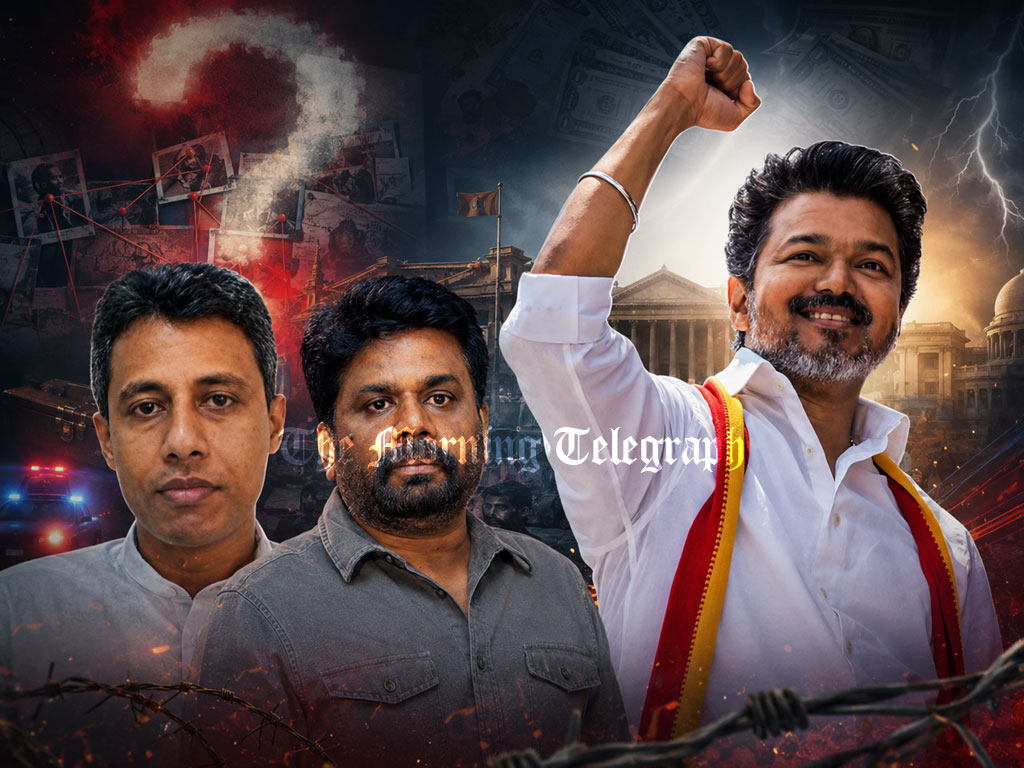
In the recently concluded Tamil Nadu state election, superstar actor Vijay achieved a remarkable and unexpected victory after entering politics for the first time by building his own political party.
This victory is significant not only for Tamil Nadu but also for Sri Lanka, because even before the election campaign began, Vijay made a highly controversial statement regarding Sri Lanka.
He declared that Katchatheevu, an island once linked to India but now under Sri Lankan control, should be handed back to India.
The statement created major political turbulence in Sri Lanka.
President Anura Kumara Dissanayake quickly responded by personally visiting Katchatheevu and strongly rejecting Vijay’s claim.
He publicly stated that Katchatheevu belongs to Sri Lanka and would never be handed over under any circumstances.
The President’s statement became headline news not only in Sri Lankan media but also across Indian media.
Political Shift in the North
Vijay’s victory has now created another major political shift, especially in Northern Sri Lanka.
For many in the North, who had long been without a strong political figure, Vijay’s win felt like the arrival of a new political hero.
This became clear when people celebrated his victory with fireworks and public excitement.
Before Vijay, the dominant symbolic figure for many in the North had been former LTTE leader Velupillai Prabhakaran.
But since Prabhakaran’s death 17 years ago, the Northern population has not had a comparable political icon.
Even Tamil Nadu media described Vijay’s rise as the return of power to the “true Tamils” or “pure Dravidians.”
That is why today we make a special observation through the “Inside Politics” column: Vijay’s political rise in Tamil Nadu may create major consequences for Sri Lankan politics as well.
Vijay has long been viewed as a strong sympathizer of the LTTE.
During the war years, whenever Tamil Nadu’s top actors joined protests and fasts in support of Tamil causes and the LTTE, Vijay was often seen among the leading participants.
He has also repeatedly spoken strongly about issues faced by Tamils in the North and East of Sri Lanka, Northern fishermen’s disputes, and Katchatheevu.
Because of this, many believe Vijay could soon become a highly influential figure in Northern and Eastern Sri Lankan politics.
Modi’s Bridge Dream
Against this backdrop, another significant development took place last week through a statement made by Indian High Commissioner to Sri Lanka Santosh Jha.
Speaking at an event in Colombo, he revived a topic that had long been pushed under the carpet: that India and Sri Lanka should urgently build a land bridge connecting the two countries, and that the project had already been delayed too long.
Many believe this statement was no coincidence, especially with Vijay’s political rise happening at the same time.
The reason is simple: connecting India and Sri Lanka by land has long been one of Prime Minister Narendra Modi’s biggest dreams.
This ambition is so deeply rooted that during Modi’s last visit to Sri Lanka, he left behind what many viewed as a powerful symbolic hint.
Traditionally, Indian Prime Ministers and foreign heads of state leave Sri Lanka through Bandaranaike International Airport.
But after completing his official meetings in Colombo, Modi chose not to leave from Katunayake.
Instead, he traveled to Anuradhapura.
From the Air Force base there, he boarded a special Indian military helicopter and flew directly back to India, something no other visiting world leader had done.
More importantly, Modi’s flight path followed the ancient route between Mannar and Rameswaram, the same region historically associated with the Setu Samudram passage.
As proof, photographs were immediately released showing Modi looking down from the helicopter toward the Setu Samudram route.
While local media treated those images as ordinary travel photographs, to those watching closely, the message was unmistakable.
Modi was sending a signal about his long-held dream of physically connecting India and Sri Lanka by land.
At the time, we fully exposed this story in the “Rajya Rahas” column as a major political revelation.
Message Reaches Sumanthiran
Alongside this chain of political developments, another significant story is now emerging in the North and East.
With Vijay’s political rise in Tamil Nadu, the main Tamil political force in Sri Lanka’s North and East, the Illankai Tamil Arasu Kachchi, has quietly launched a new political operation.
During both the last presidential election and the general election, a large share of Tamil and Muslim votes from the North and East shifted toward President Anura Kumara Dissanayake and the National People’s Power alliance.
This happened largely because Anura, during his visit to Jaffna, made several major promises: introducing a new constitution, resolving long-standing issues of Northern and Eastern Tamils, repealing the Prevention of Terrorism Act, holding Provincial Council elections, and abolishing the Executive Presidency.
However, even after one and a half years, most of these major promises remain unfulfilled.
As a result, serious questions are now being raised about whether Tamil and Muslim voters in the North and East still remain aligned with the government.
Against this backdrop, ITAK recently took a major step, quietly and without much publicity.
The party launched a new initiative aimed at bringing rehabilitated former Liberation Tigers of Tamil Eelam members and their families back into democratic politics.
This effort has reportedly received strong backing from influential Tamil diaspora groups abroad.
According to available reports, there are around 12,000 rehabilitated former LTTE members in the North and East.
As part of this effort, the first meeting was held in Mannar and the second in Vavuniya, organized by ITAK General Secretary M. A. Sumanthiran.
A notable number of participants reportedly attended both meetings.
Through this operation, ITAK appears to be preparing for an entirely new political journey in the North and East.
Many believe India may also quietly support this effort.
The key question now is what kind of relationship will emerge between this new Northern political movement and Vijay, the latest political force from Tamil Nadu.
LTTE Families and Provincial Councils
Why is ITAK bringing together former LTTE families now?
Many observers believe the answer lies in the coming Provincial Council elections.
The party is reportedly preparing for a major political struggle demanding that the government hold Provincial Council elections within the next few months and seriously address the unresolved issues of the Northern and Eastern people.
Vijay’s rise in Tamil Nadu is seen as a major boost to this strategy.
That is why many believe the government can no longer continue delaying Provincial Council elections.
Even the Election Commission of Sri Lanka has reportedly sent several communications urging the government to move quickly.
Former Elections Commissioner Mahinda Deshapriya also stated last week that the government must hold Provincial Council elections, whether under the old system or a new one.
Likewise, PAFFREL issued a strong statement on Thursday emphasizing that the elections should be held without further delay.
All these developments suggest that the government may soon find it politically impossible to postpone Provincial Council elections any longer.
Two UNP Ghosts Revealed
For quite some time, we have repeatedly reported in the “Inside Politics” column that two “ghosts” inside the United National Party were actively working to sabotage efforts to unite the UNP and the Samagi Jana Balawegaya.
After those reports, many readers repeatedly asked, “Who exactly are these two ghosts?”
Today, we reveal their names for the first time.
They are none other than UNP Chairman Vajira Abeywardena and UNP National Organizer Sagala Ratnayaka.
Even former UNP Deputy Leader Ravi Karunanayake once said that two ghosts inside the UNP were destroying the party, clearly referring to these two figures.
Many believe both men oppose UNP-SJB unity because they dream of taking control of the UNP leadership after Ranil Wickremesinghe.
If the two parties unite, they know they would likely have no meaningful place in the new alliance.
Many also believe Ranil’s own long-term plan is to ensure that after him, party leadership passes to Sagala Ratnayaka, even if the party’s vote base continues shrinking.
Ranil’s Political Trap
The latest attempt to disrupt unity came during May Day.
When Sajith Premadasa and the SJB publicly invited the UNP to attend their May Day rally, the UNP initially tried to avoid participation by saying they do not hold political rallies on Poya Day.
This, according to insiders, was part of the plan by these “ghosts.”
However, after Ruwan Wijewardene and Harin Fernando personally met Ranil and argued otherwise, Ranil eventually allowed only Ruwan to attend the SJB rally.
Even that was later sabotaged.
In the end, instead of attending the SJB rally, the UNP reportedly distributed 3,000 biryani parcels at the Buhari Hotel in Maradana, though around 700 to 800 parcels were reportedly left over and had to be thrown away.
Although the UNP did not attend the SJB rally, Ranil still sent a congratulatory message.
Because Ranil, like Vajira and Sagala, is also believed to be cautious about full party unity, he inserted one important line into that message, asking that further discussions on party unity continue through the committee already appointed for that purpose.
The moment Sajith read that line, he immediately understood the political trap.
The committee Ranil referred to is headed by Sagala Ratnayaka.
During his May Day speech, Sajith openly responded.
He said there was no longer any value in appointing more committees, because conspirators could exist inside those committees too.
He insisted that trust could not be placed there and that, at the grassroots level, the two parties were already united.
This statement caused visible panic among the “ghosts” inside the UNP.
They quickly responded through Ajith Mannapperuma, another figure seen as opposing SJB-UNP unity.
Mannapperuma accused Sajith of trying to create a “one-man show” by rejecting committee processes.
He even criticized Sajith’s father, former President Ranasinghe Premadasa, a move many found significant.
But despite his remarks, neither SJB leadership nor supporters appeared to take his comments seriously.
Meanwhile, last week, Harin Fernando also faced internal difficulties within the UNP.
He had originally planned to hold a media briefing at the UNP headquarters on Flower Road regarding issues involving Catholic schools in the Wattala area.
However, Ranil reportedly informed him that the party office could not be used for that purpose.
As a result, Harin shifted the press conference to the N.M. Perera Centre.
Harin is now seen as one of the strongest supporters of mandatory SJB-UNP unity.
At that press conference too, he stated that the two parties were already united at the grassroots level and that formal unity was only a matter of time.
Following the massive turnout at the SJB May Day rally, Sajith has now reportedly decided to begin district-level political rallies to strengthen the party ahead of the next national election.
The first of these meetings is expected to begin in Anuradhapura District before expanding down to electorate level across the country.