Vijay Tamil Nadu rise has revived concerns in Colombo over Katchatheevu, illegal fishing, Indo-Lanka ties and diplomatic pressure.
The Vijay Tamil Nadu rise has revived old political anxieties in Colombo, raising fresh questions over Sri Lanka’s strategic risks, diplomatic pressure, and future relations with India.
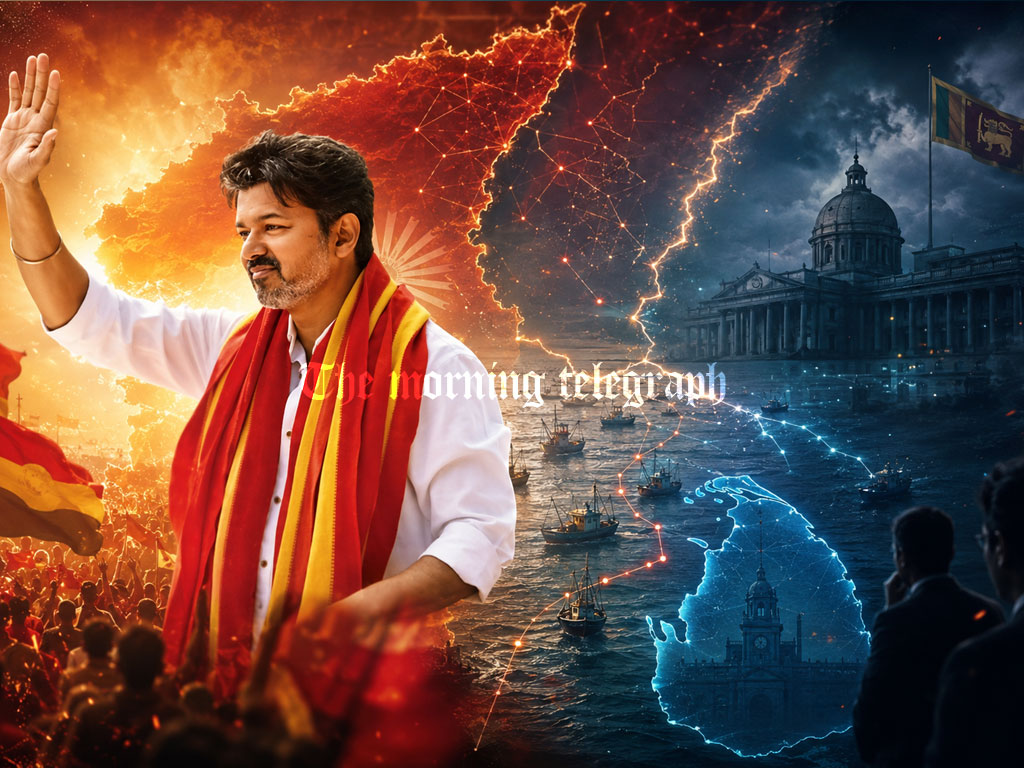
Tamilaga Vettri Kazhagam (TVK) leader Chandrasekar Joseph Vijay has achieved his chief ministerial dream in Tamil Nadu with the support of other parties, including the Congress. His rapid rise to power was driven largely by his popularity as a film star, sweeping campaign promises, and a strong protest vote shaped by anti-politics.
Winning an election, however, is very different from fulfilling the expectations created during a campaign. In politics, beginner’s luck rarely survives for long. If implemented, the freebies promised by Vijay to win voter support are estimated to consume more than 50% of Tamil Nadu’s tax revenue. That leaves Vijay with a difficult task if he is to prevent his first chief ministerial term from suffering the same fate as his first film, which reportedly became a box office bomb.

The political shift in Tamil Nadu has pushed Colombo’s commentariat into overdrive, producing sharply different assessments of what it could mean for Sri Lanka and Indo-Lanka relations. Some commentators believe Vijay’s anti-Sri Lanka remarks were merely campaign rhetoric and that he will eventually forget them.
They also argue that even if Vijay attempts to pursue his pledges, especially his promise to retrieve Katchatheevu, there is little he can do because New Delhi considers the matter settled. But those who make this argument appear to overlook how strongly the Indian Centre has been influenced by Tamil Nadu in the past.
New Delhi has previously taken extreme steps to appease Tamil Nadu politicians and advance its own interests at Sri Lanka’s expense. India trained, armed, and funded pro-Eelam terror groups and forced the Indo-Lanka Accord on President J. R. Jayewardene in 1987, opening the way for devolution. India was later hoist with its own petard when the LTTE turned against it a few years later, changing the situation dramatically.
The present world order is anything but “rules based”. International pacts, accords, covenants, treaties, charters, and similar instruments often become meaningless when powerful signatories decide to violate them.
The US violated the UN Charter, perhaps for the umpteenth time, by abducting President of Venezuela Nicolás Maduro and his wife. It has also carried out unprovoked air strikes on Iran, killing its Spiritual Leader and thousands of civilians, while destroying assets worth billions, if not trillions, of dollars.
It has been alleged that at the height of Sri Lanka’s 2022 uprising, following the forced resignation of President Gotabaya Rajapaksa, Indian High Commissioner Gopal Baglay pressured Speaker Mahinda Yapa Abeywardene to take over the presidency in violation of the Constitution.
Abeywardene later told Parliament that the goal of those who attempted to force him to appoint himself Acting President was to plunge the country into anarchy. Baglay allegedly acted in violation of the Vienna Convention on Diplomatic Relations, which requires diplomats to refrain from interfering in the internal affairs or politics of host countries.
Curiously, this very serious allegation remains unprobed, even though the grandees of the JVP-NPP government and the SJB-led Opposition often wrap themselves in the flag and repeatedly declare their commitment to protecting the national interest.
The possibility that the new Tamil Nadu administration may escalate the issue of illegal fishing in Sri Lankan waters cannot be dismissed. Such escalation could reach a point where New Delhi may feel compelled to intervene more assertively, if not aggressively.
In 2013, then Minister of Fisheries and Aquatic Resources Development Dr. Rajitha Senaratne disclosed that certain Tamil Nadu politicians owned trawlers and rented them out on the strict condition that they be used for poaching in Sri Lankan waters. These troublemakers are likely to intensify illegal fishing operations in an attempt to belittle Sri Lanka’s sovereignty and push New Delhi and Colombo toward a collision course.
Responses to vital bilateral issues should not be based solely on suspicion and perception if they are to be workable. Tamil Nadu politicians’ hostility toward Sri Lanka remains a problem that must be handled diplomatically. Foreign relations are layered and dynamic, and diplomacy demands calibrated responses to contentious issues. Still, caution is both necessary and prudent.