By Marlon Dale Ferreira
Sri Lanka renaissance vision gains focus as Prof. Patrick Mendis says the island can reclaim its Indian Ocean bridge role amid U.S. China rivalry.
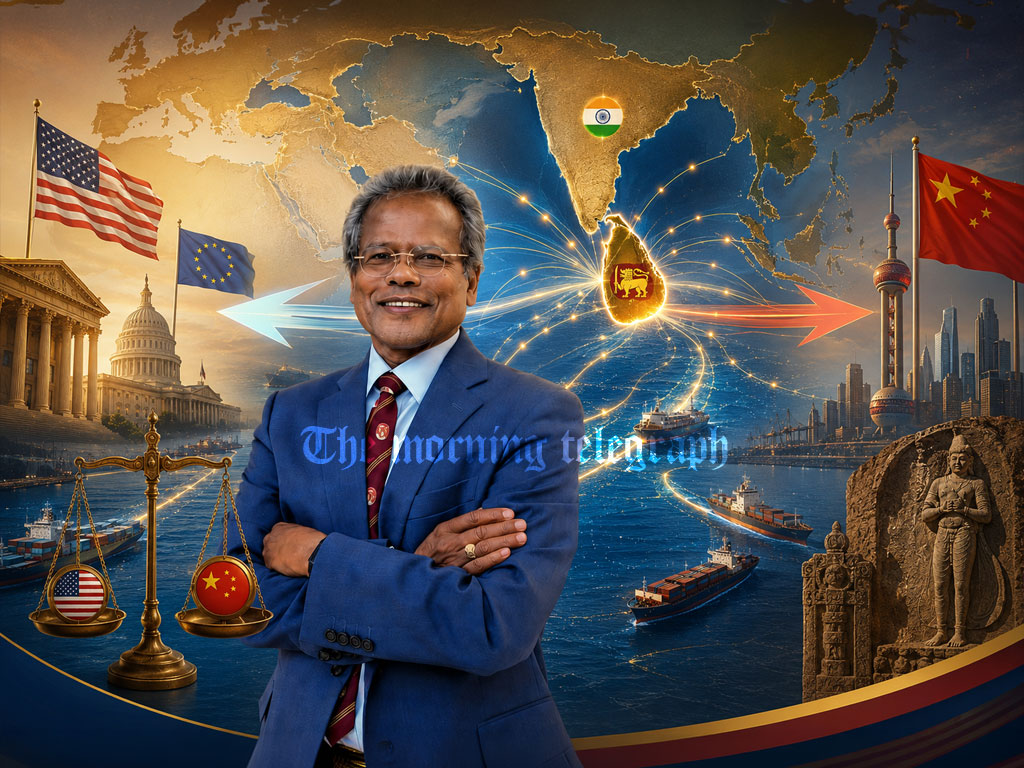
The Sri Lanka renaissance vision is gaining new attention as global rivalry between the United States and China reshapes trade, security, and diplomacy across the Indian Ocean.
At a time when major powers are redrawing global influence, a small island nation in the Indian Ocean is quietly rediscovering its ancient voice. Sri Lanka, once described as the “Grand Central Station of the Indian Ocean,” is now attempting to reclaim that historic position. Not as a battleground for superpowers, but as a diplomatic and economic bridge between East and West.
This powerful idea formed the centrepiece of a recent public lecture delivered by Prof. Patrick Mendis at the Warsaw School of Economics in Poland. Mendis, a Sri Lankan born American diplomat, economist, and former White House appointed adviser on national security education, presented a compelling argument. Sri Lanka’s future, he said, does not lie in choosing sides, but in reclaiming its past for a national renaissance.
A Diplomat Scholar With A Global Voice
Prof. Mendis is no ordinary academic. He served as the first Sri Lankan youth ambassador to the United Nations and received the UNESCO Award from Polonnaruwa, Sri Lanka’s medieval capital. During the Obama administration, he served as an American commissioner to UNESCO at the U.S. Department of State.
Now a distinguished visiting professor at the University of Warsaw, he continues to shape discussions on Sino-American, transatlantic, and Indo-Pacific relations.
His career reflects a lifelong commitment to international cooperation, strategic dialogue, and the search for balance in a divided world. His message in Warsaw was direct. Sri Lanka’s greatest advantage is not its size, but its adaptive leadership and enduring civilizational continuity.
Why The Indian Ocean Hub Matters
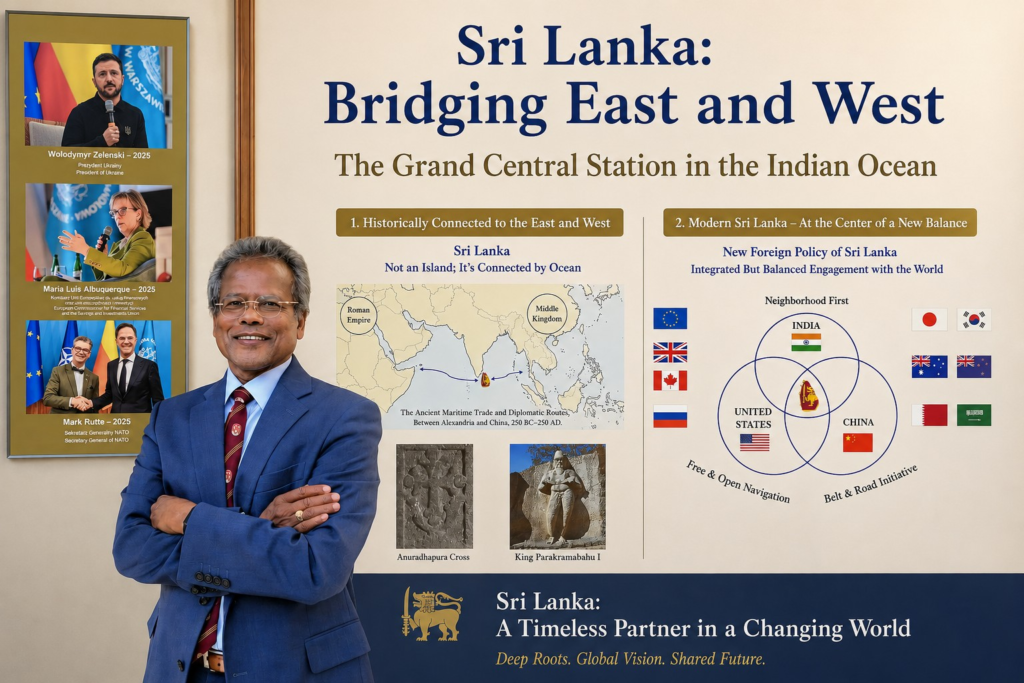
Drawing on deep historical insight, Mendis described Sri Lanka as the natural hub of the Indian Ocean, a place where civilizations, trade routes, and faiths have met for thousands of years.
“From ancient trade routes connecting the Roman Empire and Imperial China’s Han Dynasty, to early Buddhist diplomacy and maritime commerce, Sri Lanka has long played a central role in global connectivity.”
He pointed to archaeological and historical evidence, including the Anuradhapura Cross, the chronicles of King Parakramabahu the Great, and the famed Galle Trilingual Tablet of Ming admiral Zheng He, as proof of Sri Lanka’s deep ties with Europe, the Middle East, and China.
These connections, Mendis noted, were built by explorers, traders, and pilgrims long before colonial encounters shaped the modern world.
Ancient Culture As Strategic Strength
Unlike many modern states, Sri Lanka’s emerging foreign policy is deeply rooted in its civilizational identity. Mendis outlined three central pillars.
The first is Buddhist heritage, which emphasizes compassion, coexistence, and moral restraint.
The second is a hydraulic civilization that pioneered sustainable water management and rice cultivation.
The third is a maritime trading legacy that linked East and West through commerce, diplomacy, and cultural exchange.
“These are not relics of the past. They are strategic assets,” Mendis said.
He described Sri Lanka’s evolving foreign and economic policy as an “anthropogenic” model, guided by human centered values rather than ideological alignment. He said the current Colombo administration’s foreign policy motto reflects that tendency: “Friendship with all, enmity with none.”
“It is simple, yet its power resonates from Buddhist calculus.”
Balancing The U.S. China India Triangle
Sri Lanka today sits at the intersection of three concentric circles of geopolitical power, Mendis explained.
China, through its Belt and Road Initiative, maintains a major presence in Sri Lanka, including the Colombo Port City and Hambantota Port. Beijing describes Sri Lanka as the “crown jewel” of the Indian Ocean.
India, through its “Neighborhood First” policy, sees Sri Lanka as central to its maritime security strategy, reinforced by deep historical, religious, and cultural ties.
The United States and its allies, including Australia and Japan, engage Sri Lanka through Indo-Pacific frameworks, with a focus on maritime security, development assistance, and balancing China’s influence.
Rather than aligning exclusively with any one power, Mendis said, Sri Lanka is pursuing calibrated neutrality. This echoes a founding U.S. diplomatic principle: “Peace, commerce, and honest friendship with all nations.”
As Mendis emphasized, this approach is not new. It reflects centuries of Sri Lankan engagement across cultures, religions, and empires.
Europe’s Renewed Strategic Interest
Sri Lanka’s engagement with the West predates colonialism, from ancient trade with Mediterranean powers to early Christian influences. Today, relations with the European Union are being renewed through trade, tourism, education, and diplomatic exchanges.
Mendis noted that the Polish foreign minister’s visit to Sri Lanka last year, during Poland’s rotating presidency of the EU Council, showed that Sri Lanka’s ties with Europe remain both deep and enduring.
For Europe, Sri Lanka offers a gateway to the Indian Ocean and East Asia. For Sri Lanka, Europe provides strategic balance in a world increasingly shaped by competing power blocs.
A New Domestic Political Moment
Perhaps most significant, Mendis argued, is Sri Lanka’s internal transformation.
The recent political transition marks a shift away from family dominated governance toward a broader national mandate and greater unity. For the first time, a leadership team has emerged with cross-ethnic and cross-religious support. This signals a more inclusive, corruption free governance model, alongside a pragmatic foreign and economic policy.
“This transformation, grounded in history yet responsive to modern realities, positions Sri Lanka as a neutral bridge builder in a fragmented global order.”
In this context, Mendis said, the role of foreign investment and the business community is critical. Sri Lanka’s strategic location, combined with a balanced foreign policy and renewed global economic engagement, positions the island as a logistics and maritime hub in the Indian Ocean.
It also places Sri Lanka as a centre for cultural, economic, and diplomatic exchange across Asia and Europe.
Most importantly, he said, Sri Lanka can become a gateway to global supply chains linking Asia, the Middle East, and Europe.
Developing these revenue streams and integrating them into national development carries real significance for voters and the country’s long-term economic recovery.
The Past As A Guide To The Future
The central message in Warsaw was clear. Sri Lanka’s greatest advantage lies not in its size, but in its adaptive leadership and enduring civilizational continuity.
Its early embrace of Buddhism, long standing diplomatic engagement with Roman and Chinese civilizations, and vibrant cultural and economic traditions are now shaping a modern foreign policy suited to a multipolar world.
Drawing on extensive experience across China, the United States, Sri Lanka, and Europe, Prof. Mendis expressed optimism about his motherland’s policy direction and genuine leadership.
He concluded with a powerful thought:
“The island’s greatest strength lies in its enduring Buddhist identity, a nation that has long connected civilizations, cultures, and religious traditions, and is poised to do so again in the 21st century.”
About the Author
Marlon Dale Ferreira writes as an explosive investigative journalist, grounding his work in documented evidence, verified records, and direct quotations from credible sources.
His professional journey spans more than 38 years, beginning as a sports journalist before moving into aviation. After working with Air Lanka, Sri Lanka’s national carrier, he ventured into the Middle East, where he spent three decades with two of the world’s leading airlines, Emirates Airline and Qatar Airways. Through his travels to more than 100 countries, he developed a broad understanding of global affairs, cultures, governance, and human stories.
Although his career took him across the world, Sri Lanka has always remained close to his heart. It is the homeland he continues to call home, and much of his writing reflects a deep concern for its future, its people, and its institutions.
Marlon is currently on the cusp of completing a Master’s in Sacred Theology in Los Angeles, California, and looks forward to continuing his academic journey by pursuing a PhD in Theology.