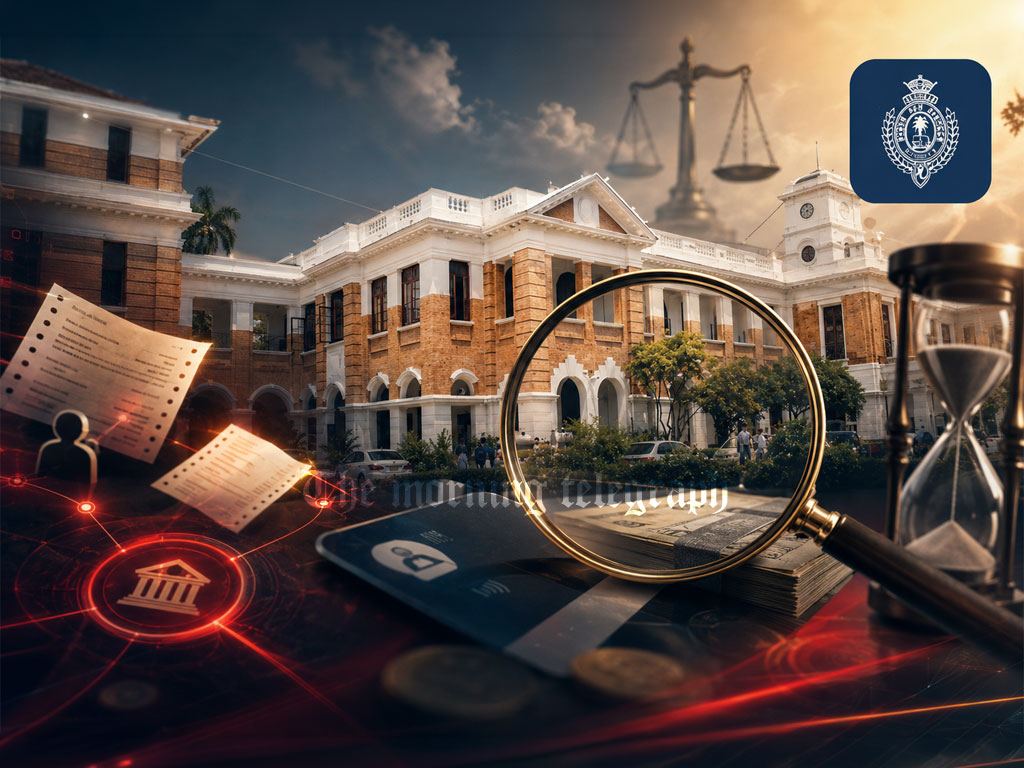
An alleged Rs. 930,000 parent collection linked to Junior Prefect appointments at Royal College has reignited serious questions over accountability, private bank deposits, delayed investigations, and whether school corruption complaints are being quietly buried.
Royal College Complaint Raises Explosive Questions
How long must Royal College wait for justice?
That is the disturbing question now hanging over one of Sri Lanka’s most prestigious schools after a corruption complaint involving an alleged Rs. 930,000 collection from parents appears to have gone cold despite repeated follow-ups and serious questions over accountability.
The complaint, involving alleged unauthorized money collection connected to Junior Prefect appointments at Royal College, Colombo, has now become much more than an internal school matter.
It has become a test case for the Ministry of Education, school governance, and the country’s willingness to act when allegations involve senior school administrators.

The Rs. 930,000 Allegation
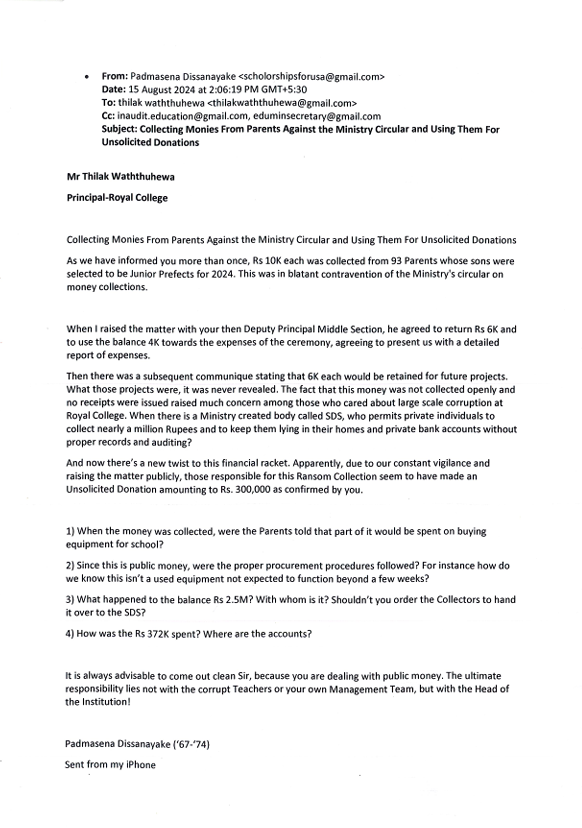
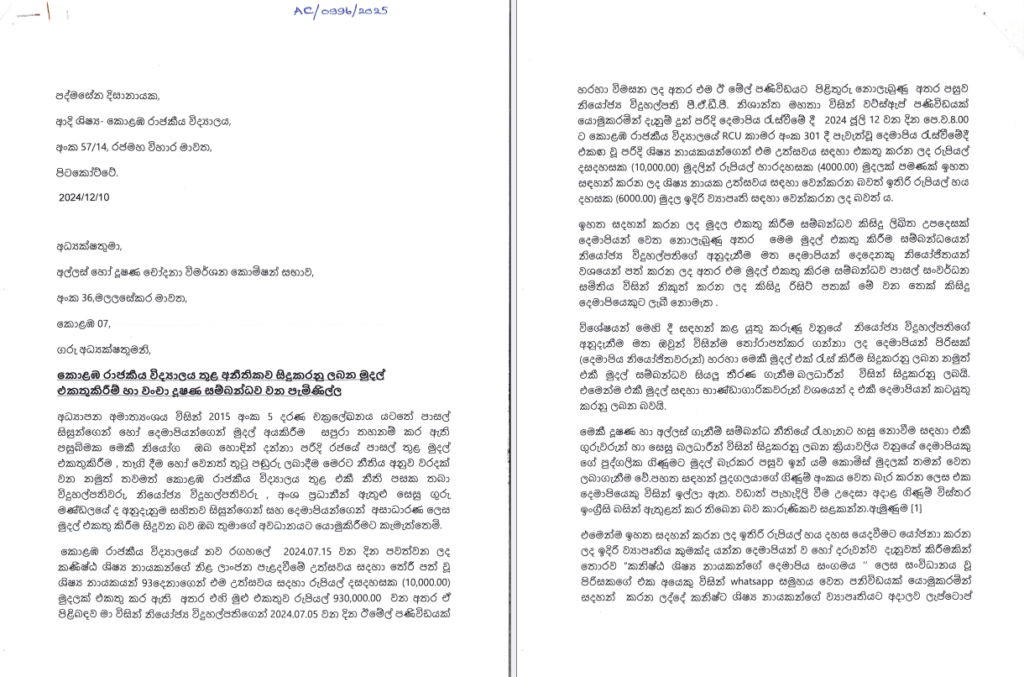
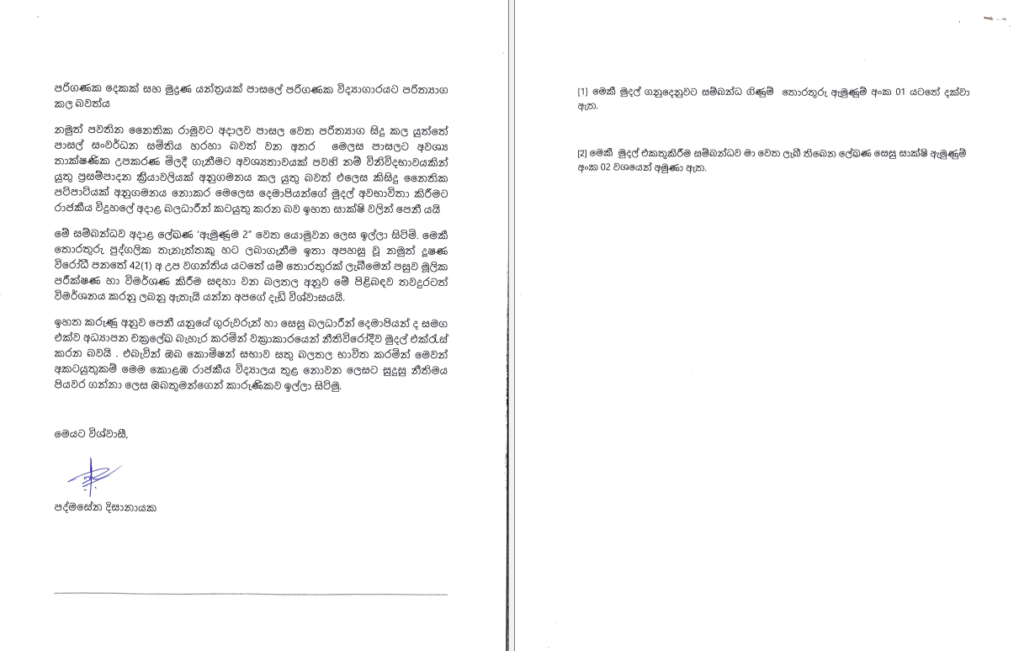
In December 2024, Padmasena Dissanayake, an alumnus of Royal College Colombo and an activist against corruption in schools, lodged a complaint with the Commission to Investigate Allegations of Bribery or Corruption, better known as CIABOC.
The complaint was made against Mr. P.A.D.P. Nishantha, who was then serving as Deputy Principal of the Middle School.
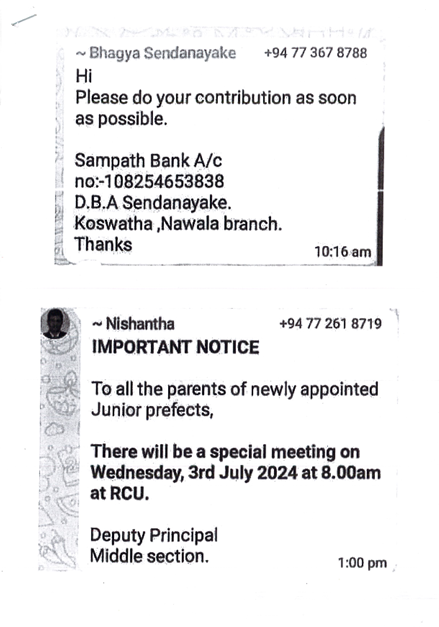
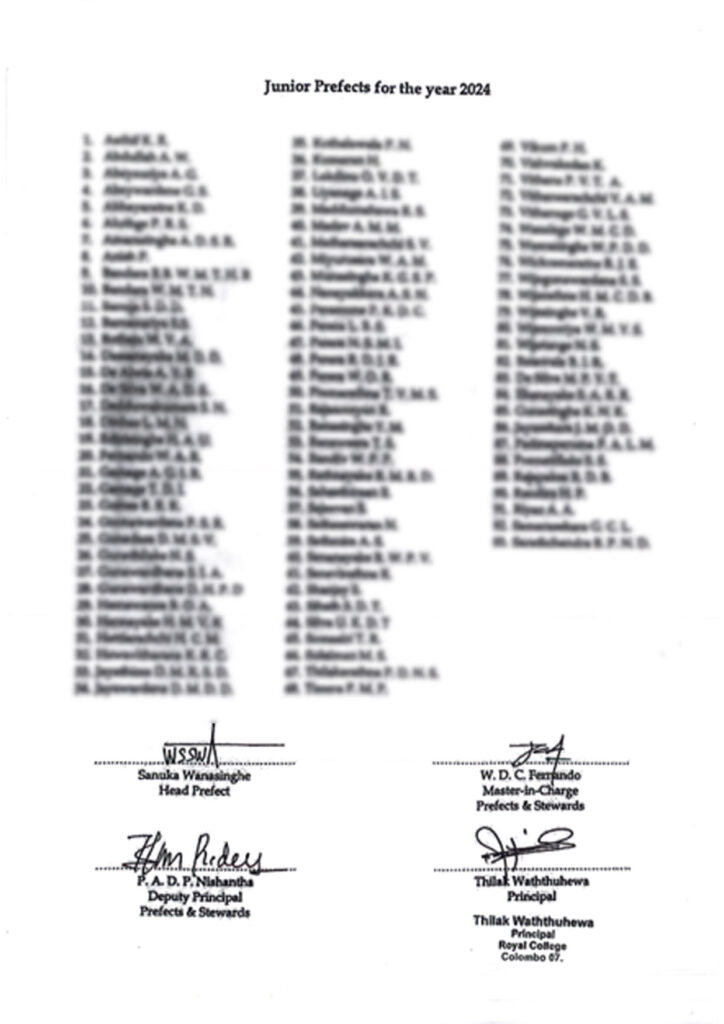
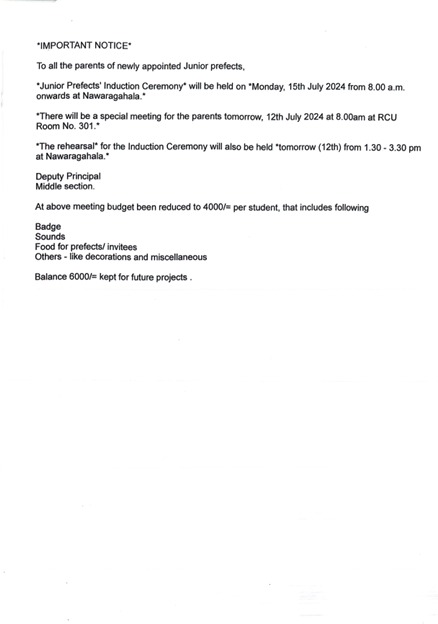
According to the complaint, a sum of Rs. 930,000 had allegedly been collected from parents in connection with the appointment of 93 Junior Prefects.
The complaint further alleged that the money had been collected through a parent and deposited into that parent’s private bank account at the Sampath Bank Nawala branch.
If true, that allegation raises a deeply troubling question:
Why would any school-related collection involving students be routed through a private bank account?
No Receipts, No Approval?
The complaint also claimed that the collection had not been sanctioned by then Principal Thilak Waththuhewa and that no official receipts had been issued.
That is the heart of the matter.
If money is collected for a school purpose, especially within a leading government school, it should be authorised, receipted, accounted for, and audited.
If the collection was legitimate, why was it allegedly not handled through the proper school channels?
If it was not legitimate, why has action taken so long?
What Happened After the Complaint?
The matter was first brought to the attention of Principal Waththuhewa in August 2024, with copies also reportedly sent to the Secretary of Education and the Internal Auditor at the Ministry.
Following this, Mr. Nishantha was removed from his position as Head of Middle School and appointed as Deputy in charge of Clubs and Societies.
But instead of the matter reaching a clear conclusion, the controversy has since deepened.
Mr. Nishantha has reportedly now been promoted by current Principal Athula Wijewardene as Senior Deputy, effectively making him the number two official at Royal College.
That development has intensified public concern.
Promotion Before Closure?
The central question now is unavoidable:
How does an officer named in a serious complaint involving alleged parent collections move upward in the school structure before the matter is fully and transparently concluded?
This does not mean guilt has been established.
But it does raise serious questions about process, judgment, and institutional accountability.
When a complaint involving public trust, parents’ money, and school administration remains unresolved, promotion before closure can create the perception that the system protects insiders rather than investigates them.
CIABOC Letter and Ministry Silence
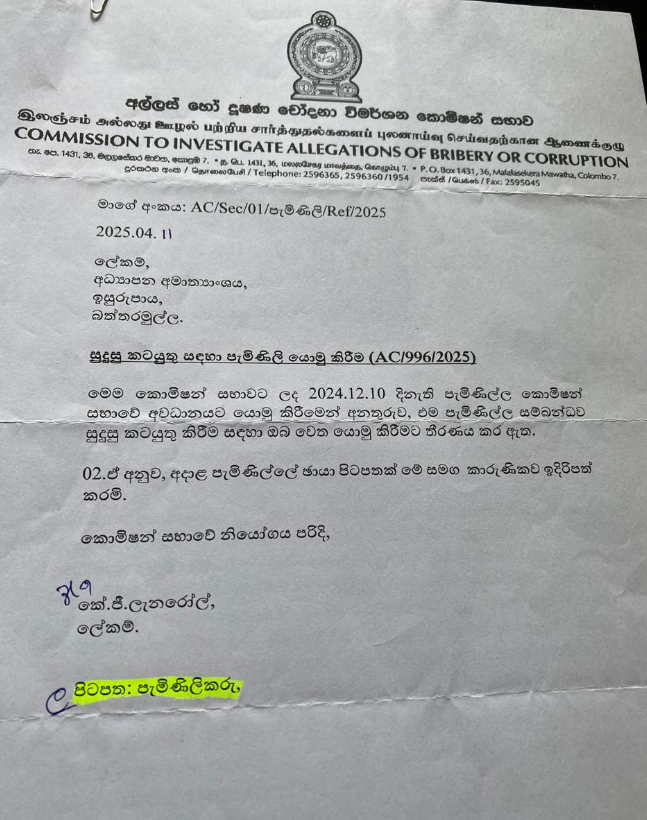
In April 2025, the Secretary of CIABOC wrote to the Secretary of Education, forwarding the complaint and requesting necessary action.
But since then, despite regular follow-ups, the matter appears to have gone silent.
The complainant is still waiting for what he describes as a fair, impartial, and transparent investigation.
His concern is made worse by fears that the inquiry may be handled by colleagues or officials connected to Mr. Nishantha, who had previously worked at the Ministry before being assigned to Royal College.
That raises another difficult question:
Can an inquiry be truly independent if it is handled within the same administrative circle?
A Wider Problem in Government Schools
This issue is no longer limited to one school, one complaint, or one administrator.
It reflects a wider fear that government schools have increasingly become vulnerable to unofficial financial practices involving certain teachers, administrators, and small groups of parents acting as collectors.
In such systems, some teachers and administrators allegedly enjoy unofficial financial benefits throughout the year, while certain parent collectors may also gain influence because their children become favoured in school activities.
This alleged culture does not appear to be limited to elite Colombo schools.
Similar concerns are now said to exist even in smaller and distant schools, despite Ministry circulars prohibiting ad hoc money collections from parents.
Minister’s Warnings Must Become Action
Education Minister Harini Amarasuriya has repeatedly warned school authorities through the media against improper collections.
But warnings alone are not enough.
If complaints remain unresolved for months, or even years, the message reaching schools is dangerous: collections may be prohibited on paper, but tolerated in practice.
That is why this Royal College complaint matters.
One firm, transparent, and fair decision could send a powerful message to every school in the country.
The Funding Reality Cannot Be Ignored
There is also a harsh truth that must be acknowledged.
Successive governments have failed to provide adequate funding for school maintenance, sports, extracurricular activities, and basic development needs.
As a result, parent contributions have become an unfortunate part of keeping many schools functioning.
But that reality cannot become an excuse for informal, unreceipted, or privately routed collections.
Schools already charge annual facilities fees to cover certain expenses.
If additional funds are genuinely needed, they can be collected legally through the School Development Society, which exists in every school under Ministry guidelines.
Under that system, every rupee must be receipted, recorded, accounted for, and audited.
So again, the question remains:
Why should any school money ever enter a private bank account?
How Long Must Justice Wait?
If the Ministry of Education is genuinely committed to eliminating corruption in schools, why should it take more than a year to investigate a complaint of this nature?
Why has the complainant been left waiting?
Why has the matter not been concluded transparently?
Why has the public not been told whether the allegation was proven, disproven, or still under active investigation?
And most importantly:
How long must Royal College wait for justice?
Royal College Justice Still on Hold
Royal College is not just another school.
It is one of Sri Lanka’s most historic educational institutions, carrying a reputation built over generations.
That reputation must be protected not by silence, delay, or administrative reshuffling, but by transparency.
If the allegation is false, the accused must be cleared.
If the allegation is true, action must be taken.
But leaving the matter hanging benefits no one.
Not the school.
Not the students.
Not the parents.
Not the accused.
And certainly not public trust.
Until the Ministry of Education acts decisively, the Rs. 930,000 question will continue to haunt Royal College:
Was this merely another complaint buried in the system, or will it finally become the case that forces Sri Lanka to clean up school-level corruption?