NPP government faces rising public anger as fuel, power, vehicle taxes, fertilizer shortages and global oil shocks deepen pressure.
NPP government pressure is mounting as rising living costs, higher taxes, fuel hikes, power tariffs and farmer unrest begin to test its political survival.
In this part of the world, the honeymoon between voters and a newly elected government rarely lasts more than a year. Anti-incumbency sentiment is now beginning to weigh heavily on the JVP-led NPP administration. Raising public expectations to win elections is a dangerous gamble in Sri Lanka because any party that wins power through such promises is expected to deliver immediately, whatever the circumstances. Patience is not a virtue Sri Lankan voters are known for. Politicians are said to get and forget, and voters do the same.

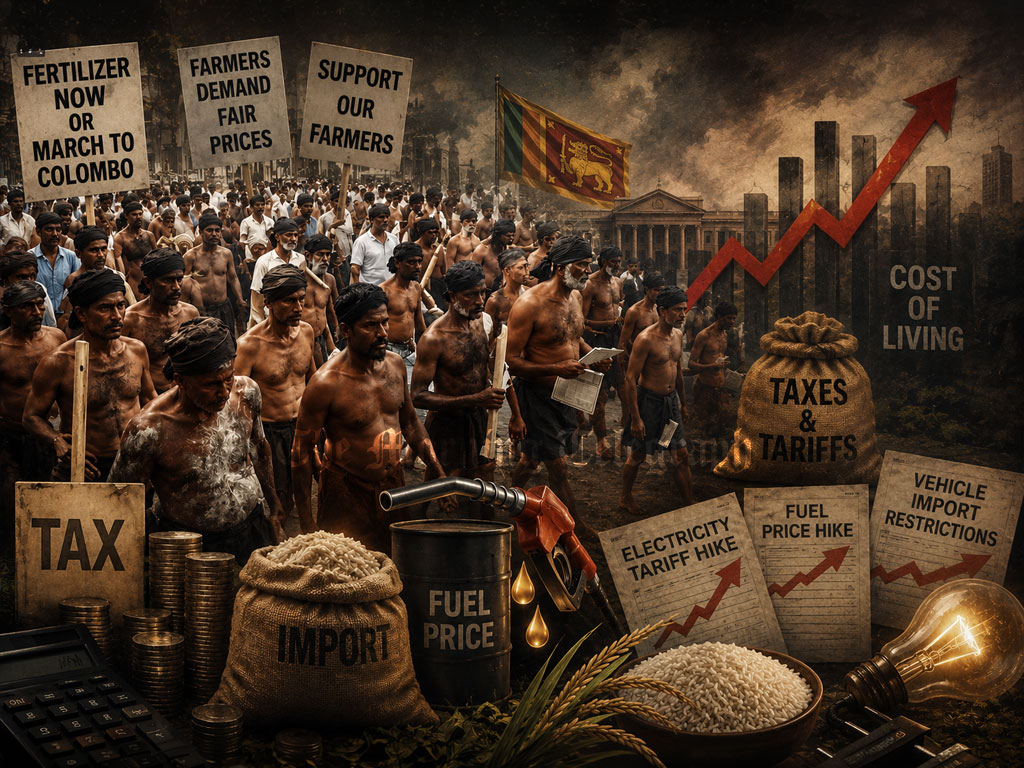
It is no longer smooth sailing for the NPP government. Serious economic challenges are building. There are complaints over unbearable cost-of-living pressures. Taxes and tariffs have risen sharply. Some farmers’ associations have warned that they will march to Colombo unless fertilizer is made available at reasonable prices without delay. These are early signs that the government’s luck may be running out.
After the 2024 regime change, steep tax and tariff increases led to a major rise in state revenue. The government even boasted that the Treasury was overflowing. A reduction in capital expenditure also helped strengthen government revenue. Foreign currency reserves increased, though slowly, and the administration managed for a while to prevent a sharp rise in the cost of living. But Cyclone Ditwah forced a massive rise in state spending on post-disaster rehabilitation and rebuilding, while the eruption of the Middle East conflict shook economies across the world.
The surge in global oil prices has hit Sri Lanka’s foreign currency reserves and pushed local fuel prices higher. Another increase is believed to be in the pipeline. The JVP-led NPP came to power claiming fuel prices had risen because of corruption and mismanagement at the Ceylon Petroleum Corporation. It also promised to bring prices down by reducing taxes. Instead, the government continues to increase fuel prices, which must remain cost-reflective under IMF loan conditions. The Opposition has accused the government of making unconscionable profits from fuel. When hardship reaches the doorstep, people stop listening to explanations and demand relief.
Electricity tariffs also continue to rise as oil-fired power plants are forced to operate around the clock to cover a major generation loss caused by low-quality coal imported for the Norochcholai power complex. These increases have dealt a heavy blow to the industrial sector, raising fears that many foreign investors may leave.
One major JVP/NPP election promise was to make imported Japanese vehicles affordable to ordinary people. But high taxes pushed vehicle prices to unprecedented levels and shattered that dream. Now the government has moved to restrict vehicle imports further by imposing a 50% Customs duty surcharge, which will push prices even higher.
The government has few options to reduce the rapidly rising import bill. It is expected to introduce more drastic restrictions on other imported goods as well. However, it is cautious about doing so immediately because the Opposition claims the country is returning to what it calls the Gotabaya Rajapaksa era.
Rice farmers are complaining that they had to begin the current paddy season without fertilizer application at the early stage of cultivation. They claim JVP/NPP politicians who once led their campaigns and staged protests in Colombo during the previous government are now avoiding them. It was farmers who first launched protests against the SLPP government over fertilizer shortages and its organic farming policy. Those protests later snowballed with the economic crisis, marking the beginning of the end of the SLPP administration.
Farmers may not be an organized political force in the conventional sense. They are divided among different political parties. According to Food and Agriculture Organization statistics, employment in agriculture accounts for about 28-30% of the labor force, while agriculture contributes only around 7-8% of GDP. But farmers live and work among rural communities, which make up more than 80% of the population. That gives them and their families real power to influence election outcomes.
US President Donald Trump has postponed the planned resumption of attacks on Iran, but has warned they could be carried out without notice unless Iran quickly agrees to a peace deal. Oil prices rallied yesterday after Trump’s statement on possible renewed hostilities, worsening pressure on economies worldwide. Sri Lanka will be among the hardest hit by the Middle East conflict and its economic fallout. The NPP government will have to adopt austerity measures to navigate these challenges while facing the political consequences that the Opposition will surely exploit. Worse still, it is under pressure to hold the delayed provincial council elections this year. The government is now walking a dangerous political tightrope as it tries to survive economic shocks and keep the Opposition at bay.