Keheliya drug trial hears explosive testimony on emergency procurements, blind approvals and failures in Sri Lanka’s state system.
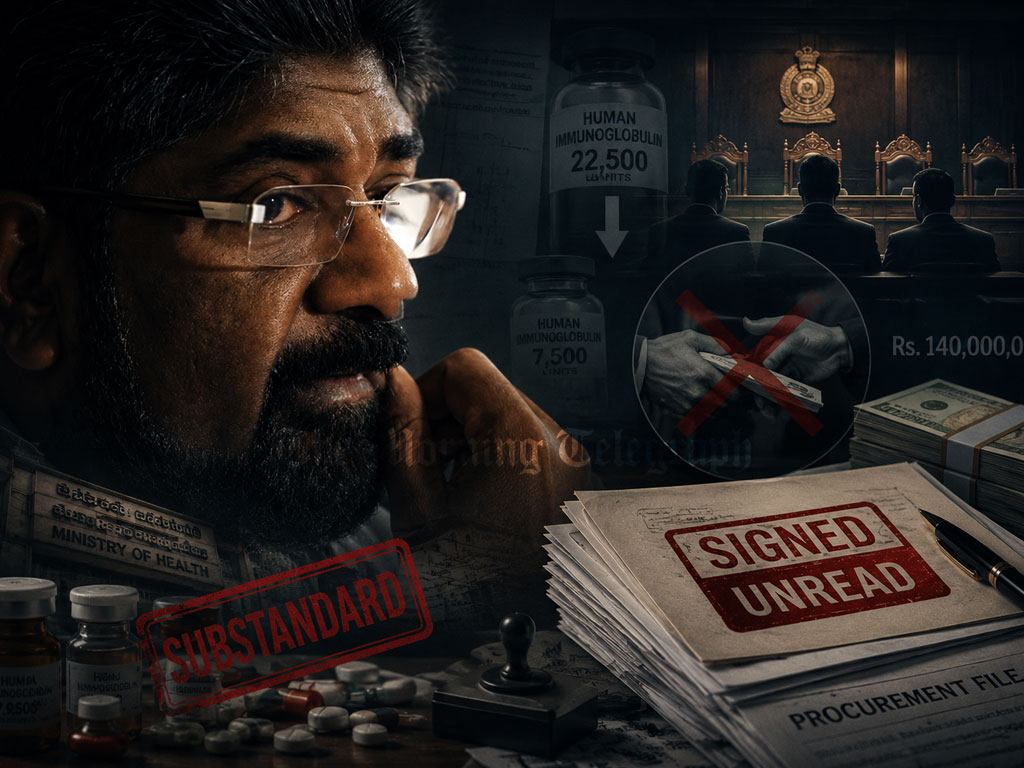
Keheliya Rambukwella’s substandard medicines trial took a dramatic turn after court heard claims that procurement approvals were signed without properly reading documents.
The high-profile case involving the procurement of substandard medicines, which allegedly caused a Rs. 140 million loss to the state, resumed today before the Colombo Permanent Trial-at-Bar.
The Attorney General has filed 13 charges against 12 defendants, including former Health Minister Keheliya Rambukwella.

The matter is being heard before a three-judge bench comprising High Court Judges Priyantha Liyanage, serving as President of the bench, together with Viraj Weerasuriya and Thilakaratne Bandara.
The prosecution called former Director General of the Department of Public Enterprises at the Ministry of Finance, T.A. Susantha Athula Kumara, as a witness.
During the examination-in-chief led by Deputy Solicitor General Lakmini Girihagama, evidence emerged that extended beyond the immediate criminal allegations and exposed what appeared to be serious systemic failures and administrative negligence within the public service.
The Deputy Solicitor General questioned the witness extensively about how procurement committee members allegedly acted on “blind trust” without personally reviewing official files.
When asked how handwritten documents had been presented to the committee, the witness stated that they were submitted as a file that was disorganized and difficult to properly examine at the time.
He further stated that the material was not printed documentation.
According to the witness, Dr. Jayanath personally held the file and verbally explained details relating to the lowest price, delivery time, and quality.
When asked whether the committee had collectively reached a decision, the witness responded that further questions had been raised during the meeting.
He said the committee had been informed that a Cabinet paper had already been submitted and that urgently needed medicines, which were out of stock, had to be procured immediately.
The witness further stated that the committee had also been informed that residual funds from the Indian Credit Line were available for use.
However, he admitted that he did not personally take the document into his hands and read it.
The Deputy Solicitor General then questioned whether the witness or the other committee members had compared the relevant documents or personally inspected them.
The witness replied that only a single document had been shown to all three members.
He stated that the handwriting was difficult to understand and added that, since they had worked together since 2021, there had been no reason to suspect wrongdoing, so he signed the document.
The testimony highlighted what appeared to be deep institutional and legal failures within public financial management and state governance.
The evidence presented in court suggested a culture where procurement committee members acted as “rubber stamps” rather than independent custodians of public funds.
Under administrative law, procurement committee members are expected to function as protectors of public finances under the Public Trust Doctrine.
The legal analysis presented in court indicated that explanations such as illegible handwriting or heavy workloads cannot excuse failures in accountability.
It was also argued that Financial Regulations impose both personal and collective responsibility on committee members, which cannot be avoided simply by relying on verbal explanations provided by coordinating officials.
The court also heard concerns regarding the use of emergency procurements as a shield against accountability.
The witness stated that because the committee had been appointed through a Cabinet decision, he assumed there was no need for further verification regarding Cabinet approval.
This testimony highlighted what appeared to be a broader bureaucratic culture in which executive directives are treated as complete protection against personal responsibility.
The court further heard that massive state expenditures had allegedly been approved based on handwritten and disorganized documents without proper evaluation of the original Expression of Interest advertisements.
The prosecution suggested this reflected either severe professional negligence or a serious breakdown in administrative responsibility.
Another major issue raised in court involved the procurement quantity of the drug Human Immunoglobulin.
Evidence revealed that the quantity had allegedly been changed from 22,500 units to 7,500 units.
The witness stated that he only discovered this discrepancy during a later disciplinary inquiry.
This revelation exposed what appeared to be a complete collapse of internal review mechanisms and post-evaluation safeguards.
The committee’s failure to involve the Internal Auditor was also highlighted as a bypassing of mandatory oversight procedures.
The court also maintained focus on legal balance under the sub-judice rule governing ongoing judicial proceedings.
The prosecution is seeking to prove that senior officials systematically exploited blind trust or willful blindness among committee members to facilitate fraud under the cover of an emergency procurement process.
Meanwhile, the defense is expected to argue that all decisions were taken in good faith during an unprecedented national crisis in order to prevent shortages of life-saving medicines.
The defense position is also expected to rely on institutional trust and executive directives issued during the emergency situation.
The court additionally heard that the Ministry of Public Administration had later exonerated the witness during an internal disciplinary inquiry.
That development highlighted the complexity involved in assigning individual criminal responsibility within what was described as a deeply broken institutional hierarchy.
Regardless of the final verdict, the trial is already being viewed as a major precedent exposing the urgent need for reforms in Sri Lanka’s procurement laws and bureaucratic accountability systems.
The 12 defendants named in the case and their legal representatives were also formally placed on record before court.
- Sudath Janaka Fernando (Isoles Biotech Pharma) – Represented by Counsel Harendra Banagala.
- Dr. Kapila Wickramanayake (Then-Director, Medical Supplies Division) – Represented by Counsel Asela Serasinghe.
- Peace Devasanthini Solomons (Assistant Director, MSD) – Represented by Counsel Isuru.
- Marakkala Manage Niran Dhananjaya (Accountant, MSD) – Represented by Counsel Asoka Serasinghe.
- Mahamadaachchi Sujith Wasantha Kumara (Stock Controller, MSD) – Represented by Counsel Asoka Serasinghe.
- Seema Hovage Janaka Sri Chandragupta (Then-Secretary, Ministry of Health) – Represented by Counsel Nuwan Jayawardena.
- Herath Mudiyanselage Dharmasiri Rathna Kumara Herath (Deputy Director General, MSD) – Legal representation not annotated in court records.
- Keheliya Bandara Dissanayake Rambukwella (Then-Minister of Health) – Represented by Counsel Anuja Premaratne and Counsel Nayantha Wijesundera.
- Buthpitiya Lekamlage Don Jayanath (Medical Officer, Medical Supplies Procurement Regulatory Unit) – Represented by Counsel Rahul Jayatilaka.
- Rathnayake Mudiyanselage Saman Kusumsiri Rathnayake (Additional Secretary, MSD) – Represented by President’s Counsel Priyantha Nawana.
- Arambe Gedara Thusitha Sudarshana (Deputy Director, MSD) – Represented by Counsel Amitha Ariyaratne.
- Dr. Vijith Gunasekera (Then-CEO, National Medicines Regulatory Authority) – Represented by Counsel Chaminda Athukorala.