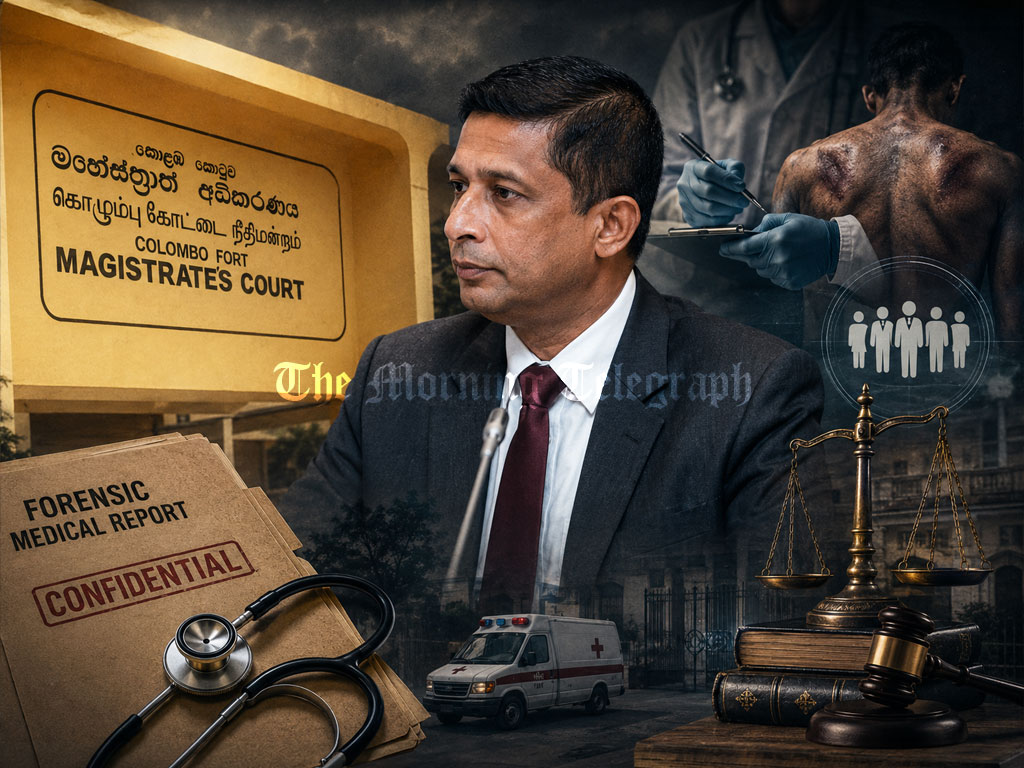
Suresh Sallay will undergo an independent forensic medical assessment ordered by court to examine torture allegations, mental health, and custody claims.
Suresh Sallay is set to undergo a comprehensive forensic medical examination after the Colombo Fort Magistrate’s Court ordered an independent assessment to determine whether torture allegations made during his detention have any factual basis.
The special order was issued in relation to retired Major General Suresh Sallay, the former Director of the State Intelligence Service, who is currently being detained by the Criminal Investigation Department (CID) under the Prevention of Terrorism Act (PTA).
Colombo Fort Magistrate Prasanna Amarasena directed the Director General of Health Services to immediately arrange for the suspect to be presented before a five-member multidisciplinary expert forensic medical board and submit a report to court.

Court Clarifies No Final Finding on Torture
While issuing the order, the Magistrate highlighted an important legal distinction regarding the allegations.
Although a Judicial Medical Officer’s (JMO) report submitted earlier by lawyers representing Suresh Sallay referred to alleged torture, the Magistrate clarified that the previous Magistrate had not reached any final determination or conclusion that the suspect had in fact been subjected to cruel torture.
The court therefore emphasized that the purpose of appointing the independent expert medical board is to professionally determine the truth or falsity of the claims made by both parties.
The positions presented before court remain sharply divided.
Sallay’s legal team maintains that a violation of humanitarian rights and fundamental rights has occurred.
The CID, represented by Additional Solicitor General Dilip Peiris, argues that the allegations amount to an attempt to mislead the court.
Special Medical Assessment Ordered at Kalubowila
Under the Magistrate’s directive, Suresh Sallay, who is currently receiving treatment at the National Hospital of Sri Lanka in Colombo, must be presented before the South Colombo Teaching Hospital, commonly known as Kalubowila Hospital, for the examination.
Kalubowila Hospital is also the institution where the current Director General of Health Services previously served as Director.
The five-member expert medical board appointed by court consists of the following specialists:
| Expert Doctor | Position |
|---|---|
| Specialist Dr. Thusitha Mendis | Chairman |
| Specialist Dr. Chiththahari Abeynayaka | Member |
| Specialist Dr. Dasanthi Akmeena | Member |
| Specialist Dr. Duleyika Amarasinghe | Member |
| Specialist Dr. Wajira Dharmawadana | Member |
The board has been tasked with independently evaluating whether the suspect has been subjected to cruel treatment or torture, assessing his current mental condition, and determining whether there is any risk of self-harm or suicidal behaviour.
Key Areas of Investigation
The court-appointed medical board has been instructed to conduct a detailed and comprehensive examination covering several important aspects of the suspect’s physical and psychological condition.
One key area concerns his mental health status, particularly the allegation that he is suffering from a “Moderate to Severe Depressive Episode.”
The board will also assess whether there is evidence of Post-Traumatic Stress Disorder (PTSD), a condition that has been raised during the legal proceedings.
In addition, specialists will examine physical health concerns linked to Sallay’s reported fast-unto-death protest, including the possibility of muscle deterioration and related medical complications.
The findings of the multidisciplinary assessment are expected to play a significant role in the ongoing legal proceedings.
The Colombo Fort Magistrate ordered that the expert medical report be submitted to court on the next hearing date and postponed the case until July 1.
Political and Legal Implications Intensify
Beyond the courtroom, the case has also generated a highly charged political and public debate.
Different stakeholders continue to view the matter through competing legal, political, and human rights perspectives.
Opposition parties and human rights organisations argue that the case concerns the fundamental right to life of a detainee and the protections guaranteed under Article 11 of the Constitution, which prohibits torture and cruel treatment.
The Government, meanwhile, maintains that the investigation is based on evidence, including grid data and intelligence informant statements, and should proceed free from political influence in order to secure justice for victims of the Easter Sunday attacks.
With the court now placing responsibility in the hands of an independent medical board, the focus has shifted away from political arguments and toward professional medical evaluation.
The confidential report expected from Kalubowila Hospital on July 1 is widely anticipated to become a pivotal document in determining whether the allegations surrounding Sallay’s detention are supported by evidence or whether investigators’ claims prevail.
Political analysts believe the findings could significantly influence future developments in both the national security and political arenas, making the upcoming medical assessment one of the most closely watched aspects of the entire case.