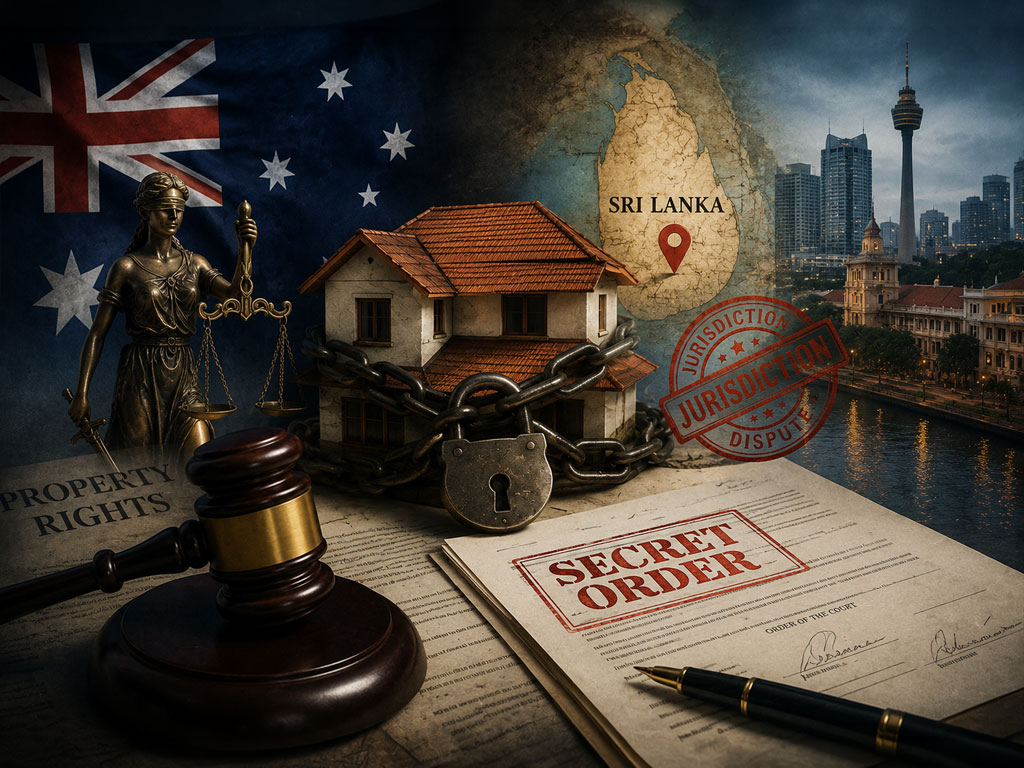
A Sri Lankan property dispute has raised claims of secret Australian court orders, jurisdictional overreach and blocked appeals.
A Sri Lankan property dispute linked to Australian family law proceedings has triggered serious allegations about jurisdiction, undisclosed orders and unanswered appeals.
Sri Lankan families in Australia claim court decisions made in 2023 affected ownership rights over residential land in Sri Lanka. They allege that several people with interests in those properties received no notice and could not participate in the proceedings.
The dispute began in the Australian Federal Circuit and Family Court. According to documents and accounts shared by affected individuals, the court issued orders involving several Sri Lankan properties held within one extended family.
Those challenging the decisions claim the orders went beyond assessing the financial interests of the parties before the Australian court.
Instead, they allege the decisions altered legal arrangements involving land governed by Sri Lankan law.
The allegations have caused concern within sections of the Sri Lankan diaspora. Families fear the case could affect confidence in the security of overseas property held by dual citizens and expatriates.

Sri Lankan Property Dispute Centres on Colombo Homes
According to accounts provided by affected individuals, the properties included ancestral residential holdings in Colombo.
A Sri Lankan-born Australian woman had reportedly transferred the properties to her two adult children as gifts recognised under Sri Lankan law.
Those challenging the orders allege that the Australian court later treated the properties as one asset associated with both parents. They claim the court ordered ownership to pass to the woman’s husband.
The affected parties argue that completing such a transfer would require the lawful revocation of the earlier gifts.
They contend that Sri Lankan law does not permit the completed gifts to be revoked in the manner contemplated by the Australian proceedings.
Supporters of the family also allege that the court indicated it could execute documents for the property owner if she refused to sign them herself.
The elderly couple at the centre of the dispute are described as frail and in poor health.
The claims remain accounts from the affected individuals and their supporters. However, they have raised significant questions about how one country’s family court can address ownership interests in land located under another country’s legal system.
Families Question Australian Court Jurisdiction
The central dispute concerns jurisdiction.
Those following the case argue that no treaty authorises an Australian court to determine ownership of privately held residential land in Sri Lanka.
They maintain that any transfer, cancellation of a gift or alteration of title should take place under Sri Lankan law.
They also argue that Sri Lankan courts should retain authority over questions concerning land registered within the country.
Several property owners allegedly received no notice that the Australian proceedings could affect their legal interests.
According to those raising concerns, these individuals could not appear before the court, present evidence or challenge the proposed transfers.
Some reportedly discovered the decisions only after the orders had already taken effect. Others whose claimed interests may be affected are said to remain unaware of them.
The affected parties say these circumstances prevented meaningful participation and restricted their ability to pursue appeals.
Unpublished Reasons Deepen Concerns
Questions have also emerged over the reasons supporting the orders.
People familiar with the proceedings claim the Australian court did not publish reasons explaining how it reached its conclusions.
They also say the orders themselves remain unavailable to the wider public.
The absence of published material, they argue, has made it harder for affected parties to understand the court’s legal reasoning.
It has also complicated efforts to challenge the decisions or seek assistance from authorities in either country.
Without full reasons, questions remain about how the court considered Sri Lankan property law, the validity of the earlier gifts and the interests of people who were not parties to the Australian case.
The dispute has therefore grown beyond an argument between members of one family.
It now involves wider concerns about due process, cross-border legal authority and the recognition of foreign property rights.
Australian Home Allegedly Sold Without Owners’ Knowledge
The controversy also involves a property in Australia owned by the elderly parents.
Individuals connected to the case allege that the Australian home became linked to the Sri Lankan assets during the proceedings.
They claim the court ordered the property to be sold and directed the proceeds into an Australian lawyer’s trust account.
According to supporters of the family, the owners learned that the sale had been completed only several months later.
This allegation has intensified concerns about whether the affected parties received adequate notice and an opportunity to protect their interests.
Those involved say they attempted to obtain relief within the Australian legal system after the 2023 ruling.
Applications were reportedly submitted to the High Court of Australia. The applicants argued that the orders breached international protections involving property rights and affected the interests of dual citizens.
They say their submissions included opinions from Sri Lankan lawyers explaining how Sri Lankan property law applied to the disputed land.
However, according to those following the case, the High Court declined to hear the matter.
Appeals Sent to Australian Authorities
After the High Court process ended, supporters of the family reportedly contacted several Australian institutions.
They say correspondence went to Prime Minister Anthony Albanese, the Attorney-General, the Foreign Minister and senior judicial officers.
According to those raising the allegations, they did not receive responses addressing the central questions.
These included whether the Australian court possessed jurisdiction over Sri Lankan land and what legal basis allowed the contested orders.
The matter was also referred to the Australian Federal Police, supporters of the family say.
However, police reportedly classified it as a civil dispute rather than a criminal matter.
The family’s supporters claim investigators did not accept documents they offered in support of their allegations.
They also approached local members of Parliament.
According to those involved, they were told that broader judicial oversight mechanisms would be necessary before complaints about judicial conduct could receive formal consideration.
Sri Lankan Authorities Also Approached
The affected individuals also sought assistance from Sri Lankan authorities.
Members of the diaspora say they requested meetings with the Sri Lankan High Commissioner in Australia.
They also sent correspondence to Sri Lanka’s Foreign Minister and Attorney General.
However, those making the requests say they have not received substantive replies addressing the alleged cross-border property issues.
The lack of clear responses from both countries has increased frustration among the families involved.
They argue that the dispute falls between two legal systems while the contested transfers continue to carry practical consequences.
The Sri Lankan property dispute has also continued through further proceedings in Australia.
According to individuals following the matter, one court acknowledged that the original 2023 orders were unjust. However, they claim it still allowed property transactions arising from those orders to continue.
In another case, affected parties reportedly sought to halt additional transfers.
They say the applications raised concerns about alleged violations of legal rights and possible criminal conduct, including money laundering.
However, they allege that the efforts to stop the transactions were unsuccessful.
Compensation Route Reportedly Rejected
During later proceedings, affected individuals say they were advised to consider seeking compensation through the Australian Financial Complaints Authority.
However, they contend that the authority told them it does not handle disputes involving overseas property.
They were also reportedly informed that it could not compensate losses connected to land outside Australia.
This left the affected parties without the remedy they believed the court had suggested.
Supporters of the family say this illustrates a wider problem. Australian proceedings may affect overseas assets, yet Australian complaint bodies may lack the power to address resulting losses.
Wider Fears Over Cross-Border Property Security
The dispute has generated broader concern among Sri Lankans living overseas.
Those following the case point to publicly available estimates from the Australian Criminal Intelligence Commission concerning fraud and money laundering in the Australian property sector.
They argue that authorities need stronger safeguards whenever legal proceedings involve international assets or overseas ownership rights.
The affected families fear that the case could create uncertainty for Sri Lankans abroad who retain ancestral homes or other property in their country of origin.
Many dual citizens hold assets under different legal systems. Family disputes, inheritance questions and financial proceedings can therefore create complex jurisdictional issues.
However, those raising concerns argue that complexity cannot justify excluding affected owners from proceedings.
They say courts must provide notice, recognise foreign property laws and explain the legal basis for decisions affecting overseas land.
The allegations in this case have not received a publicly detailed response from all institutions named by the affected parties.
Nevertheless, the dispute raises important questions about notification, judicial transparency and the limits of cross-border family court orders.
Until authorities clearly explain the jurisdictional basis of the decisions, confidence in the protection of overseas property rights may remain uncertain.