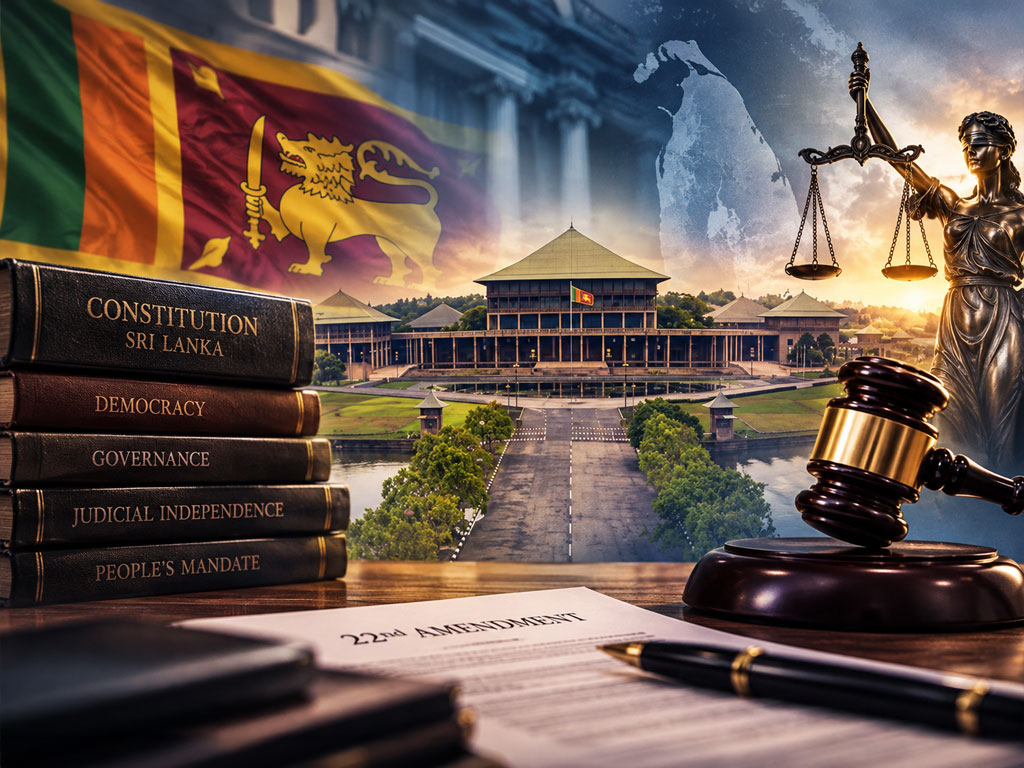
The 22nd Amendment Sri Lanka debate tests how a powerful parliamentary majority balances its mandate with constitutional restraint.
The mandate is not a licence to exceed constitutional limits. The deeper test is how a government with overwhelming parliamentary power chooses to exercise restraint.
With the Supreme Court’s determination on the 22nd Amendment now delivered, another important debate has begun in Sri Lanka’s constitutional politics.
It would be a mistake to read this purely as a technical legal question concerning the retirement age of judges, the tenure of the Chief Justice or the strength of the government’s parliamentary majority.
The deeper question is how a government with a powerful electoral mandate deals with constitutional power.
In that sense, the 22nd Amendment can be regarded as a litmus test of Sri Lanka’s constitutional democracy. It is not, by itself, a test that determines whether Sri Lanka is democratic. Rather, it offers an opportunity to examine the quality and maturity of that democracy and, particularly, the restraint with which political power is exercised.
A litmus test reveals the nature of a substance. Politically, what might the 22nd Amendment reveal?
The fundamental question is no longer simply: Does the government have the legal power to do this?
The Supreme Court has now expressed its determination on the constitutional requirements surrounding the Bill.
The more important political question begins after that determination: How should something that can legally be done also be done democratically?
That distinction matters.

The Mandate and the Constitution
At the 2024 parliamentary election, the National People’s Power secured 159 seats, giving the government an exceptionally large parliamentary majority.
Such a mandate provides considerable political space. It gives a government the strength to implement policies, enact legislation and pursue reforms to the machinery of government.
But a political mandate and constitutional power are not the same thing.
People elect a government to govern. The authority entrusted to that government, however, remains authority exercised within a constitutional framework.
A mandate is political approval to exercise power. It is not a licence to remove the limits placed upon that power.
Here lies one of democracy’s fundamental paradoxes.
On the one hand, democracy reflects the will of the majority. On the other, constitutional democracy places limits even on the authority of that majority.
The question, therefore, is not simply whether a government possesses the numbers necessary to act. It is whether a majority is prepared to recognise limits on its own power.
That, in my view, is where the 22nd Amendment becomes a genuine constitutional litmus test.
The Court and Parliament Have Different Roles
The respective roles of the Supreme Court and Parliament must also be distinguished.
A court considering proposed legislation is concerned with its constitutionality. It does not choose the political policy that Parliament should pursue. Its task is to make a legal determination within the framework established by the Constitution.
The Supreme Court’s determination on the 22nd Amendment must therefore be understood within those limits.
The Court has determined that the provisions of the Bill do not require approval by the people at a referendum under Article 83, while identifying amendments to Clause 2.
That answers an important constitutional question. It does not necessarily answer every democratic or political question surrounding the proposal.
The opening of a legal door does not settle the question of how political power should walk through it.
Once the constitutional boundaries have been defined, Parliament must decide what to do within them. In doing so, legislators should consider not only what the Constitution legally permits, but also the broader principles underlying constitutional government.
Legality and Democratic Trust
This is where legality and democratic legitimacy need to be considered separately.
Constitutional compliance is essential for legislation to be lawful. But legality alone does not necessarily guarantee public confidence in democratic institutions.
That distinction is particularly important when dealing with the judiciary.
Judicial independence is not simply the institutional ability of judges to decide cases according to law. Public confidence that the judiciary remains institutionally independent of political power is also fundamental to the legitimacy of the system.
Proposals concerning judicial retirement ages or the tenure of the Chief Justice should therefore invite more than one question.
The first is straightforward: Does the Constitution permit this?
The second is broader: What effect could such a change have on public confidence in the institutional independence of the judiciary?
Raising that question should not automatically be interpreted as an accusation about the government’s motives. There is a distinction between alleging improper intent and examining the institutional consequences or perceptions that legislation may create.
Similarly, the question of whether changes of this nature could shape the judiciary in a manner favourable to those currently exercising political power requires careful treatment.
A general change to the retirement age of judges is conceptually different from altering the tenure of a particular judge to suit an immediate political objective.
It would therefore be simplistic either to declare automatically that the 22nd Amendment threatens judicial independence or to insist that the proposals raise no legitimate institutional questions whatsoever.
What matters is the substance of the legislation, its transitional provisions, its application to future governments and its potential consequences for institutional independence.
Clear constitutional reasoning is particularly important where provisions affect an incumbent office-holder. Public confidence depends not only on what is done, but also on whether the reasons for doing it are transparent and institutionally defensible.
The Government’s Bigger Test
This is where the deeper political significance of the 22nd Amendment becomes apparent.
A government with a powerful mandate can legislate more easily than one dependent on a fragile parliamentary majority. Its ability to implement policy is correspondingly greater.
Yet possession of a strong majority is not, by itself, evidence of democratic maturity.
In many respects, that is precisely where the test begins.
A government without sufficient numbers may exercise restraint because political circumstances force it to compromise and share power. A government with an overwhelming majority must often generate that restraint from within.
The higher test of constitutional democracy, therefore, is not merely whether political actors behave democratically when their power is limited. It is whether they are willing to restrain themselves when their power is extensive.
This is not an accusation directed at one government. It is a broader institutional principle applicable to any government that commands overwhelming legislative power.
Where Does a Mandate End?
That leads to a deeper question: What exactly is an electoral mandate?
A mandate confers political authority on a government. But it does not stand above the Constitution. Rather, it operates within the constitutional order through which the people themselves have structured political power.
This tension between popular sovereignty and constitutional limitation is hardly unique to Sri Lanka. It is one of the central questions of modern constitutional democracy.
People elect governments. Democracy, however, does not mean that an election subsequently permits those in office to remove every limitation on political power in the name of the people.
Democracy is therefore about more than elections.
How authority is exercised after an election is equally important.
The debate surrounding the 22nd Amendment should consequently move beyond the narrow question of “Can the government do this?”
It should also ask: “How should the government do this?”
Likewise, asking whether Parliament possesses the constitutional authority to enact a measure should not prevent us from asking how Parliament ought to exercise that authority.
The “how” encompasses more than parliamentary procedure. It includes transparent reasoning, open debate, legal argument, dialogue with relevant institutions, respect for constitutional precedent and consideration of how the same law might be used by future governments.
The quality of democracy is not measured solely by how quickly a majority can make a decision.
Sometimes, it is better measured by the restraint that a majority exercises over the power it already possesses.
The Real Litmus Test
The 22nd Amendment is therefore significant for reasons extending beyond whether Parliament ultimately passes it.
It allows Sri Lanka to ask a series of broader constitutional questions.
How does a government with a powerful mandate respond to constitutional limits?
How does a large parliamentary majority approach the institutional independence of the judiciary?
When a judicial determination establishes that a particular constitutional route is available, how does political power choose to use that route?
And perhaps most importantly: Would we regard the same law as fair if it were being exercised tomorrow by a government we opposed?
That final question is crucial.
Good constitutional law cannot simply be law that appears desirable because it suits the political circumstances of the present.
A stronger test is whether we would still regard that law as legitimate and fair if political power changed hands.
That is where the maturity of constitutional democracy is truly tested.
If discussion of the 22nd Amendment is confined to the Chief Justice’s tenure or the retirement age of judges, we risk overlooking its broader significance.
This is also a debate about political power, electoral mandates, parliamentary majorities and judicial independence.
More fundamentally, it asks whether those who possess considerable power are willing to recognise limits on how that power should be exercised.
The 22nd Amendment should therefore not be treated as a final verdict on whether democracy exists in Sri Lanka.
It is better understood as something more revealing: a litmus test of the maturity of Sri Lanka’s constitutional democracy.

Digital Creator
Lecturer, Open University of Sri Lanka
Former Teaching Assistant, University of Colombo