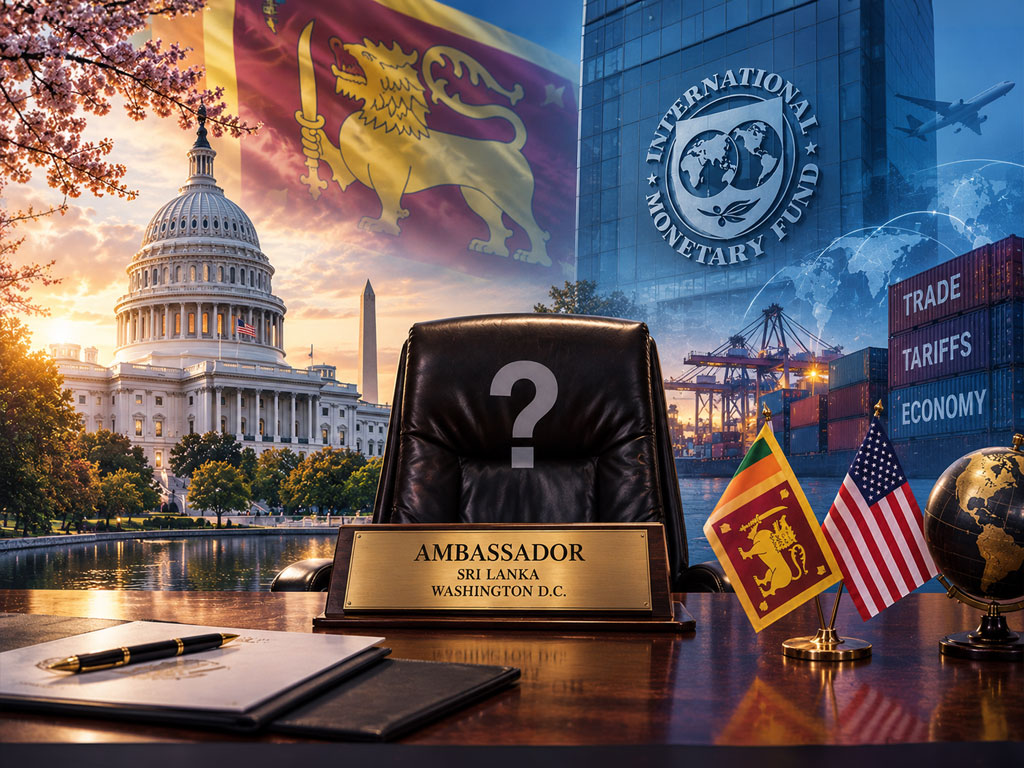
The Sri Lanka US Ambassador post remains vacant as Colombo faces crucial IMF, trade and tariff negotiations involving Washington.
COLOMBO — Sri Lanka’s failure to appoint a new Ambassador to the United States following Mahinda Samarasinghe’s departure has left one of the country’s most strategically important diplomatic posts without a permanent head at a time of heightened economic and trade uncertainty.
The vacancy comes as Sri Lanka continues its IMF-supported economic programme, negotiates trade issues with Washington and confronts a rapidly changing U.S. tariff environment.
History shows that Colombo has previously attached considerable importance to its representation in Washington.
William Gopallawa, who would later become Sri Lanka’s first President (first and only Non-Executive President), served as Ceylon’s Ambassador to the United States from September 1961 until March 1962 during the administration of Prime Minister Sirimavo Bandaranaike.
Gopallawa was subsequently recalled to Ceylon and appointed Governor-General in 1962. A decade later, following the adoption of the 1972 Constitution and Ceylon’s transition to a republic, he became the country’s first President.
When Gopallawa was appointed Governor-General, U.S. President John F. Kennedy sent him a congratulatory message in which he specifically acknowledged his service in Washington.
“Your Ambassadorship in Washington did much to reinforce the traditional bonds of friendship between our two countries,” Kennedy wrote.
The episode underlined the importance successive governments have placed on the diplomatic relationship with the United States.

Samarasinghe Sent to Washington
Decades later, President Gotabaya Rajapaksa turned to senior politician Mahinda Samarasinghe for the Washington posting.
Samarasinghe resigned from Parliament in 2021 before taking up duties as Sri Lanka’s Ambassador to the United States.
His tenure eventually coincided with one of the most difficult economic periods in Sri Lanka’s post-independence history, including the 2022 economic crisis and the country’s subsequent engagement with the International Monetary Fund.
Washington is particularly important in that context because the United States is the IMF’s largest shareholder and remains a major destination for Sri Lankan exports.
Samarasinghe’s term also extended into a period of considerable uncertainty over U.S. trade and tariff policy.
Reports earlier this year indicated that he was expected to return to Sri Lanka in July at the conclusion of his assignment.
Yet no successor has so far been publicly announced to take up the ambassadorial position in Washington.
IMF Programme Remains at a Critical Stage
The timing deserves particular attention because Sri Lanka’s IMF programme remains active.
The IMF Executive Board completed the combined Fifth and Sixth Reviews of Sri Lanka’s Extended Fund Facility arrangement in May, releasing approximately US$695 million and bringing total disbursements under the programme to about US$2.4 billion.
On September 23, following its latest visit to Colombo, an IMF staff team said discussions with Sri Lankan authorities on the Seventh Review would continue “in the near term” towards agreement on the policies and parameters required to conclude that review.
That is more precise than saying Sri Lanka’s “IMF agreement has still not been concluded”. The four-year EFF arrangement was approved in March 2023 and remains in operation, with individual reviews continuing under the programme.
Diplomatic representation in Washington does not determine IMF decisions. Nevertheless, maintaining high-level engagement with the United States remains strategically important given Washington’s influence in international financial institutions and the broader bilateral economic relationship.
New U.S. Tariff Risks
Trade policy provides another reason why the Washington appointment matters.
The United States and Sri Lanka have a Trade and Investment Framework Agreement dating from 2002 and are currently negotiating an Agreement on Reciprocal, Fair, and Balanced Trade, according to the U.S. Department of Commerce.
Sri Lankan exports have also been affected by wider changes in U.S. tariff policy. In July, the White House directed that Sri Lankan goods covered by a Section 301 action be subject to a 10% tariff rate.
A separate and potentially more consequential issue has emerged over Russian energy.
President Donald Trump signed legislation in September granting the U.S. President authority to impose tariffs of up to 100% on goods from countries identified among the five largest importers of Russian oil or gas.
India, one of Sri Lanka’s most important economic partners, is among the countries potentially exposed under the measure because of its substantial purchases of Russian crude.
The legislation does not mean that a 100% tariff has automatically been imposed on India. It provides the U.S. administration with the authority to impose tariffs up to that level, subject to the law’s provisions and presidential discretion.
The distinction matters because changes in U.S. trade policy affecting India and other major economies could have wider consequences for regional trade, energy markets and Sri Lanka’s own economic environment.
Why Washington Matters Now
An ambassador cannot determine American trade policy, control IMF decisions or eliminate external economic risks.
The value of having a senior diplomatic representative in Washington lies elsewhere.
An ambassador provides direct political access, maintains relationships across the U.S. administration and Congress, represents Sri Lanka’s interests during negotiations and helps coordinate economic diplomacy at a time when decisions in Washington can have significant consequences for Colombo.
That makes the current vacancy more than a routine diplomatic staffing issue.
Sri Lanka is simultaneously navigating an IMF programme, U.S. trade negotiations, global tariff uncertainty and continuing external economic pressures.
Against that backdrop, the question is straightforward: why has a successor to Mahinda Samarasinghe not yet been appointed?
The government has not publicly explained in the material available for this article why the position remains vacant or when a new ambassador will be named.
Until an appointment is announced, one of Sri Lanka’s most consequential overseas diplomatic postings remains without a permanent ambassador at a particularly sensitive moment for the country’s economic diplomacy.