President Anura Kumara Dissanayake has challenged private fuel suppliers over pricing demands and distribution restrictions, while Energy Minister Anura Karunathilaka maintains that existing agreements allow those companies to set their own prices. The Government now faces questions over how it intends to reconcile contractual obligations with consumer protection.
COLOMBO — President Anura Kumara Dissanayake’s decision to expand the Ceylon Petroleum Corporation’s retail network by 75 filling stations has brought renewed attention to Sri Lanka’s fuel market, where disagreements over pricing, supply restrictions and contracts with private distributors are testing the Government’s ability to protect consumers.
The President has accused certain private fuel suppliers of restricting distribution while seeking substantial increases in diesel prices, arguing that agreements signed under previous administrations have limited the State’s ability to intervene.
Energy Minister Anura Karunathilaka, meanwhile, has acknowledged that private suppliers retain contractual rights to determine their retail prices according to their operating costs.
Although the Minister has also warned against deliberate supply restrictions and rejected demands for the Government to raise fuel prices, the two positions raise an important policy question: how can the administration protect consumers while respecting contractual arrangements that permit private pricing?
The dispute involves major private fuel suppliers including Lanka IOC, Sinopec and RM Parks, which operates under the Shell brand.
The issue extends beyond the price displayed at filling stations. It concerns competition, access to essential services, the Government’s contractual powers and the extent to which private distributors can influence Sri Lanka’s fuel market.

President Challenges Private Fuel Suppliers Over Pricing and Shortages
Addressing a National People’s Power rally in Ibbagamuwa on October 11, President Dissanayake criticised agreements under which private fuel companies entered the domestic market, arguing that certain contractual provisions restricted the Government’s ability to respond to supply disruptions.
He alleged that some suppliers were limiting fuel distribution despite holding stocks, seeking higher prices before increasing their sales.
According to the President, private suppliers had requested diesel price increases ranging from Rs. 116 to Rs. 132 per litre.
These were reported requests for price increases, not established profit margins or evidence that companies had earned an additional Rs. 132 on every litre sold.
Dissanayake contrasted those demands with the CPC’s decision to limit the increase in its diesel prices to approximately Rs. 10 per litre while absorbing additional costs through government support.
He also stated that the CPC’s share of the diesel market had risen from approximately 58% to 77%, reflecting a shift towards the State-owned supplier amid restrictions affecting private distribution.
The President reportedly indicated that the existing agreements had been referred to the Attorney General for examination, with the Government seeking greater flexibility to address supply failures and protect consumers.
His central argument was that the State should not be prevented from intervening when commercial decisions threaten the continuity of an essential national service.
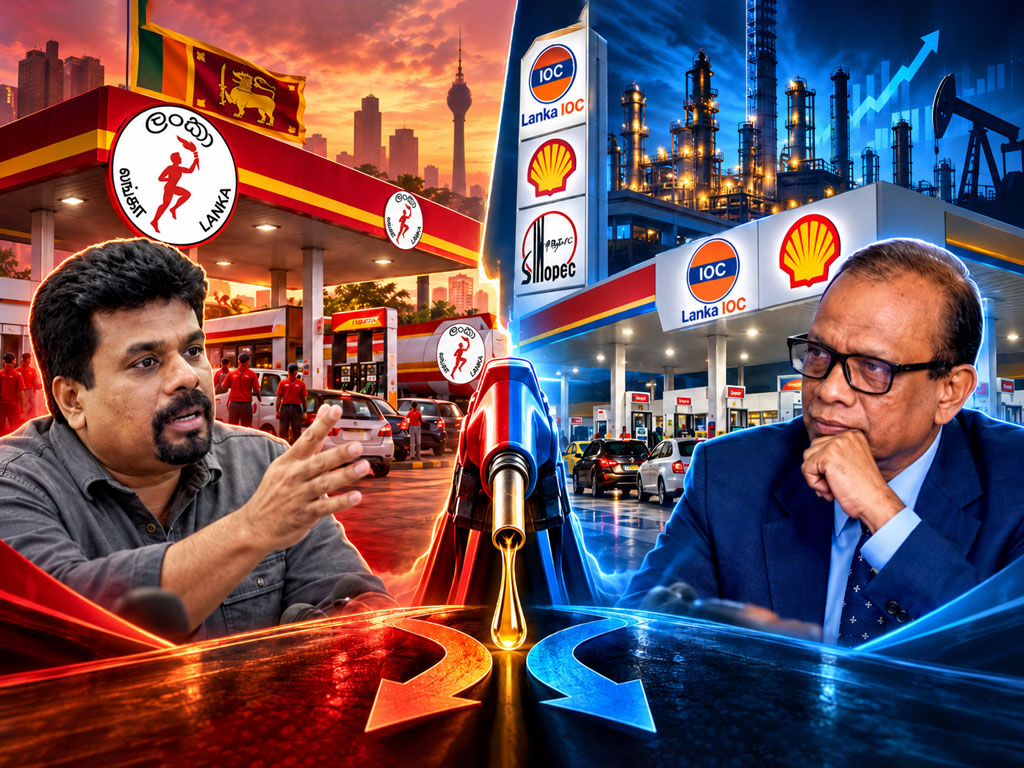
Sri Lanka fuel pricing policy faces scrutiny as the President backs stronger CPC competition while the Energy Minister defends private pricing freedom.
Read MoreSeventy-Five New CPC Filling Stations Planned
One of the Government’s principal responses is a proposal to establish 75 additional CPC filling stations, particularly in areas where privately operated outlets currently dominate fuel distribution.
CPC Chairman D.J. Rajakaruna confirmed that authorisation had been granted for the expansion, saying the network could be extended further if circumstances required.
The initiative is intended to provide consumers with alternative sources of fuel and reduce dependence on individual private distributors.
Communities served by relatively few filling stations are particularly vulnerable when suppliers reduce deliveries or temporarily suspend distribution.
In areas such as Dehiattakandiya, which the supplied material highlights as an example of limited consumer choice, the establishment of additional State outlets could improve access and strengthen competitive pressure.
However, the effectiveness of the proposed expansion will depend on where the stations are located, how quickly they become operational and whether the CPC can maintain adequate supplies.
The Government has not established through the information examined that all 75 outlets are already under construction or that they will be completed within a particular timeframe.
The programme therefore represents a proposed structural response rather than an immediate solution to every localised shortage.
Minister Says Private Suppliers Can Determine Their Prices
The controversy has also drawn attention to remarks made by Energy Minister Karunathilaka concerning the pricing rights of private fuel companies.
Speaking during the current dispute, the Minister explained that private operators could determine their retail prices according to their costs under the agreements governing their activities.
His explanation reflects the contractual framework under which the companies operate.
However, the Minister also made clear that the Government would not increase CPC fuel prices simply to satisfy the demands of private suppliers.
He warned that legal measures could be considered if private companies continued restricting fuel distribution in ways that inconvenienced consumers.
These additional remarks are significant because they distinguish recognition of existing contractual rights from an unconditional endorsement of the companies’ conduct.
The Minister’s position therefore cannot fairly be characterised solely as support for unrestricted private pricing.
Nevertheless, it exposes a practical difficulty for the Government.
If companies are contractually entitled to charge higher prices, but consumers in some areas have little access to alternative suppliers, the effectiveness of market competition becomes questionable.
An arrangement may permit a company to set prices according to specified conditions without necessarily ensuring that consumers enjoy genuine choice.
The Government must therefore explain how it intends to prevent localised dependence on individual suppliers while respecting legally binding agreements.
One Government, Two Approaches to Fuel Regulation?
The President’s criticism of existing fuel agreements and the Energy Minister’s acknowledgement of private pricing rights are not necessarily contradictory.
One concerns the Government’s intention to amend what it considers restrictive contractual provisions. The other describes the legal arrangements currently governing private suppliers.
However, the distinction has not entirely resolved questions about how future fuel pricing and distribution will be managed.
If current agreements allow private companies to apply their own pricing formulas, what safeguards exist to prevent consumers in areas with limited competition from facing substantially higher prices?
If suppliers reduce distribution because prevailing prices are commercially unsustainable, what minimum supply obligations can the Government enforce?
And if the Attorney General determines that the agreements contain provisions detrimental to public interests, how quickly can those arrangements be amended without exposing the State to contractual disputes?
These questions require detailed policy explanations rather than assumptions about the motives of individual ministers.
The information examined provides no verified evidence that Karunathilaka has entered into an improper arrangement with private fuel suppliers or is acting on their behalf.
His publicly reported statements include warnings of possible legal action and an express refusal to impose the companies’ requested price increases on consumers.
The appropriate matter for scrutiny is whether the Government’s regulatory strategy is coherent, enforceable and capable of maintaining reliable supplies nationwide.
CPC Reports Rs. 28 Billion in Profits
Financial performance has become another important element of the President’s argument.
Dissanayake stated that the Ceylon Petroleum Corporation had recorded approximately Rs. 28 billion in profits during 2026 and was using its improved financial position to help protect consumers from international fuel price pressures.
The President also referred to support equivalent to approximately Rs. 70 per litre of diesel under the Government’s price-stabilisation arrangements.
These figures were presented as evidence that a profitable State enterprise could contribute to consumer relief while maintaining supplies.
The broader financial position, however, requires consideration of the costs associated with subsidies, international oil prices, exchange-rate movements and the sustainability of continued State support.
CPC profitability alone does not establish that every subsidy or retail expansion programme can be financed indefinitely.
The Government should therefore clarify how the proposed filling stations will be funded, what financial impact the subsidy arrangements will have and whether the current pricing model can be sustained if international petroleum costs remain elevated.
What the Government Must Clarify
The dispute presents several questions requiring direct answers from the Ministry of Energy, CPC and relevant regulatory authorities:
- What contractual provisions allow private suppliers to determine their own retail prices?
- What minimum stockholding and fuel distribution obligations apply to those companies?
- What evidence supports the reported restrictions on fuel distribution?
- How were the requested diesel price increases of Rs. 116 to Rs. 132 per litre calculated?
- What amendments to existing agreements have been proposed?
- When will the Attorney General’s review be completed?
- Where will the 75 new CPC filling stations be established, and when are they expected to operate?
- What arrangements will protect consumers in areas where a single distributor dominates the market?
- How will the Government finance and sustain its current diesel price-support measures?
Clear answers would help distinguish legitimate commercial concerns from conduct that may breach contractual or regulatory obligations.
They would also establish whether existing fuel policies sufficiently protect consumers without discouraging the investment needed to maintain a reliable national distribution network.
Consumer Protection Must Guide Fuel Market Reform
Private investment and State participation are not inherently incompatible within a competitive fuel market.
The difficulty arises when the regulatory framework fails to provide sufficient protection against interruptions in an essential service or leaves consumers without practical alternatives.
The Government’s proposed expansion of CPC filling stations may address some of these vulnerabilities, particularly in areas currently dependent on private distributors.
Equally, any attempt to revise existing contracts must be supported by a sound legal basis and a clear assessment of the commercial obligations involved.
The President has made his concerns about the current arrangements public, while the Energy Minister has acknowledged both the contractual pricing rights of private operators and the Government’s intention to act against unjustified supply restrictions.
The next test is whether those positions can be translated into a consistent national policy.
The Attorney General’s review, the implementation of the proposed CPC expansion and the Government’s decisions on future pricing arrangements will determine how the present dispute is resolved.
For consumers, the principal concern is straightforward: access to fuel at predictable prices without becoming dependent on the commercial decisions of a single supplier.
That outcome will require enforceable rules, sufficient competition and coordinated action across the Government, rather than statements alone.