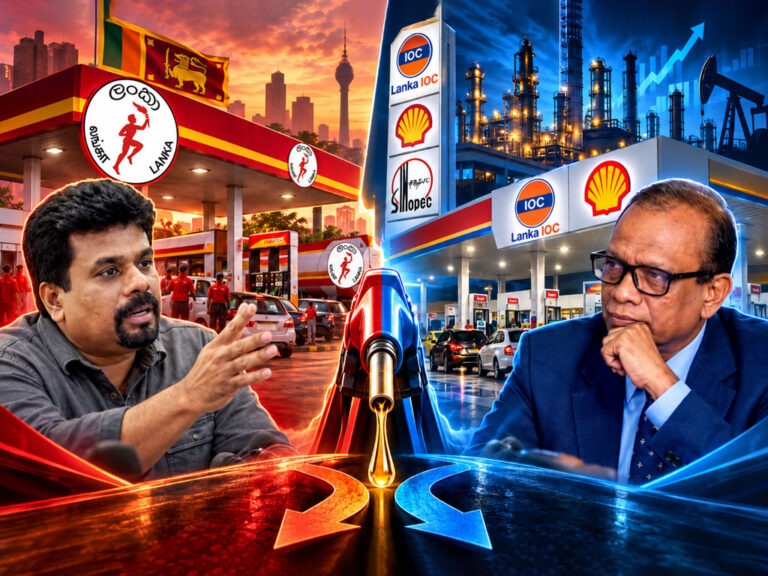
Sri Lanka fuel pricing policy faces scrutiny as the President backs stronger CPC competition while the Energy Minister defends private pricing freedom.
COLOMBO — President Anura Kumara Dissanayake’s decision to establish 75 new Ceylon Petroleum Corporation filling stations in areas where private suppliers dominate deserves support as a practical attempt to strengthen competition and protect consumers. Yet remarks attributed to the Energy Minister have created an uncomfortable question over whether the Government is speaking with one voice on fuel policy.
The President has focused attention on areas where motorists depend heavily on private operators such as Lanka IOC, Sinopec and Shell, arguing that stronger CPC representation would give consumers an alternative where State-owned filling stations are limited.
From a consumer perspective, the principle is difficult to dispute. Competition is meaningful only when customers have a genuine choice.
The President has also pointed to the CPC’s reported Rs. 28 billion profit and its ability to return part of that benefit to consumers through more affordable fuel. His argument appears to be that a State-owned institution should help prevent situations in which market access and pricing leave consumers with few practical alternatives.

Dehiattakandiya was cited as an example of an area where limited access to CPC filling stations can leave motorists dependent on private suppliers.
Of particular concern is the President’s reference to a diesel price difference of as much as Rs. 132 per litre. If consumers in particular locations are confronted with such disparities while having little realistic choice of supplier, the Government has a legitimate responsibility to examine whether the market is delivering the competition originally intended.
Private Competition Must Also Protect Consumers
Opening the fuel market to private companies was intended to increase competition, improve supply security and reduce excessive dependence on a single supplier.
Private participation, however, cannot be judged simply by the number of companies operating in the market.
For consumers, genuine competition should deliver reasonable prices, dependable supplies and meaningful choice.
A market in which an operator can restrict distribution because a particular price is commercially unattractive may make sense from a purely corporate perspective. From the standpoint of national energy security and essential public services, the consequences are more complicated.
That is why the President’s plan to establish another 75 CPC filling stations is important. A stronger State network can provide a competitive counterweight without necessarily eliminating private-sector participation.
Energy Minister’s Remarks Need Clarification
Against that background, remarks attributed to the Energy Minister at a meeting of the Container Transport Owners’ Association are surprising.
The Minister reportedly said private fuel companies have the “freedom” to conduct their operations and determine their prices.
Private companies naturally require commercial freedom to operate. But that freedom cannot be considered in isolation from consumer protection, energy security and the conditions under which companies were allowed into an essential national market.
The apparent tension is therefore significant.
On one side, the President is criticising pricing disparities and supply restrictions while seeking to strengthen the CPC’s presence. On the other, the Energy Minister appears to be emphasising the freedom of private suppliers to make their own commercial decisions.
Those positions require reconciliation.
The Minister’s willingness to remain accessible to transport operators by telephone is administratively welcome, but accessibility is not a substitute for a clear national policy on fuel pricing and supply.
Government Needs One Coherent Fuel Policy
Sri Lanka cannot afford two competing policy messages on essential services such as fuel and gas.
A competitive market does not mean unrestricted freedom for suppliers regardless of the effect on consumers. Nor should State intervention mean eliminating private-sector participation simply because companies seek profits.
The challenge is to establish rules under which both State and private suppliers compete fairly while consumers retain access to fuel at reasonable prices.
If the Government believes the CPC should expand into areas underserved by the State network, that strategy should be clearly articulated and implemented.
If private operators are entitled to determine prices independently, the limits and regulatory safeguards surrounding that freedom should also be explained.
The President’s decision to strengthen the CPC network offers a practical way of increasing consumer choice. The Energy Minister should now clarify how his interpretation of private-sector pricing freedom fits within that policy.
For an essential commodity such as fuel, the public should not have to determine which of two different government messages represents national policy.
Competition can benefit consumers, but only when the market is structured to serve them as well as the companies operating within it.