Sri Lanka India export opportunities could expand as Reliance seeks deeper local partnerships, but competitiveness and policy stability remain critical.
COLOMBO — Sri Lankan businesses could gain greater access to India’s rapidly expanding consumer market as Reliance Consumer Products Ltd. signals its willingness to deepen partnerships with local manufacturers, but translating that interest into sustained export growth will require stronger production capacity, competitive pricing and a more predictable investment environment.
Reliance Consumer Products CEO T. Krishnakumar told the Sri Lanka Economic and Investment Summit 2026 that the company had built relationships with four Sri Lankan businesses over the past four years and introduced products from two of them into the Indian market, with encouraging results.
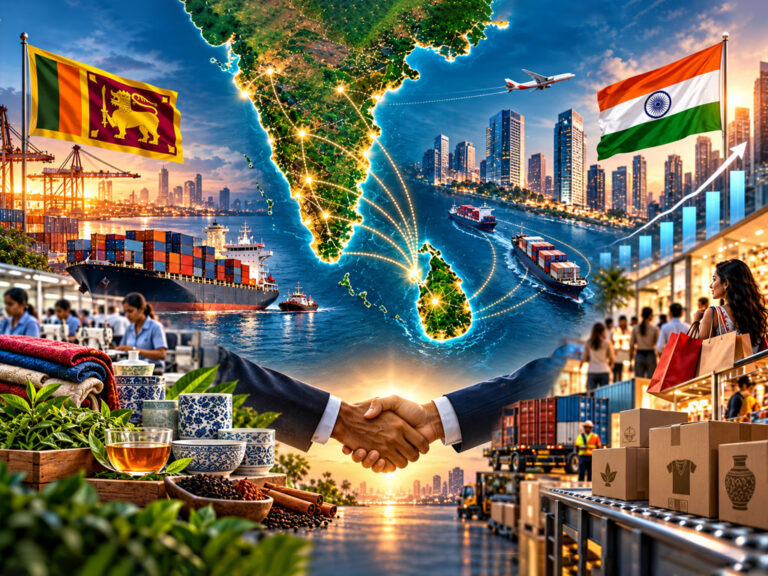
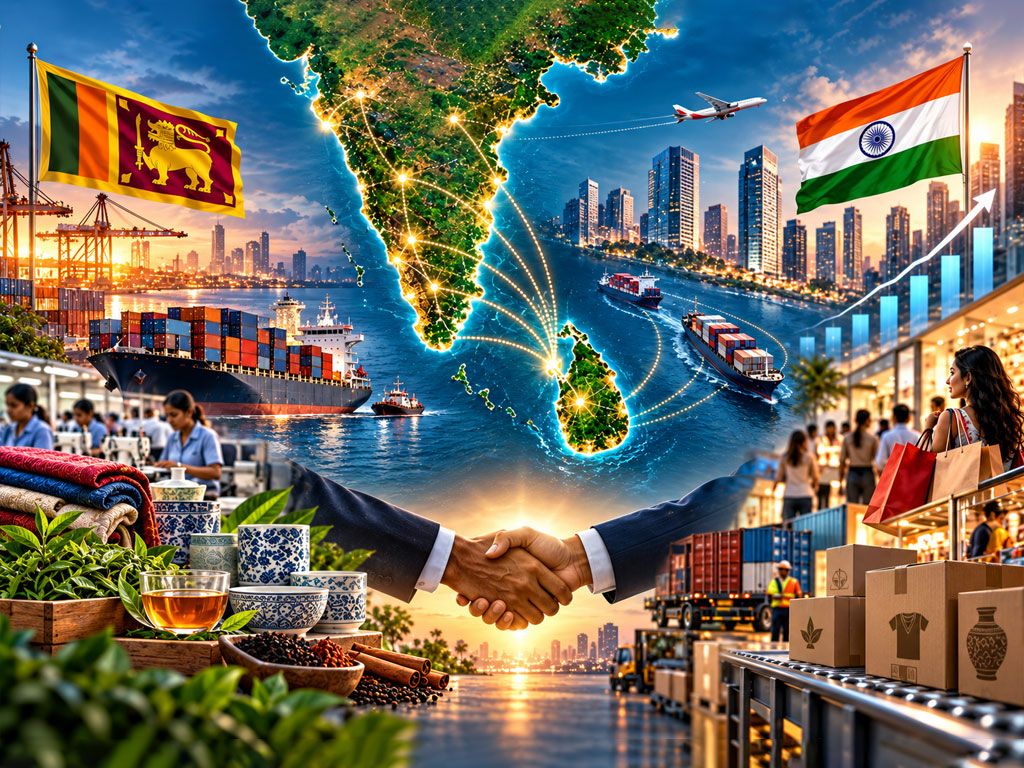
The experience demonstrates that Sri Lankan products can find commercial opportunities across the Palk Strait. It also highlights how far the country must travel before a small number of corporate partnerships develops into a broader transformation of its export economy.
Sri Lanka already possesses recognised strengths in tea, apparel, ceramics and food production. Yet success in established sectors does not automatically guarantee competitiveness in India, where producers face enormous scale, sophisticated distribution networks and increasingly demanding consumers.

Scaling Sri Lankan Businesses for India
For Sri Lankan exporters, the challenge begins with scale.
Production costs, access to finance, technology, logistics, distribution and market entry can all determine whether a product that performs well domestically can compete successfully across a much larger regional market.
Smaller manufacturers are particularly exposed to these constraints. Many may lack the capital, technical capability or commercial experience needed to increase output while maintaining quality and keeping prices competitive.
Krishnakumar said potential partnerships could extend beyond the purchase of finished goods to product development, sourcing, manufacturing, packaging and distribution.
Properly structured, such arrangements could allow Sri Lankan companies to become part of integrated regional value chains rather than remaining isolated suppliers of individual products.
That distinction matters.
A company that participates in manufacturing, product development, packaging and distribution can capture considerably more economic value than one supplying a low-margin input.
For Sri Lanka, the objective should therefore be to attract partnerships that strengthen domestic capabilities, transfer useful technology and allow local businesses to retain a meaningful share of the value they create.
Policy Stability Will Shape Investor Confidence
Commercial opportunity alone will not determine whether those partnerships expand.
Krishnakumar identified predictable taxation, dependable regulation, timely approvals and effective mechanisms for resolving business difficulties as priorities for long-term investors.
That message carries particular relevance as Sri Lanka seeks to convert improved macroeconomic stability and stronger foreign reserves into productive private investment.
Investors assessing manufacturing or distribution projects must be able to estimate costs and risks over several years. Frequent tax changes, inconsistent regulation or prolonged administrative delays can undermine confidence even when attractive incentives are available.
Sri Lanka’s recovery will therefore remain incomplete if improved headline economic indicators are not followed by new productive capacity, stronger exports and better employment opportunities.
A sustained investment strategy requires policy continuity that allows businesses to plan beyond the next budget cycle.
Technology Can Help, but Cannot Replace Fundamentals
Digitalisation and artificial intelligence could also play an important role in improving productivity and connecting smaller businesses with larger markets.
Krishnakumar pointed to digital payments, farmer-oriented platforms and improved access to information as mechanisms capable of increasing efficiency across supply chains.
For smaller Sri Lankan businesses, digital tools could reduce transaction costs, improve access to customers and provide better information on demand, pricing and production.
Technology, however, cannot compensate for weak infrastructure, poor management or an inadequately trained workforce.
Public and private investment in education, practical skills, innovation and digital access will be necessary if small businesses and younger workers are to benefit from regional economic integration.
The opportunity created by India’s consumer expansion will have limited value if Sri Lankan firms lack the people, systems and infrastructure needed to respond to it.
Products Must Match Indian Consumer Demand
Consumer behaviour will be another decisive factor.
Krishnakumar emphasised that sustainable growth depends on reliable quality and affordability, supported by efficient manufacturing, sourcing and distribution.
Sri Lankan producers cannot assume that a product successful in the domestic market will automatically succeed in India.
Different regions, income groups and consumer preferences can require changes in pricing, packaging, product size, branding and distribution.
Understanding household purchasing power will be particularly important.
Products must be developed for the markets they are entering, not simply exported in their existing form and expected to find buyers.
That approach will require closer market research and stronger collaboration between Sri Lankan producers and Indian distribution partners.
Government Must Measure the Economic Benefits
The Government’s task should now be to convert corporate interest into measurable economic outcomes.
Those outcomes should include:
- increased export earnings;
- new manufacturing investment;
- stronger domestic supplier networks;
- technology and skills development;
- higher local value addition; and
- quality employment.
Transparent monitoring would help determine whether cross-border partnerships are genuinely strengthening Sri Lanka’s productive economy or merely increasing the volume of low-value supplies moving through regional value chains.
Policymakers should also pay attention to how benefits are distributed.
If local companies provide basic inputs while branding, technology, market relationships and higher-margin activities remain outside Sri Lanka, the overall economic impact may be considerably smaller than headline trade figures suggest.
Export growth is most valuable when it creates deeper domestic capability.
India’s Consumer Boom Is an Opportunity, Not a Guarantee
India’s expanding consumer economy gives Sri Lanka access to a neighbouring market of enormous scale.
Geography provides an advantage, but proximity alone will not produce export success.
Sri Lankan firms will have to compete on quality, price, consistency and reliability while adapting products to Indian consumer preferences.
Government policy must support that effort through predictable rules, efficient approvals and infrastructure capable of reducing the cost of production and trade.
Reliance’s experience with four Sri Lankan businesses, including the introduction of products from two of them into India, offers evidence that such partnerships can work.
The larger challenge is turning isolated successes into a repeatable model.
If Sri Lanka can strengthen domestic manufacturing, improve workforce capabilities and build a stable investment environment, India’s consumer expansion could become an important engine for export-led growth.
Without those reforms, however, the country risks remaining a peripheral supplier rather than developing into a stronger regional manufacturing and distribution partner.