By Roy Denish.
At least 275 Sri Lankans killed in Russia’s war were identified in Ukrainian data, exposing concerns over deceptive recruitment networks.
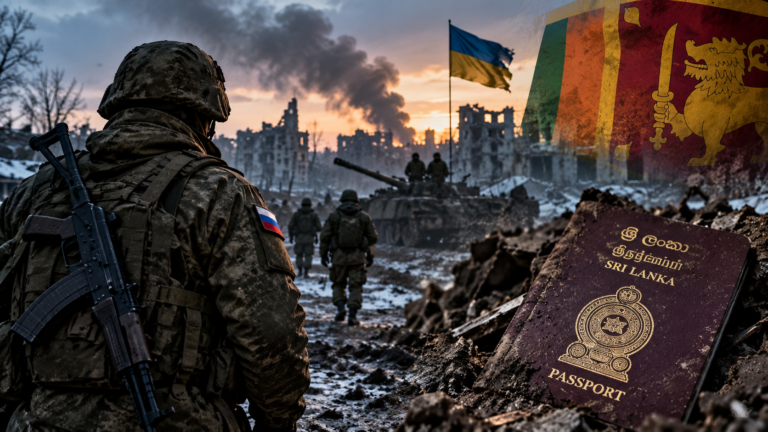
COLOMBO – At least 275 Sri Lankan nationals were killed while fighting for Russian forces in Ukraine, according to figures obtained by investigative journalists, exposing the human cost of foreign military recruitment and renewing concerns over networks accused of exploiting economically vulnerable Sri Lankans.
The findings, published in March 2026 by Himal Southasian and reported by the Organised Crime and Corruption Reporting Project (OCCRP), draw on data supplied by Ukraine’s Coordination Headquarters for the Treatment of Prisoners of War.

The dataset covers the period from Russia’s full-scale invasion of Ukraine in February 2022 to September 2025.
It records at least 455 deaths among fighters recruited from six South Asian countries: Sri Lanka, Nepal, India, Bangladesh, Pakistan and Afghanistan.
Sri Lankan nationals accounted for 275 of those deaths, the highest recorded toll among the countries covered.
The number is substantially higher than the 59 deaths acknowledged by Sri Lankan authorities in February 2025, although the two figures cover different reporting periods and may reflect different methods of verification.
Promises of Employment, Followed by War
For Sri Lankan families struggling with financial pressures, overseas employment has long represented an opportunity to secure higher earnings and greater economic stability.
Recruitment into Russia’s military has created a far more dangerous variation of that aspiration.
Reports concerning foreign fighters describe recruitment arrangements in which some individuals were allegedly promised security work, support duties or other employment opportunities before becoming involved in military operations.
The distinction between voluntary enlistment, fraudulent recruitment and human trafficking is legally important. Not every Sri Lankan who joined Russian forces was necessarily trafficked, and each allegation requires examination of the individual’s recruitment circumstances and consent.
Nevertheless, deception concerning the nature of employment, the confiscation of identity documents and coercion can be indicators of trafficking or exploitation.
Former military personnel are particularly relevant to the investigation because their professional experience may make them attractive to recruiters seeking individuals with military skills.
For some families, the consequences have included the loss of a principal income earner, difficulties establishing the fate of missing relatives and uncertainty over compensation.
Questions Over Recruitment Networks
The casualty figures have added urgency to calls for Sri Lankan authorities to examine how recruitment networks operated and whether recruiters misrepresented the risks associated with overseas military service.
A central question is whether prospective recruits were adequately informed that they could be deployed to active combat zones.
Any investigation must also distinguish between independent recruitment agents, officially authorised arrangements and individuals allegedly operating outside the law.
Where deception or coercion is established, prosecutors would need to determine which offences are supported by the evidence and who should be held responsible.
Allegations concerning the involvement of former military officers or politically connected intermediaries require particular scrutiny, but such claims cannot be treated as proven without supporting evidence.
The original account also alleges serious deficiencies in Sri Lanka’s enforcement of human-trafficking laws. Specific claims concerning the absence of convictions and investigations require confirmation against the relevant reporting period in the US State Department’s Trafficking in Persons Report.
Families Left Seeking Answers
Beyond the casualty statistics are families confronting uncertainty about whether relatives have been killed, captured, wounded or remain missing.
Where deaths occur in foreign military service, obtaining official records, recovering remains and pursuing compensation can involve complicated diplomatic and legal procedures.
For families who believe their relatives were recruited through deception, the search for information also becomes a demand for accountability.
The Ukrainian dataset provides evidence of the scale of South Asian participation and fatalities, but it does not, by itself, establish the circumstances under which every individual enlisted.
Nor does it establish how many recruiters committed criminal offences.
What it does establish is the scale of an extraordinary human loss: hundreds of South Asians, including at least 275 Sri Lankans, were recorded as having died while serving in Russia’s war.
The findings leave Sri Lankan authorities facing difficult questions about recruitment oversight, victim protection, diplomatic assistance and the investigations required to determine whether criminal networks contributed to those deaths.