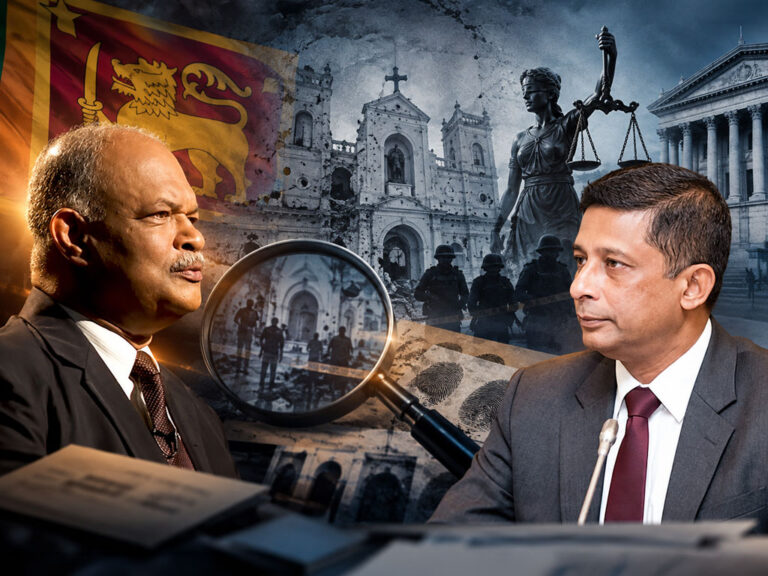
The Shani Abeysekara Sallay investigation has revived debate over prior Easter attack inquiries, political alignment and investigative independence.
The investigation of former State Intelligence Service Director Major General (Retd.) Suresh Sallay over alleged links to the 2019 Easter Sunday attacks has revived an uncomfortable question: should CID Director Shani Abeysekara be directing an inquiry whose wider history includes scrutiny of decisions made by the CID during his previous tenure?
That question deserves examination. But it also demands precision.
Sri Lanka’s Easter Sunday investigations have generated competing allegations, commission findings, court proceedings and political accusations over seven years. Claims about Abeysekara’s conduct before the attacks cannot simply be converted into findings of criminal responsibility, just as allegations now being investigated against Sallay cannot be treated as proof of guilt.
The issue is therefore not whether either man should be declared guilty by public opinion.
It is whether the structure of the present investigation provides sufficient institutional independence, and sufficient public confidence in that independence, to withstand scrutiny.

The Questions Over the Pre-Attack Investigation
Before the April 21, 2019 attacks, intelligence concerning Zahran Hashim and members of his extremist network had circulated among several arms of Sri Lanka’s security establishment.
The subsequent inquiries exposed serious failures across the country’s intelligence, police and political structures.
Abeysekara was serving as CID Director at the time.
The original submission for this article argues that intelligence relating to suspects including Rilwan, Shaini and a figure known as Army Mohideen had reached the CID before the attacks and contends that operational decisions by the department impeded efforts by other investigators.
Those assertions have subsequently formed part of a much wider and heavily contested debate over responsibility for the failure to prevent the bombings.
What cannot safely be said, however, is that Abeysekara’s personal criminal responsibility for the attacks has been established.
It has not.
Indeed, the legal picture has become considerably more complicated.
On September 15, the Supreme Court ruled in favour of Abeysekara and former senior CID officer Ravi Seneviratne in a fundamental rights case arising from a complaint alleging failures connected to the Easter attacks.
The Court found that the complaint lodged by retired DIG Palitha Siriwardena was politically motivated and that the investigation initiated on its basis violated the fundamental rights of Abeysekara and Seneviratne.
That judgment cannot reasonably be omitted from any current assessment of claims that Abeysekara’s alleged pre-attack failures are established and indisputable facts.
It does not settle every historical question about the performance of the CID before April 21, 2019. But it substantially changes the context in which accusations against Abeysekara must now be presented.
The Easter Sunday bombings killed more than 260 people and injured hundreds more. Determining why available intelligence failed to prevent the attacks remains a legitimate matter of enormous public importance.
So too does distinguishing established findings from contested allegations.
From Political Platform Back to the Police
Another issue is less disputed.
After leaving the CID following the change of government in 2019, Abeysekara later publicly aligned himself with the National People’s Power.
In June 2024, he appeared at an NPP event involving retired police officers. NPP representatives publicly said at the time that they intended to use the expertise of Abeysekara and Seneviratne to investigate financial crimes and unresolved cases under a future NPP administration.
Following the NPP’s rise to power, Abeysekara returned to police service.
The National Police Commission subsequently approved his appointment as CID Director in June 2025.
None of this proves that investigations conducted under his leadership are politically motivated.
Political association, by itself, is not evidence that an investigator has fabricated evidence, manipulated an inquiry or acted unlawfully.
Nevertheless, Abeysekara’s public association with the governing political movement before his return to senior investigative office creates a legitimate issue of institutional perception.
Police investigations must not only operate according to law. Particularly in cases involving former intelligence and military officials, they should be capable of demonstrating independence from political interests.
That standard should apply regardless of which party controls the government.
Sallay’s Lawyers Have Already Raised the Issue
The conflict-of-interest argument is not confined to political commentary.
Sallay’s legal team has raised similar concerns before the courts.
During Court of Appeal proceedings in June, President’s Counsel Sanjeeva Jayawardena argued on Sallay’s behalf that senior police officers, including Abeysekara and Seneviratne, who themselves had faced allegations concerning failures before the Easter attacks, were now involved in investigating Sallay.
The argument forms part of Sallay’s challenge to his arrest and detention.
His lawyers have also alleged that Abeysekara harbours personal animosity towards him.
Those remain allegations by the defence, not judicial findings.
The Attorney General’s Department has rejected the claim that Abeysekara is conducting the investigation out of malice.
More importantly, the Fort Magistrate’s Court has already considered an application seeking Abeysekara’s removal from the investigation.
On July 1, Fort Magistrate Pasan Amarasena rejected that request in a 23-page order, allowing the investigation to remain under the current CID Director.
Any commentary questioning Abeysekara’s role must therefore acknowledge that a court has already declined to remove him from the investigation.
That does not prevent public debate about institutional independence. It does mean that such debate should not be presented as though a conflict of interest has already been legally established.
It has not.
The Standard Must Apply to Both Sides
The same principle applies to Sallay.
He has been arrested and detained in connection with the continuing Easter Sunday investigation, and prosecutors have placed allegations against him before court.
Those allegations are serious.
They are still allegations.
Sallay is entitled to the presumption of innocence unless and until guilt is established through the judicial process.
Equally, criticism of the investigators cannot become a substitute for examining the evidence gathered against him.
If evidence implicating Sallay is credible, lawfully obtained and capable of surviving judicial scrutiny, questions about the political history of individual investigators do not automatically make that evidence disappear.
Conversely, the gravity of the allegations against Sallay cannot eliminate legitimate scrutiny of how the investigation is being conducted.
Both propositions can be true at the same time.
Independence Matters More Than Political Loyalty
Sri Lanka’s difficulty is that the Easter Sunday attacks have become entangled with successive governments, intelligence agencies, police officers, political parties and competing narratives of responsibility.
Each change of administration has brought renewed accusations about what previous officials knew, what they failed to do and whether subsequent investigations were themselves politically influenced.
That history makes institutional credibility especially important.
Abeysekara’s public support for the NPP before returning to senior police service inevitably invites scrutiny. His earlier position as CID Director before the Easter attacks does the same.
But scrutiny is different from conviction.
There is no basis for stating as fact that he is manufacturing a case against Sallay, just as there is no basis at this stage for declaring Sallay innocent of the allegations under investigation.
The relevant question is whether the investigation can demonstrate its integrity through evidence, lawful procedure, judicial oversight and transparency.
That standard should not change according to who is being investigated or which political party is in office.
Let the Evidence Survive the Test
The Easter Sunday attacks demand accountability. They also demand something more difficult: an investigative process capable of surviving allegations of political interference from every direction.
If the evidence against Sallay is strong, it should withstand rigorous examination by his lawyers and the courts.
If allegations concerning Abeysekara’s conduct are raised, they too should be assessed against judicial findings and documented evidence rather than political assertion.
The September 15 Supreme Court judgment is particularly important in that regard. It demonstrates the danger of allowing politically motivated complaints to become instruments of criminal investigation.
At the same time, the July 1 Magistrate’s Court order demonstrates that the judiciary has not accepted the argument that Abeysekara must be removed from the Sallay investigation.
Those two decisions belong in the same conversation.
Justice is not strengthened by deciding in advance that Sallay is guilty. Nor is it strengthened by deciding in advance that Abeysekara is corrupt, conflicted or fabricating evidence.
Seven years after the Easter Sunday bombings, Sri Lanka needs an investigation whose conclusions rest on evidence capable of surviving the courtroom, not on the political identity of either the investigator or the investigated.
That is the standard by which this investigation should ultimately be judged.