Iran strikes on US bases across the Middle East have reportedly caused major damage, exposing Pentagon vulnerabilities and rising losses.
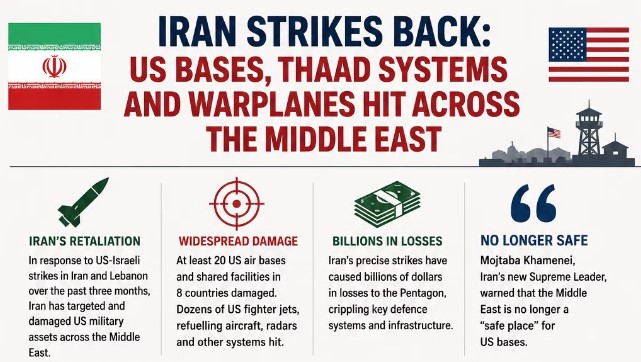
Iran strikes on US air bases across the Middle East have reportedly caused severe damage to American military facilities, air defence systems, surveillance aircraft, refuelling planes, and other strategic assets, raising fresh questions over Pentagon vulnerability.
In what is being described as a David versus Goliath-style confrontation, Iran has reportedly damaged at least 20 US air bases built across several countries in the Middle East. The attacks are also said to have destroyed or damaged dozens of fighter jets and other military aircraft, causing billions of dollars in losses to the Pentagon.
The damage reportedly extends beyond aircraft. Iran’s strikes are said to have affected state-of-the-art air defence systems, refuelling aircraft, radar facilities, and other key military infrastructure.
According to the BBC, the Shiite regime successfully targeted and damaged both US bases and shared military facilities in retaliation for US-Israeli strikes across Iran and Lebanon over the past three months.
On the other hand, the Pentagon has claimed that it has struck 13,000 targets since the beginning of Operation Epic Fury in February this year.

Iranian Missile Attacks
The gravity of the situation can be understood through the claim made by the newly appointed Supreme Leader, Mojtaba Khamenei.
In a statement, he said the Middle East was no longer a “safe place” for US bases.
Although President Donald Trump has repeatedly claimed that the US Air Force has wiped out the Iranian military, analysts say Tehran’s attacks have been more precise and have caused greater devastation than US officials have admitted.
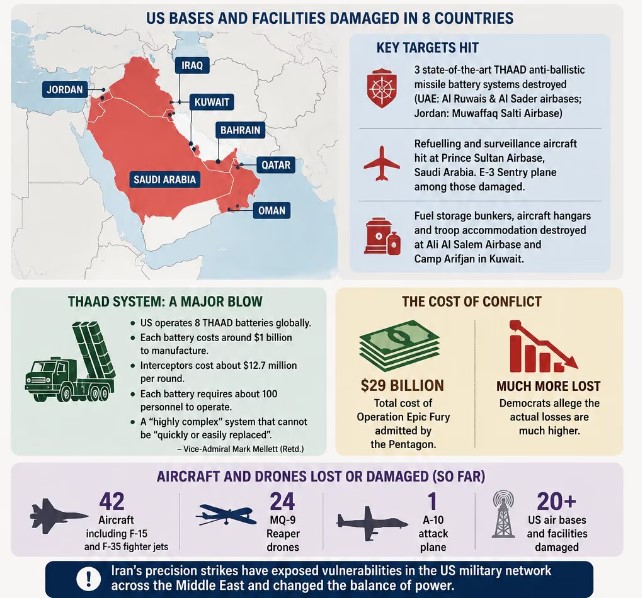
Using satellite imagery provided by international sources, BBC Verify has reported that US air bases and other facilities in Saudi Arabia, the United Arab Emirates, Qatar, Kuwait, Iraq, Jordan, Bahrain, and Oman have suffered severe damage.
It further stated that three advanced anti-ballistic missile battery systems at Al Ruwais and Al Sader airbases in the UAE, as well as Muwaffaq Salti Airbase in Jordan, have been destroyed.
The Pentagon operates eight Terminal High Altitude Area Defence, or THAAD, batteries around the world. Each system reportedly costs around US$ 1 billion to manufacture, while the interceptors it fires cost around US$ 12.7 million per round.
Each THAAD battery requires a crew of about 100 personnel to operate.
Speaking to BBC Verify, Vice-Admiral Mark Mellett, the former head of the Irish Defence Forces, said these batteries are at the heart of a “highly complex” regional defence network that cannot be “quickly or easily replaced.”
THAAD Systems And Aircraft Hit
According to the BBC, Iranian strikes have also heavily damaged US refuelling and surveillance aircraft at Prince Sultan Airbase in Saudi Arabia.
Satellite images reportedly show damaged aircraft and smoking craters. One of the aircraft has been identified as an E-3 Sentry surveillance plane, which US media reports say could cost up to US$ 700 million to replace.
BBC Verify has also reported that Iran targeted Ali Al Salem Airbase and Camp Arifjan in Kuwait, where fuel storage bunkers, aircraft hangars, and troop accommodation facilities were destroyed.
It remains too early to calculate the full cost of the facilities damaged in the Iranian attacks. However, the Pentagon has reportedly admitted that the total cost of Operation Epic Fury stands at US$ 29 billion.
That amount may be needed for the “repair or replacement of the equipment” destroyed during the conflict.
Democrats allege that the real cost of losses in the conflict may be far higher.
It has also been reported that at least 42 aircraft, including F-15 and F-35 fighter jets, 24 MQ-9 Reaper drones, and an A-10 attack plane, have been destroyed or damaged so far.
SOURCE :- MAWRATANEWS.LK