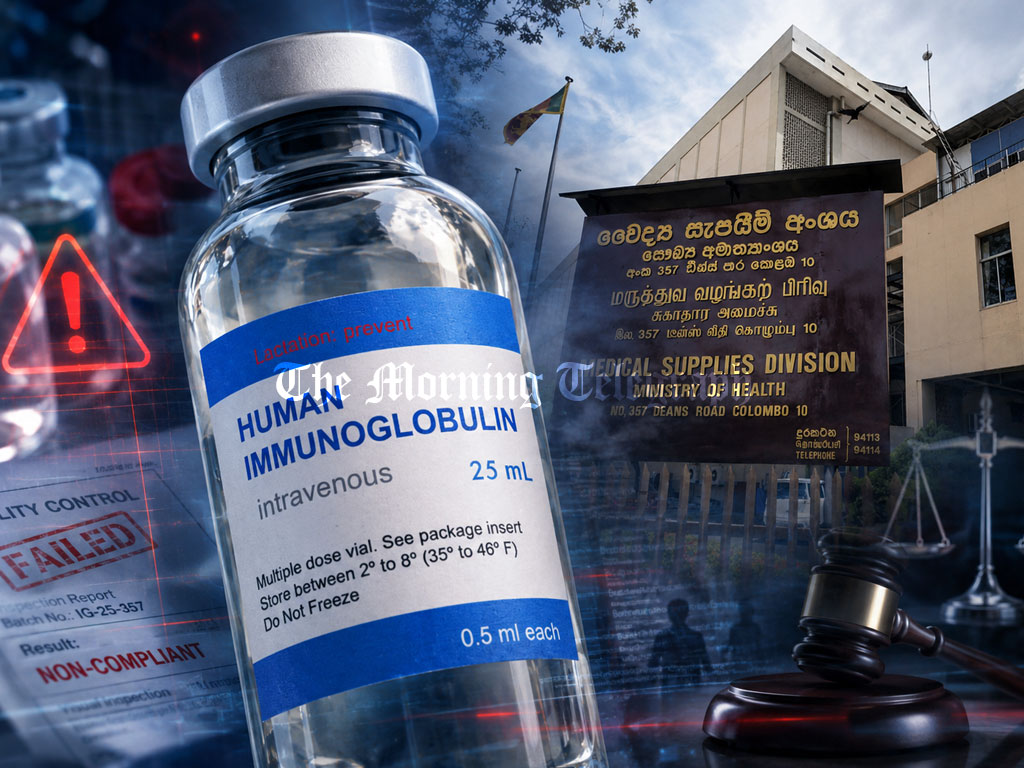
Substandard drugs case exposes prosecution errors, withdrawn evidence, and digital data disputes in Rs. 144 million High Court trial.
The substandard drugs case involving Immunoglobulin and Rituximab has exposed serious prosecution setbacks, with document errors and evidence contradictions surfacing before the High Court.
The controversial trial concerns the alleged fraudulent supply of substandard drugs to the Health Department, resulting in the suspected misappropriation of more than Rs. 144 million in public funds.
The case was once again taken up before a permanent three-judge High Court bench, where serious weaknesses and multiple contradictions in the prosecution’s filing of evidence were brought to the attention of court.
The matter was heard yesterday, June 2, before a bench comprising Justices Priyantha Liyanage, Chairman, Viraj Weerasuriya, and Thilakaratna Bandara.
The day’s proceedings were marked by the defence raising a serious credibility issue over the manner in which the prosecution had handled documents and evidence.

Prosecution Admits Filing Error
At the start of the trial, Deputy Solicitor General Lakmini Girihagama, appearing for the prosecution, apologized to court after admitting that a document she had presented the previous day had been mistakenly transferred and filed.
She requested the court’s permission to correct the error.
Defence lawyers strongly objected, stating that the situation had reached a point where documents presented by the prosecution could no longer be trusted.
After considering submissions from both sides, the Chairman of the bench ordered that the error be corrected and noted accordingly.
Analyst Reports Raise Fresh Questions
The prosecution’s weaknesses were further highlighted when objections were raised regarding three Government Analyst reports, numbered 194, 197, and 198.
The prosecution had failed to clearly specify which case exhibits corresponded to the reports noted on the back of the indictment.
The prosecution later corrected the facts before court.
Report No. 194 was said to relate only to Item 8 of the notice dated 2025/12/01, involving a flash drive allegedly provided by the 8th accused.
Report No. 197 was linked to Item 10 of the notice, identified as Case Exhibits 73 and 74.
Report No. 198 was connected to Item 9 of the notice, identified as Case Exhibit 110.
Access To Flash Drive Disputed
A critical issue then emerged over the flash drive allegedly provided by the 8th accused.
It was strongly questioned why the other accused had not been granted access to that material.
The defence argued that, under the provisions of the Evidence Ordinance, access should also be provided to the other accused.
As a result, the prosecution informed court that it would not present Government Analyst Report No. 198, which related to the item submitted by the 8th accused, as evidence.
This was seen as a major setback for the prosecution’s case.
Pronto System Evidence Examined
The evidence of D.T. Thudugamuwa, a Questioned Documents Examiner attached to the Digital Unit of the Government Analyst’s Department, was then led.
He explained technical details relating to the Pronto software system used by the Medical Supplies Division, its backup server, and the method by which data had been extracted.
The witness confirmed that data entry operators did not have authority to modify or delete data in the system.
He further stated that even technical officers had only “view” access.
Digital Exhibits Opened In Court
The server computer designated as HD 219/24 was opened in court.
Identification was carried out by comparing the serial numbers of the relevant exhibits, including M1, the backup computer, M2, its key, M3, the external hard drive, and M4, the CD.
Daily and monthly stock reports covering 182 identified drugs with SR numbers, extracted from the system, were displayed in court as Excel files.
Fair Trial Concerns Raised
When the evidence was displayed on a digital screen, defence lawyers informed court that their clients could not see the screen and were therefore unable to receive proper legal advice.
Recognizing the right of the accused to a fair trial, the bench immediately arranged for the accused to be seated where the screen was clearly visible.
The proceedings demonstrated how crucial documentary accuracy, digital evidence integrity, and chain of custody are in a serious financial fraud case involving multiple accused and complex electronic records.
The prosecution’s apology over a wrongly transferred document, together with the decision to withdraw Government Analyst Report No. 198 from evidence, highlighted significant inconsistencies in the prosecution’s process.
The case was adjourned until June 3 at 10:00 AM for further trial.
Case Report
2026/06/02
When the case concerning substandard Immunoglobulin and Rituximab drugs was taken up for hearing yesterday, Deputy Solicitor General Lakmini Girihagama submitted to the court at the very beginning of the proceedings that a document she had presented the previous day had been transferred and filed by mistake. She apologized to the court and requested permission to correct it.
Following her request, the defence lawyers stated that the situation had reached a point where the documents presented by the prosecution could no longer be trusted. After considering the submissions of both parties, Chairman Justice Priyantha Liyanage ordered that the error be corrected and noted accordingly.
Judge: Objections were raised regarding three Government Analyst reports, namely Nos. 197, 198, and 194, noted on the back of the indictment, because the prosecution had not informed the court which case exhibits these reports pertained to. When the prosecution presented facts, it stated that Report No. 194 pertained only to Item 8 of the notice dated 2025/12/01, a flash drive allegedly given by the 8th accused. Report No. 197 pertained to Item 10, Case Exhibits 73 and 74, while Report No. 198 pertained to Item 9, Case Exhibit 110.
When the trial began today, the prosecution requested an opportunity to correct the facts presented yesterday. The prosecution apologized to the court for the previous day’s submissions. Primarily, it was argued that access to the flash drive given by the 8th accused should also be provided to the other accused, who had not been given access. It was submitted that the prosecution was proceeding according to the Evidence Ordinance despite this lack of access. Additionally, it was argued on behalf of the 2nd accused that there was doubt as to which case exhibits the items mentioned by the Government Analyst pertained to.
However, the facts corrected today state that Government Analyst Report No. 194 pertains only to Item 8 of the notice.
According to Government Analyst Report No. 198 mentioned in paragraph 2, there is no change in the case exhibits. Accordingly, the difference in the numbers of the Government Analyst reports corrected today from those mentioned yesterday is that no other fact was presented. It cannot be concluded that any prejudice is caused by correcting these numbers. Furthermore, the prosecution stated today that Report No. 198, pertaining to the item submitted by the 8th accused, would not be presented as evidence by the Government Analyst on behalf of the prosecution.
The Attorney General filed this case against the defendants on 14 charges, including conspiracy to fraudulently prepare and supply the drugs Rituximab and Human Immunoglobulin to the Health Department in Colombo between September 2, 2022, and September 4, 2023, and the fraudulent misappropriation of Rs. 144,293,357.32.
This case is being heard before a permanent three-judge High Court bench comprising Justices Priyantha Liyanage, Chairman, Viraj Weerasuriya, and Thilakaratna Bandara.
The defendants named are Isoles Biotech Pharma owner Sudath Janaka Fernando, Director of the Medical Supplies Division, Dr. Kapila Wickramanayake, Assistant Director of MSD, Pees Devashanthini Solomon, Accountant of MSD, Marakkalage Niran Dhananjaya, Stock Controller of the unit, Maha Madawachchi Wasantha Kumara, former Health Secretary S.H. Janaka Chandragupta, Deputy Director General of the Health Ministry, Herath Mudiyanselage Dharmasiri Rathnakumara Herath, former Health Minister Keheliya Bandara Rambukwella, Medical Officer of the MSD, Butpitiya Lekamalage Don Jayanath, Additional Secretary of the Drug Regulatory and Supply Unit, Rathnayake Mudiyanselage Saman Kusumsiri Rathnayake, Deputy Director of the MSD, Arachchige Thusitha Sudarshana, and former CEO of the National Medicines Regulatory Authority, Dr. Wijith Gunasekara.
Subsequently, under the guidance of the Deputy Solicitor General, the witness from the Government Analyst’s Department, Questioned Documents Examiner Ekanayake Mudiyanselage Dinesh Thikshana Udangamuwa, testified as follows:
DSG: What is data identification?
Witness: If an investigation is requested through a covering letter, it involves identifying the necessary data. For example, consider a shop’s software. If something suspicious has occurred, data such as stock data and invoice data is identified. That is done through the system.
DSG: Are there other methods?
Witness: If the software from an active server can be obtained, it is copied. Otherwise, it is obtained through HQL queries. The most practical method is to take the backup server computer to the laboratory as a case exhibit for examination.
DSG: What is a backup server?
Witness: When software is running, the primary server may fail. To prevent business interruption, a server computer is activated.
DSG: Is it correct to say that a backup runs as a helper to the live server?
Witness: Agreed.
DSG: Is the information in both identical?
Witness: To check whether the amount of information is identical, the number of rows containing data can be counted to see whether they are the same.
DSG: What is verification?
Witness: It is a method used to check whether they are identical.
DSG: Why is it more suitable to bring the backup to the laboratory?
Witness: Instead of going to the premises to examine data for further study, it can be examined in the laboratory over time.
DSG: How is data brought to the backup?
Witness: Different institutions follow different methods.
DSG: Do those entering this data have the authority to change it?
Witness: Those entering data do not have the authority to change or delete it. Even technical officers were given only viewing access.
DSG: Can data be uploaded via an HQL query?
Witness: Yes. Due to the slow state of this data system, uploading data was not possible even after more than five hours. Later, after checking the infrastructure, we went to the MSD’s Lite server. Accordingly, a copy of the Lite server was added to the backup server via the backup and HQL query and examined.
We identified a backup copy relevant to March 4, 2024. We identified that the row count of the data server and the row count of a backup were equal.
DSG: Was it decided to bring it to the laboratory afterwards?
Witness: Yes.
DSG: In this investigation, four case exhibits are presented: a backup server, a hard drive, a key, and another item. What is that other item?
Witness: A Pronto Manual User from the MSD that should activate the backup server.
DSG: Was a key taken as a case exhibit?
Witness: Yes, Your Honour.
After the lunch recess, when the case resumed, a lawyer appearing for the 12th accused requested permission for her client to attend a clinic at the National Hospital tomorrow for medical treatment. The court granted permission and stated that a formal request should be made tomorrow.
Witness resumes testifying
DSG: You gave evidence regarding taking over case exhibits under Communication 297. Did you tell the CID on 2024/04/08 to send it to the laboratory? What does Communication 297 contain?
Witness: M1 is the server computer. M2 is its key. M3 is the external hard drive. M4 is the CD. An error in M3 was corrected and obtained.
DSG: Where were the case exhibits taken over?
Witness: In other laboratories of the Government Analyst’s Department, case exhibits are taken over after being sealed. However, in the Digital Unit, we break the seals and examine the exhibits in the presence of the officers who bring them to our laboratory, and then issue the communication.
DSG: Did the case exhibits you examined on 2024/04/08 have serial numbers?
Witness: Yes. Whether we take any case exhibit or the police take it, they are taken with serial numbers. If the serial numbers are typed with printing errors, the communication is issued with the number on the case exhibit. The covering letter through which they were received had printing errors.
DSG: When did you start copying data from the case exhibits?
Witness: I started after April 17, 2024, as instructed by officers of the MSD. I created a query, copied the data, and arranged it in a comprehensible manner.
DSG: You started investigations regarding 182 drugs.
Witness: These were in the database. An attempt was made to run it at the MSD on a previous day. Later, other computers and data were uploaded to Excel files.
DSG: What was meant by “upgrading the backup computer”?
Witness: It was upgraded to make the data accessible.
DSG: What information did the Magistrate request from you?
Witness: Information regarding 182 drugs identified with SR numbers.
DSG: What was your methodology for that?
Witness: We cannot do it all at once. The stock received and issued by the MSD must be added as “+” and “-”.
The MSD’s server computer, designated as HD 219/24, was opened in front of the bench.
DSG: When checking whether M1 is the backup computer, did you check it?
Witness: Yes.
DSG: Did the serial number match?
Witness: Yes.
DSG: Is this the backup computer of this Pronto system?
Witness: Yes, Your Honour.
DSG: Can the M3 hard drive be identified?
Witness: It can be identified by the serial number. The cable, key, and CD were also identified by the witness.
A report prepared by the witness, contained on a CD and designated as Communication 297 I, was displayed on a digital screen via a laptop for everyone in court to see.
DSG: What are the two files in this report?
Witness: The daily stock report and the monthly stock report.
DSG: What are the examinations in the daily stock report in the first folder?
At this point, defence lawyers informed the court that their clients could not see the digital screen and therefore could not give them further advice. Accordingly, after allowing the accused to sit where they could see the screen, the trial resumed.
DSG: There is data under four tabs here. What are they?
Witness: The daily stock of the MSD from September 1 to 30, 2022; the institutional stock for that period; the institutional stock of the MSD, National Stock; and a tab maintained as a precautionary measure to prevent computer errors.
Further evidence was obtained regarding these four tabs, and the case was adjourned until yesterday, June 3, at 10:00 AM.