Roy Denish
A devastating fire at a Horana elders’ home killed 12 vulnerable residents, exposing urgent questions over safety, negligence, emergency response, and the forgotten dignity of Sri Lanka’s elderly.
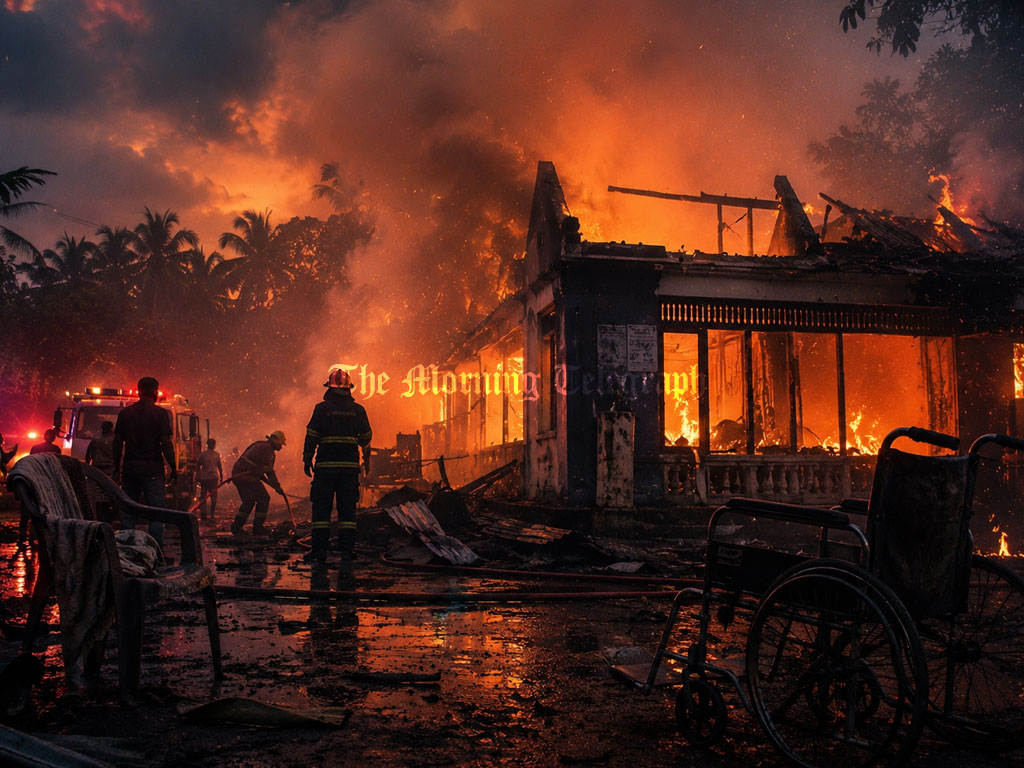
The late afternoon sun usually brought a gentle, predictable quiet to the Mawpiya Sewana elder care home in Batagoda Galpatha. Affectionately known by its residents as Senehase Kædælla, or the Nest of Affection, the facility was a sanctuary for nearly seventy-two elderly souls.
For many, it was the final harbor after lifetimes of storm, while for others, who carried the quiet, fractured worlds of mental disabilities, it was a rare place of predictable routine. The elders’ home had gained widespread recognition in recent years through social media platforms, particularly TikTok, where videos showcasing the daily lives of its residents regularly attracted large audiences.
From birthday celebrations and festive gatherings to light-hearted moments between staff and residents, the content earned the facility a devoted online following and transformed many of its elderly residents into familiar faces among social media users. On this particular Wednesday afternoon of June third, the veranda was filled with the low hum of old age.

In the main hall, rows of heavy wooden and plastic chairs held men and women whose bodies had long since betrayed them. Some dozed, heads tilted toward their chests, while others stared blankly through the open windows, watching the shadows lengthen across the Horana landscape. Among them sat an eighty-two-year-old former carpenter whose legs had been rendered useless by a stroke year prior, whom we will call Podi Mahaththaya, though this and other names used for the victims are not their actual names. Next to him was a frail woman given the fictional name Premawathi, who spent her days rocking rhythmically, murmuring prayers only she could hear. They were waiting for the evening tea, waiting for the twilight of their lives to pass in peace, with no way of knowing that twilight was about to be violently stolen.
It began without a scream. Somewhere in the structure of the facility, a sharp snap pierced the air, and a fire erupted, rapidly engulfing sections of the home and triggering a large-scale emergency response. Within seconds, a thin ribbon of black smoke snaked along the ceiling, and by the time the first attendant noticed, the ribbon had become a wall.
A cry to get out shattered the afternoon stillness, instantly dissolving the sanctuary into a theater of panic. But panic requires momentum, and for the residents of Senehase Kædælla, momentum was a luxury they no longer possessed. The fire did not crawl, it leaped. Fed by old mattresses, wooden rafters, and the dry heat of the afternoon, the flames transformed the wing into a roaring furnace in a matter of minutes. Thick, toxic columns of black smoke rolled into the main hall, choking the air and blocking out the sunlight. The intensity and speed of the fire complicated rescue operations severely.
Inside the hall, the scene became a living nightmare. For a healthy person, escaping the room would have taken mere seconds, but for the residents, it was an insurmountable mountain. Podi Mahaththaya gripped the armrests of his chair. His mind, sharp beneath his silver hair, screamed at him to stand, to run, to survive.
He leaned forward, straining every muscle in his back, but his useless legs refused the command. Around him, the room was dissolving into a haze of orange and black. He could hear the terrifying roar of the ceiling collapsing just one room over. Beside him, Premawathi had stopped rocking. The smoke had found her lungs, forcing her into a violent fit of coughing. She reached out a trembling, wrinkled hand, grasping blindly through the smog. Her eyes, wide with a sudden, tragic clarity, met his, but there was no strength left to cry out, only the realization of absolute helplessness.
The heat grew intolerable, blistering the paint on the walls and scorching the very air they breathed. Because of their severe physical limitations and mental frailties, many could not comprehend the monster bearing down on them. Some froze, paralyzed by terror, while others simply closed their eyes, lacking the physical strength to even lift themselves from the chairs that held them captive.
Outside, the Anguruwatota Police, firefighters, medical personnel, and local villagers from Millaniya descended upon the inferno. The heat radiating from the building was so intense it singed the eyebrows of the first rescuers who tried to breach the doors. Young men from the village, driven by desperation, smashed the glass perimeters. Thick billows of suffocating smoke poured out, blinding them. Attendants and police officers lunged into the blackness, operating entirely on instinct. They grabbed whomever they could touch, including shuffling grandmothers, terrified grandfathers crying out for long-dead parents, and those too dazed to move. A young officer hoisted a frail woman onto his back and sprinted away from the collapsing roof, shouting for her to hold on tight. It was a frantic, agonizing numbers game. Emergency teams managed to evacuate dozens of occupants, with forty-four residents reportedly escaping the jaws of the fire without physical injuries, thrown onto the grass outside where they lay gasping, weeping, and covered in soot. But inside, the heart of the Nest of Affection had become an inescapable tomb.
By the time the fire brigade and the community finally managed to subdue the raging monster, the afternoon sun had set, replaced by the grim, flickering red lights of emergency vehicles. The air smelled of burnt timber, ash, and an underlying, stomach-turning tragedy. When the police and rescue workers finally stepped through the smoking ruins of the main hall, they were met with a sight that would haunt them for the rest of their days. The most poignant, devastating reality of the disaster lay in how death had claimed its victims. Twelve elderly residents had not perished while running for the doors, nor had they died fighting. They had been burnt to death in the very chairs they had been sitting in when the fire began. Subsequent searches led to the discovery of multiple victims within the building, raising concerns that the final death toll could change, as authorities continue searching for three individuals who remain unaccounted for in the aftermath of the disaster. The flames had moved with an inhumane velocity, but it was the profound physical vulnerability of the victims that sealed their fate. They had released their last breaths into the scorching air, trapped in a seated posture, unable to take even a single step toward survival.
As twilight finally gave way to night, the grounds of the Horana District Hospital and the Galpatha Regional Hospital were filled with the chaotic sounds of medical emergencies. Seven residents who sustained injuries were urgently admitted and are receiving treatment, though the condition of the injured has not yet been officially disclosed. Back at Batagoda Galpatha, the smoking shell of Senehase Kædælla stood silent against the night sky. News of the tragedy prompted a massive outpouring of grief online, with thousands of followers expressing shock, sorrow, and condolences. Many shared memories of the home’s uplifting videos and paid tribute to the residents whose warmth and humor had touched audiences across the country and beyond.
Meanwhile, relief efforts remain underway. Fifty-one displaced residents have been relocated to temporary accommodation at Batagoda Primary School, where arrangements have been made to provide shelter, food, and essential support until longer-term solutions can be identified. Investigators have yet to determine the cause of the fire, and specialists are expected to examine the scene in detail to establish how the blaze began and whether any structural, electrical, or safety-related factors contributed to the disaster. (Although initial investigations has revealed, the fire started due an explosion triggered by a gas cylinder). A magistrate’s inquiry is scheduled to take place as part of the legal process, while findings from the Judicial Medical Officer are expected to assist authorities in determining the precise causes of death and confirming the identities of the victims. Horana Police, together with other relevant agencies, are continuing investigations into the incident as the community comes to terms with a tragedy that has deeply saddened both local residents and the many people who followed the home’s residents through social media. They had come to this place to spend the final chapters of their lives in comfort, shielded from the harshness of the world. Instead, twelve of them had been forced to leave it in a manner so tragic, so cruel, that no one could have ever anticipated it. The government is yet to response, as the nation mourns the broken Nest of Affection, leaving behind only ash, empty chairs, and a sorrow that hangs heavily over the entire country.
The Sri Lanka Police have deployed three separate investigative teams specifically to ascertain the root cause of the devastating fire at the Senehase Kedella elders care home in Horana and to check for any institutional negligence. Forensic experts from the Government Analyst’s Department along with the Horana Magistrate have visited the scene to inspect the debris, collect forensic evidence, and officially determine what triggered the blaze. Following the magistrate’s initial on-site inquiry, authorities are executing formal post-mortem examinations via the Judicial Medical Officer before releasing the victims’ bodies to their families.
The death toll has risen to 12 in the disaster. While 10 victims died at the scene and two more succumbed to their injuries later, police and relief teams continue searching the heavily damaged structure as three residents remain unaccounted for. Hospital administrators at the Horana District Hospital are monitoring the surviving injured residents, where seven individuals continue to receive intensive care and treatment for severe burn injuries and smoke inhalation.
Authorities initially evacuated and sheltered 51 uninjured or stabilized survivors at the Batagoda Primary School to provide immediate relief. Because the facility also housed individuals with specialized mental health conditions, local social services and district officials are working to relocate the displaced elderly permanently to more secure, state-vetted care facilities.