By Roy Denish
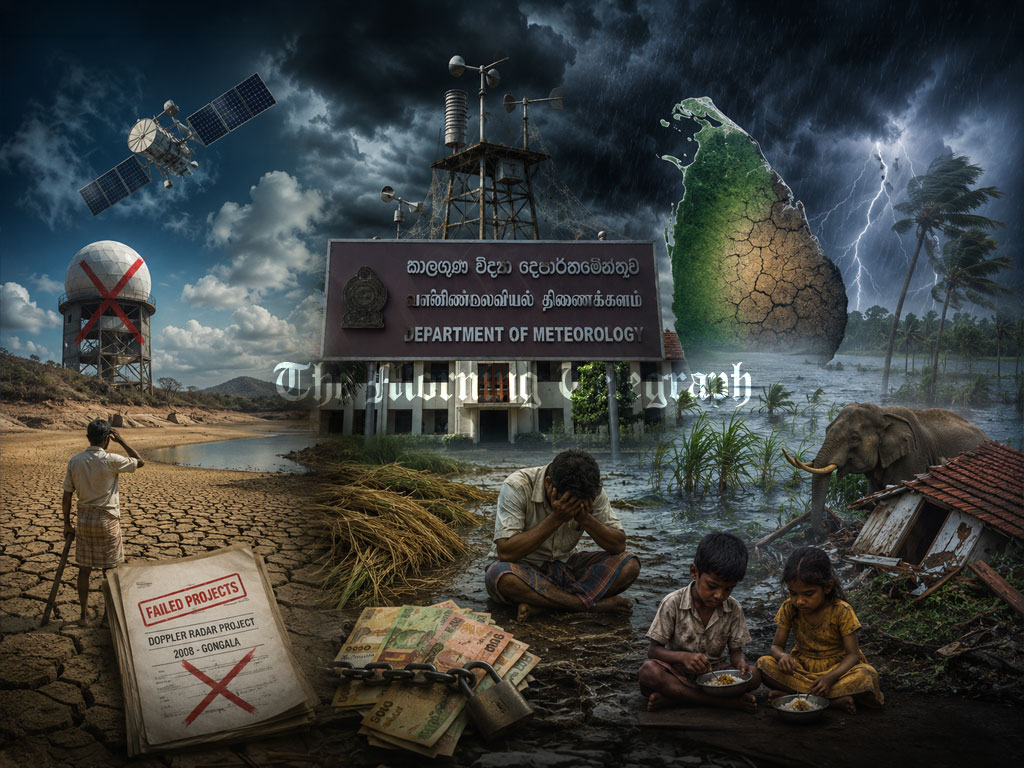
The Sri Lankan Department of Meteorology has become notorious for its highly unpredictable and frequently inaccurate weather predictions, leaving the public and farming communities completely unprepared for severe weather shocks. This institutional failure is deeply rooted in the continuous use of severely outdated equipment and obsolete technology. Most critically, Sri Lanka still does not possess a single operational Doppler weather satellite or radar system to monitor its skies. For nearly two decades, procurement efforts to establish a Doppler system have been derailed by bureaucratic missteps, administrative negligence, and multi-million rupee losses, including a failed 2008 radar installation in Gongala and stalled subsequent initiatives.
The predictable rhythm of the monsoons has long served as the lifeblood of Sri Lanka. For generations, the agricultural heartland of this island nation operated with a deep understanding of the natural cycles, organized around the two primary cultivating seasons known as the Yala and Maha monsoons.
Today, that ancient predictability has completely fractured. Across the vast northern plains, the central highlands, and the fragile coastal belts, a devastating confluence of escalating climate changes, unchecked ecological degradation, and short-sighted government land policies is driving rural communities toward systemic collapse. This crisis is unfolding within a complex global environment marked by deep ideological shifts.

While vulnerable nations grapple with immediate, existential environmental threats, global climate leadership remains fractured. The legacy of climate change skepticism, most notably exemplified by the political stance of Donald Trump, his recurrent characterization of global warming as a scientific hoax, and his administration’s historic withdrawal from the Paris Climate Agreement continues to cast a long shadow over international climate mitigation efforts. When major industrialized carbon emitters deprioritize international accords, the financial and structural burden of climate disasters shifts heavily onto developing island states like Sri Lanka. In these fragile ecosystems, the consequences of global climate denial are felt on the ground in the form of ruined harvests, encroaching wilderness, rising poverty lines, and a generation of malnourished children.
The macroeconomic shockwaves rippling through Sri Lanka’s rural provinces can be evaluated through the lens of international development frameworks like the Monterrey Consensus. The baseline logic of the Monterrey value emphasizes that a developing nation’s path toward sustainable development and macroeconomic stability depends entirely on the financial viability, structural resilience, and internal resource mobilization of its domestic production systems. For Sri Lanka, that internal capacity is intrinsically bound to its agrarian economy, which employs nearly a third of the national workforce and sustains the food supply of over 22 million people. When climate disruptions destabilize this primary sector, the entire economic foundation envisioned by global development models begins to erode.
Smallholder farming systems are highly susceptible to sudden environmental changes. The capital invested by farmers in seed, fertilizer, fuel, and labor represents their entire household net worth, often supplemented by informal, high-interest loans. When unpredictable weather cycles cause a total harvest failure, the economic value generated by the agrarian sector plummets, triggering a cascade of defaults that destabilizes rural banking networks, dries up local markets, and forces the state to divert scarce national funds toward emergency relief rather than long-term development infrastructure.
For the average Sri Lankan farmer, the primary manifestation of climate change is the near-total loss of operational predictability. Rice cultivators and smallholder vegetable growers are increasingly caught in a climate pincer, alternating between severe, prolonged droughts and sudden, catastrophic flash floods. The traditional calendar, which dictated precise dates for tilling, seeding, and harvesting, has been rendered obsolete.
During dry spells, major agricultural reservoirs sink to dead storage levels, forcing regional authorities to restrict water distribution and spark intense disputes between communities over irrigation rights. Conversely, when the rains do arrive, they increasingly take the form of hyper-intense, short-duration deluges. These intense rain events overwhelm aging irrigation canals, wash away expensive fertilizers, and submerge thousands of acres of ready-to-harvest paddy fields. Smallholder farmers, who typically cultivate plots of land smaller than one hectare, have no financial buffer against these back-to-back losses. A single failed season wipes out their thin operating margins, trapping families in deep cycles of debt and accelerating a desperate flight from traditional agriculture.
Worsening this agricultural instability is the stark reality that Sri Lanka remains functionally blind to incoming atmospheric hazards due to a chronically crippled national forecasting system. The Sri Lankan Department of Meteorology has become notorious for its highly unpredictable and frequently inaccurate weather predictions, leaving the public and farming communities completely unprepared for severe weather shocks. This institutional failure is deeply rooted in the continuous use of severely outdated equipment and obsolete technology. Most critically, Sri Lanka still does not possess a single operational Doppler weather satellite or radar system to monitor its skies.
For nearly two decades, procurement efforts to establish a Doppler system have been derailed by bureaucratic missteps, administrative negligence, and multi-million rupee losses, including a failed 2008 radar installation in Gongala and stalled subsequent initiatives. Without the real-time atmospheric tracking data, wind-speed measurements, and rainfall intensity metrics that a Doppler system provides, national forecasters are left relying on coarse, generic satellite imagery and obsolete predictive models. This severe technological gap creates a permanent blind spot, making it impossible to predict the rapid intensification of localized storms or the sudden shifts of monsoonal fronts. Consequently, farmers receive late, vague, or actively conflicting weather warnings, leaving them entirely unable to safeguard their crops, manage irrigation gates, or evacuate livestock before disaster strikes.
The crisis in the countryside is further compounded by a severe ecological imbalance, where climate shifts are actively accelerating habitat degradation and driving wild flora and fauna into direct conflict with human settlements. As natural forest covers experience shifting rainfall patterns and prolonged thermal stress, the resilience of native ecosystems declines, opening the door for aggressive invasive alien plant species. Fast-growing exotic invaders—such as hard milkwood, Lantana camara, and Mesquite are rapidly colonizing disturbed forest margins, tank villages, and abandoned agricultural lands.
These invasive plants choke out native vegetation, alter local soil chemistry, and deplete limited groundwater reserves. In dry-zone reservoirs and wetlands, the spread of invasive aquatic weeds blocks irrigation channels and disrupts local inland fisheries, adding another layer of economic strain to communities already struggling with climate-induced crop failures.
Concurrently, the degradation of natural habitats is fueling an unprecedented escalation in human-wildlife conflict. As natural watering holes and foraging grounds dry up in the interior forests, wild animals are forced to venture deep into human-dominated landscapes in search of sustenance. The human-elephant conflict has reached historic highs, with wild herds routinely moving through rural villages, trampling crops, destroying grain stores, and demolishing homes.
It is no longer just elephants; farmers across the island report massive crop losses due to foraging troops of macaques, purple-faced langurs, and rapidly expanding populations of peacocks, which have emerged as major agricultural pests in the dry zone. This ecological encroachment creates an environment of constant insecurity, where farmers must risk their lives nightly to guard their fields against wildlife incursions, only to see entire seasons of labor destroyed in a matter of hours.
The vulnerability of the rural landscape is severely worsened by poorly planned man-made structures that cut across natural drainage pathways. Over the past few decades, Sri Lanka’s rural and semi-urban landscapes have seen a rapid expansion of concrete infrastructure, ranging from ad-hoc commercial buildings and raised highway embankments to private boundary walls built directly on floodplains. Many of these structures are built without conducting comprehensive hydrological impact assessments.
When extreme rainfall events occur, these elevated roads and concrete foundations act as artificial dams, blocking the natural flow of surface runoff toward rivers and reservoirs. Instead of draining safely across the landscape, water is backed up into adjacent villages and agricultural fields, turning moderate rains into prolonged, destructive floods. This artificial flooding waterlogs the root systems of sensitive crops, triggers localized soil erosion, and contaminates village drinking wells with agricultural runoff and sewage.
The lack of strict zoning enforcement and the failure to preserve traditional flood retention wetlands mean that the physical infrastructure intended to catalyze development often ends up destroying the climate resilience of neighboring farms.
The underlying structural driver of this ecological and economic instability is a long history of ad-hoc land governance, often dictated by political survival rather than scientific planning. In Sri Lanka, state land is an invaluable political currency. Ahead of national and regional elections, successive administrations have frequently bypassed environmental regulations and sustainable land-use planning to implement large-scale state land alienation programs aimed at appeasing key voter blocks.
Vast tracts of ecologically sensitive state land including vital forest reserves, wildlife corridors, and critical watershed areas—have been alienated, subdivided, and handed over to individuals for ad-hoc agricultural expansion, commercial ventures, or political settlement schemes. These land grants are routinely executed without conducting comprehensive feasibility studies, strategic environmental assessments, or soil stability analyses.
The consequences of this politically motivated land distribution are disastrous. Distributing steep slopes in the hill country for ad-hoc cultivation destroys the stability of the soil, triggering catastrophic landslides during the monsoon seasons. In the dry zone, clearing isolated forest patches for political settlements fragments natural wildlife corridors, trapping elephant herds in pockets of developed land and ensuring perpetual, violent clashes with new settlers. By prioritizing short-term electoral gains over scientific land management, ad-hoc state policies are actively dismantling the natural defenses that shield rural communities from climate shocks.
The ultimate measure of this systemic failure is its human cost, written in the steady impoverishment of rural families and a deepening public health crisis among their children. As climate volatility, wildlife conflicts, and political mismanagement combine to erode agrarian incomes, a significant portion of the rural population is sliding below the national poverty line.
The loss of agricultural livelihoods has triggered an economic regression in the provinces. Families are increasingly adopting desperate coping mechanisms: cutting back on essential healthcare, pulling older children out of school to work as day laborers, and severely reducing the quality and frequency of their daily meals. For households already living near the economic margin, a single major climate shock—like a destroyed harvest or a house demolished by a wild herd permanently strips away their financial independence, cementing their place below the poverty threshold.
This economic decline has triggered a critical developmental crisis for the next generation. Across Sri Lanka, approximately 42 percent of children under the age of four are living in multi-dimensional poverty a comprehensive measure that tracks acute deficiencies in early childhood development, healthcare access, clean sanitation, and basic living standards.
The most immediate and dangerous manifestation of this poverty is the sharp rise in child malnutrition. Recent public health data shows that nearly 17 percent of young children across the island suffer from chronic malnutrition, displaying alarming rates of stunting and wasting. This physical wasting is a direct consequence of prolonged food insecurity, as soaring inflation and collapsing farm incomes make essential, nutrient-rich foods like milk, eggs, pulses, and fresh proteins completely unaffordable for rural parents.
The long-term implications are devastating: a generation of children is growing up with compromised immune systems and permanently impaired cognitive development, trapping the future workforce in a continuous cycle of low productivity and multi-dimensional deprivation.
The systemic breakdown of Sri Lanka’s rural heartland is not an inevitability of nature, but the predictable consequence of a compounded failure of governance. While the accelerating impacts of climate change present an existential threat, the true catastrophe lies in how these environmental stresses are magnified by short-sighted human actions on the ground.
The reality is that the nation’s natural climate resilience has been systematically traded away for short-term political survival and ad-hoc infrastructure development. When administrations hand over vital ecosystems and forest reserves to appease voter blocks, they are not helping the poor; they are stripping the landscape of the natural watersheds and buffers that protect those very citizens from climate disasters.
When concrete structures are allowed to block natural floodplains without hydrological oversight, development becomes an engine for environmental destruction. This local ad-hocism is worsened by leaving the national meteorological service under-funded and technologically starved, effectively leaving the entire agricultural population blind to the weather.
Furthermore, this internal mismanagement operates under a global cloud of climate change skepticism, where the failure of major industrialized nations to sustain real environmental commitments deprives vulnerable island states of the global safeguards and financial support they urgently require.
Sri Lanka stands at a critical historical turning point. Continuing down the current path of ad-hoc land distribution, uncoordinated infrastructure spending, and blind, reactive crisis management will guarantee the continued erosion of the agricultural economy. This trajectory will push more families below the poverty line and lock future generations into a cycle of chronic malnutrition.
Mitigating this crisis requires a fundamental shift in governance. Land-use policy must be completely insulated from short-term political interference and realigned with strict, independent scientific assessments. Modernizing the national forecasting infrastructure by acquiring functional Doppler systems must be prioritized as an urgent national security necessity rather than an optional administrative upgrade.
Preservation of biodiversity corridors, aggressive containment of invasive flora, and the restoration of natural drainage networks must become central components of state planning. Globally, Sri Lanka and other vulnerable nations must form a unified diplomatic front to demand that major carbon-emitting economies honor their climate obligations, regardless of shifting political winds in foreign capitals.
The shadows lengthening over the island’s paddy fields are a stark reminder that when scientific planning is abandoned for political convenience, the ultimate price is paid by the most vulnerable segments of society.