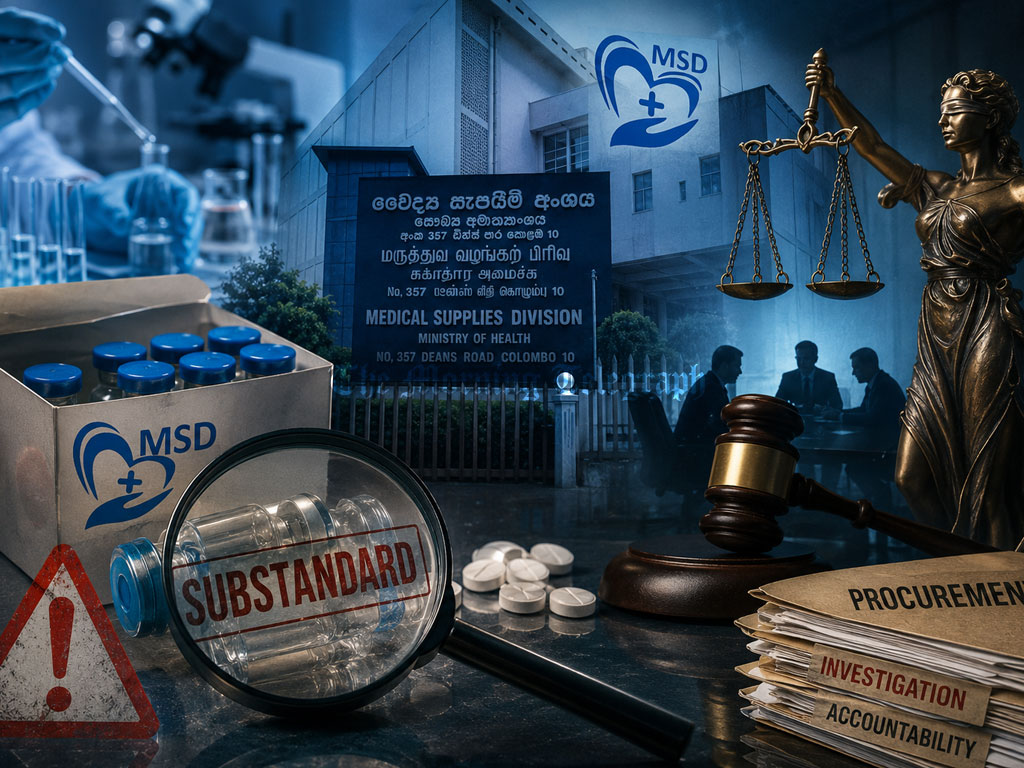
The Substandard Drugs case reveals gaps in procurement, quality control, and oversight as defence lawyers challenge key prosecution evidence.
The Substandard Drugs case being heard before the Permanent High Court Trial-at-Bar continued to expose deep-rooted weaknesses within Sri Lanka’s state health procurement system, with defence lawyers highlighting institutional loopholes, accountability gaps, and witness inconsistencies during proceedings on June 11.
A review of the court record from yesterday’s hearing suggests that the trial has evolved beyond a criminal case against a handful of accused individuals. Instead, it has become a broader examination of the structural deficiencies that exist within the country’s drug procurement and regulatory framework.
During the hearing, defence counsel Harendra Banagala and Asela Serasinghe, appearing for the first and second accused respectively, subjected Chief Stores Controller of the Medical Supplies Division (MSD), M. H. D. N. Bandara, to extensive cross-examination.
Their questioning raised significant concerns regarding transparency, accountability, and institutional coordination among state agencies responsible for medicine procurement and quality assurance. The proceedings were further intensified by a series of objections raised by Deputy Solicitor General Lakmini Girihagama, who leads the prosecution.

Questions Over Regulatory Coordination and Accountability
One of the key themes that emerged during the cross-examination was the apparent lack of coordination between the Criminal Investigation Department (CID) and the National Medicines Regulatory Authority (NMRA).
Defence counsel Harendra Banagala questioned whether the witness had provided a statement to the CID concerning the company at the centre of the case.
Bandara responded that he had not.
When asked whether similar incidents had been reported elsewhere, the witness stated that such matters were reported to the NMRA through the Quality Control Division.
Banagala then questioned whether the witness had refrained from giving a statement to the CID because reports were already being channelled through the NMRA.
No clear response was recorded from the witness.
The defence sought to highlight what it described as an institutional tendency to shift responsibility between agencies rather than ensuring comprehensive criminal investigations where irregularities are alleged.
The exchange also raised questions about whether potentially serious issues were confined to internal reporting mechanisms instead of being pursued through criminal investigative channels.
Debate Over Whether the Product Was a Drug or Raw Material
Another major aspect of the defence strategy focused on the classification of the imported substance and whether it should legally be considered a medicine or merely a raw material.
During questioning, Banagala challenged the basis upon which a hydrate-type compound had been categorised.
Bandara explained that the substance was a compound created by combining several raw materials and was intended for external administration to patients. He further stated that it was used in the preparation of a liquid and functioned as an external medication.
The defence then suggested that the combination of those ingredients ultimately produced a drug.
Bandara maintained that compounds used externally were not considered medicine and reiterated that the item was not classified as a drug but rather formed part of a standard procedure.
Through this line of questioning, the defence attempted to establish that certain products may have been processed under the category of raw materials, potentially bypassing stricter review procedures ordinarily required for pharmaceutical products.
The issue has emerged as one of the more significant procurement-related questions raised during the trial.
Admissions Regarding Quality Testing Facilities
Cross-examination by defence lawyer Asela Serasinghe focused heavily on the technical limitations of the state health sector and the ability of authorities to properly assess pharmaceutical quality.
One particularly significant exchange concerned laboratory testing capabilities.
Serasinghe asked whether, even by 2023, there was a fully equipped laboratory capable of conducting complete testing procedures.
Bandara acknowledged that, as of 2023, there was still no facility capable of carrying out comprehensive testing.
The admission may carry considerable implications for the prosecution’s case.
The defence is expected to argue that if adequate testing facilities did not exist, questions naturally arise regarding how product quality was verified and certified before procurement decisions were made.
The issue directly touches on the reliability of the quality assurance mechanisms that formed part of the procurement process.
Repeated Objections During Cross-Examination
A notable feature of the day’s proceedings was the frequency of objections raised by Deputy Solicitor General Lakmini Girihagama during defence questioning relating to procurement decisions and committee-level approvals.
In one instance, Serasinghe referred to approximately 180 drugs that had reportedly been submitted for consideration and questioned whether procurement had subsequently taken place under the Ministry of Health and the NMRA.
The prosecution objected immediately, prompting support from several other lawyers appearing in the matter.
The Chairman Judge then intervened and inquired how many lawyers were representing the second accused.
In another exchange, Serasinghe questioned the witness about procurement reference numbers and whether purchase orders had been issued following particular procurement decisions.
The prosecution again raised objections.
These repeated interventions suggested an effort by the prosecution to prevent the witness from commenting on procurement decisions or administrative matters beyond his direct knowledge and responsibility.
They also reflected ongoing attempts by the court to ensure that questioning remained within the scope of the charges before the Trial-at-Bar.
Key Weaknesses Highlighted During Proceedings
Several issues emerged during the hearing that may prove significant as the case progresses.
One of the most striking observations was the witness’s repeated inability to recall details regarding drug complications, reported deaths, or the identities of officers responsible for accepting goods.
Responses such as “I do not remember” and “I do not know” featured prominently throughout the cross-examination.
The defence used these responses to suggest broader institutional shortcomings and failures in accountability.
Questions were also raised regarding the gap between documented procedures and the physical process through which goods were received and recorded.
The defence scrutinised the handling of invoices, warehouse acceptance procedures, and the use of official seals and stamps, seeking to identify inconsistencies between paperwork and operational practice.
Another issue highlighted during the hearing was the fragmented nature of procurement responsibility.
Evidence presented before court pointed to responsibilities being spread across multiple bodies, including the Emergency Procurement Committee, NMRA, National Medicines Quality Assurance Laboratory (NMQAL), and the Medical Supplies Division.
The defence argued that this structure created a situation in which responsibility became dispersed, making it difficult to identify a single authority willing to accept accountability for procurement outcomes.
As the trial continues, the prosecution faces the challenge of establishing a strong evidentiary foundation supported by documentation, scientific analysis, and institutional records capable of overcoming defence arguments centred on procedural loopholes and administrative deficiencies.
Yesterday’s proceedings demonstrated that reliance solely on the recollection of officials may not be sufficient in a case of such magnitude and public importance, where questions surrounding accountability, regulatory oversight, and procurement integrity remain at the centre of one of Sri Lanka’s most closely watched criminal trials.
Court Record
2026/06/11
When the case concerning the importation of substandard drugs was called before the permanent three-judge High Court yesterday (11), Defence Lawyer Harendra Banagala, appearing for the first accused, began cross-examining the witness, M. H. D. N. Bandara, the Chief Stores Controller of the Medical Supplies Division (MSD) of the Ministry of Health.
Lawyer: You have a general note regarding the quality of a drug. It mentions that questions have arisen regarding drugs supplied by a certain company.
Witness: Regarding a company called Selegent Life Sciences, Your Honour. It was said that there was a quality issue concerning Human Immunoglobulin supplied by a supplier.
Lawyer: Do you know this company?
Witness: I have heard it is a pharmaceutical company.
Lawyer: Don’t you remember that there were problems with the drugs brought from it?
Witness: No, Your Honour.
Lawyer: According to you, since problems regarding drugs are reported daily, it is a normal thing.
Witness: Yes, such incidents are reported.
Lawyer: But is it normal for such things to be reported?
Witness: We have established a system. Reports are received through that.
Lawyer: Did you give a statement to the Criminal Investigation Department (CID) regarding this company?
Witness: No, Your Honour.
Lawyer: Within the existing system, even if problems arise, there is a reporting mechanism. Apart from this case, have others been reported?
Witness: They are reported to the National Medicines Regulatory Authority (NMRA) through the Quality Control division.
Lawyer: Do you admit that because reports are received through the NMRA, you did not give a statement to the CID?
(No clear answer was recorded from the witness)
Lawyer: Drugs have been issued to the MSD system. A notification has been made regarding that. Don’t you remember?
Witness: No, I did not do it, Your Honour. I do not know personally. They must have looked into it and taken action regarding the drug.
Lawyer: I say that you are an irresponsible state officer.
Witness: I reject that.
Lawyer: A state officer who answers while avoiding the question I ask.
Witness: No, Your Honour.
Lawyer: I asked about the documents considered when accepting goods. Under number 1 of document 307, what is there?
Witness: Proper certificate.
Lawyer: Where is “YES” written and sealed?
Witness: On the invoice.
Lawyer: If the relevant seal is placed and “YES” is written?
Witness: That means the medicine has been supplied.
Lawyer: How many counters are there in your institution for accepting drugs?
Witness: The relevant Stores Control division must be informed. Then the invoice must be brought and handed over to the Stores Control Officers.
Lawyer: After checking the stock, to whose custody is it taken?
Witness: To the warehouse, Your Honour.
Lawyer: Is it accepted into the warehouse in the presence of the Stores Control Officers?
Witness: It is taken into the warehouse of the Medical Supplies Division.
Lawyer: Can the supplier go to the warehouse?
Witness: The supplier is the one who brings it to the warehouse and hands it over, Your Honour.
Lawyer: The officers accepting the goods, after checking the relevant documents including the invoice and being satisfied, then accept.
Witness: That is a simultaneous process, Your Honour.
Lawyer: The matter of the Stores Control Officers accepting is over.
Witness: Yes, Your Honour.
Lawyer: Your Medical Supplies Division carries out stock acceptance and drug issuance. How many drugs do you take? Do you take surgical items?
Witness: About 300 drugs, about 4,000 surgical items.
Lawyer: Does the Medical Supplies Division manufacture them?
Witness: No, Your Honour.
Lawyer: Is there a drug list marked as 1 on page 250 of P 210 I? You were asked about 104 drugs, weren’t you?
Witness: Yes, Your Honour.
Lawyer: You were also asked about raw materials, weren’t you? Your answer was that you do not take raw materials. Are raw materials not taken for drug manufacturing? Why is this hydrate type named as a raw material?
Witness: It is a compound made by combining several raw materials to be given externally to patients. It is used to prepare a liquid. It is an external medication.
Lawyer: That means a drug is made using these two items.
Witness: Compounds taken externally are not considered medicine.
Lawyer: What is it mixed with?
Witness: It is not manufacturing. It is something the dispenser mixes within the hospital.
Lawyer: You are showing this as a raw material.
Witness: This is not a drug. It is a standard procedure.
Lawyer: Where is that stated?
Witness: It is a globally accepted standard.
Lawyer: Are the items you mention considered an accepted one?
Witness: It is accepted within the Formulary Review Committee.
Lawyer: I suggest that there is no such thing.
Witness: There is, Your Honour.
Lawyer: You are talking about a drug.
Witness: I completely reject it. This is a raw material.
Lawyer: Is there a drug called Sodium Citrate?
Witness: Yes, Your Honour.
Lawyer: According to your theory, that too is a raw material.
Witness: That is something given directly.
Lawyer: When giving evidence, you said that Rituximab was not accepted.
Witness: No, Your Honour.
Lawyer: Does the officer in charge of the relevant subject accept it?
Witness: Accepts, Your Honour.
Lawyer: Who accepts it?
Witness: Priyantha Kasturi.
Lawyer: You were not shown the minutes kept at the time of accepting the drug and questioned.
Witness: Yes, Your Honour.
Lawyer: You said that documents regarding the supply of Rituximab were not received?
Witness: The Human Immunoglobulin given to the MSD had been supplied to the hospital system. There was some quantity within the MSD.
Lawyer: Very sure?
Witness: Yes, but not sure how many were there.
Lawyer: Don’t you remember? Was there? Or not?
Witness: I haven’t checked.
Lawyer: Don’t you remember if all were supplied or not?
Witness: Don’t remember.
Lawyer: Who accepted the Human Immunoglobulin?
Witness: A team went.
Lawyer: Can’t you say names?
Witness: I remember the people I worked with, the Assistant Director. I don’t remember the names of the others.
Lawyer: Do officers accept drugs sealed? How are stocks accepted with seals?
Witness: The same people seal the stocks.
Lawyer: …… Do you know a person named Pradeep Madusanka?
Witness: There are about 500. I don’t know names. We are officers.
Lawyer: What is the procedure for retaining a drug when it is withdrawn?
Witness: There has been no personal need for that.
Lawyer: Is the drug withdrawal process carried out through an institutional process?
Witness: Yes. The drug recall process is in the drug manual.
Lawyer: Does it also state where to keep withdrawn drugs?
Witness: It mentions expired stock. The drug manual mentions how to deal with drugs withdrawn from use for any reason.
Lawyer: Does it say to deposit them in another place?
Witness: I can check and say.
Lawyer: A document was used as 1 v 30 in file 95. Can that document be seen in 103-105 of this file as 1 v 30?
Witness: No.
Lawyer: I mentioned sodium dry hydrogen as a raw material. Do you know that it was supplied by Isolez Bio Pharma?
Witness: I don’t know that. It is a matter recorded in the computer system.
Lawyer: Do you know that it is deposited as a supply list? Do you know that no deaths occurred from this Human Immunoglobulin?
Witness: The Quality Control division might know.
Lawyer: Do you know?
Witness: No, I don’t know.
Lawyer: Do you know that complications like hand itching, stomach inflammation occurred from Human Immunoglobulin?
Witness: I don’t know.
Lawyer: Do you know that no complications occurred from this Rituximab?
Witness: No, Your Honour.
Lawyer: Do you know that no deaths occurred from Rituximab?
Witness: I don’t know.
(Defence Lawyer Asela Serasinghe, appearing for the second accused, began cross-examining the witness.)
Lawyer: Who was the DDG (Deputy Director General) of the Medical Supplies Division?
Witness: There was no one.
Lawyer: There were Directors, weren’t there?
Witness: Yes, Your Honour.
Lawyer: Have you worked with Dr. Kapila Wickramanayake?
Witness: Yes, Your Honour.
Lawyer: He came in 2022. Do you know that after January 3rd, he did not serve as the Director there?
Witness: He went abroad.
Lawyer: He went there because he received permission from the Ministry for further education and training in Scotland, United Kingdom.
Witness: From the beginning of January 2022, other officers acted.
Lawyer: You were questioned regarding this case. Do you know about the drug lists? That those goods were procured in September and October.
Witness: About 180 drugs were referred to it, weren’t they? Do you know that afterwards, procurement has taken place under the Ministry of Health, under the NMRA?
(Deputy Solicitor General Lakmini Girihagama objects. Several other lawyers stand up to support Defence Lawyer Asela Serasinghe.)
Chairman Judge: How many lawyers are appearing for the second accused?
(Cross-examination resumes)
Lawyer: A procurement had been selected for Human Immunoglobulin and Rituximab.
Witness: Yes, Your Honour.
Lawyer: That was done by the Procurement Division of the Ministry of Health. There, an Emergency Procurement Committee offered tenders for this drug.
Witness: A committee was maintained for that.
Lawyer: Do you know that SPC (State Pharmaceuticals Corporation) Chairman, Lawyer Sarath Liyanage, was a member of it?
Witness: I don’t know about that either.
Lawyer: Your Medical Supplies Division needs to receive a notification for further actions.
Witness: Was notified.
Lawyer: I suggest that this notification was made to the Deputy Director General of the Medical Supplies Division, Mr. Herath, in October 2022.
Witness: Only if such a letter is shown can I say.
Lawyer: The order list and purchase order need to be issued by the MSD.
Witness: Yes.
Lawyer: Please see if you can identify that notification.
(Presents document P 264)
Lawyer: This is file 72.
Witness: Yes, Your Honour.
Lawyer: Look at the reference number for this procurement. After this procurement, a purchase order has been issued, hasn’t it?
(Deputy Solicitor General objects)
Lawyer: You have given statements three times under the CID. I suggest that the person named Kasturi Singha related to accepting Rituximab is witness 163.
Witness: I don’t know.
Lawyer: Why don’t you know about it?
Witness: I don’t know.
Lawyer: Is the Assistant Director to whom Rituximab drug belongs, Chandani Wanniarachchi?
Witness: Yes.
Lawyer: That person is the 173rd witness in this case.
Witness: Yes.
Lawyer: Do you know that documents 1 V 28 and 1 V 29 were issued by Dr. Kapila Wickramanayake?
Witness: Yes, Your Honour.
Lawyer: According to the notification from the NMRA on January 3rd, the second accused acted. He informed all hospitals.
Witness: Did what had to be done.
Lawyer: Dr. Kapila Wickramanayake acted on the NMRA notification to withdraw those drugs. He sent a letter dated 2023/10/16 informing that. A copy was also sent to you.
Witness: It was notified as number MSD/9/special/2023/1.
Lawyer: All products here had been received. That document was marked as 2 V 32.
Judge: What is that?
Witness: Even though stock was available that way, they were not used, Your Honour. They had been withdrawn. Now they are withheld.
Lawyer: All supplies of Isolez Bio Pharma have been withheld. Were they physically checked?
(No answer was recorded from the witness)
Lawyer: Under the Drug Quality Control Act, it is with the NMQAL. Can any drug be tested there?
Witness: Yes, Your Honour.
Lawyer: Even by 2023, there was no fully equipped laboratory with all facilities.
Witness: Yes, Your Honour, even by 2023 there was no place to conduct a complete test.
Lawyer: Drugs and surgical equipment are received daily by the MSD. A large staff works there efficiently and busily.
Witness: Yes.
Lawyer: Who can come here from the laboratory and give evidence?
Witness: Mrs. Kaushalya Wijesinghe.
Lawyer: Did she work in that laboratory in 2023?
Witness: I remember that she was in the Stores Control division at that time.
Lawyer: It was informed via an email on May 25th that the drug relevant to this case was received by the MSD.
Witness: The Stores Control division had conducted an inspection regarding that.
Lawyer: But do you know the quality of the two drugs relevant to the case? You saw the Stores Control duty list, didn’t you? You identified the box seals in document P 71, didn’t you? 2 V 34 showed the note of the relevant stock controller and the Assistant Director. Several seals had been placed on both sides of this invoice. The seal indicating acceptance of goods had also been placed there. Describe what the box seal line there is.
Witness: First is the seal of the Stores Control division. It is placed by the officer of the Stores division and the Assistant Director.
Lawyer: At this time, where was the stock?
Witness: It had not yet arrived at the warehouse.
Lawyer: Where does consignment inspection take place?
Witness: In a room downstairs in the MSD.
Lawyer: Who is there?
Witness: A Health Supply Assistant of the MSD, they computerize the stock.
Lawyer: That is the seal there.
Witness: Yes.
Lawyer: Are experienced people there for that job?
Witness: Yes.
The cross-examination of the witness was postponed until today (12).