
By Roshan Jayasinghe
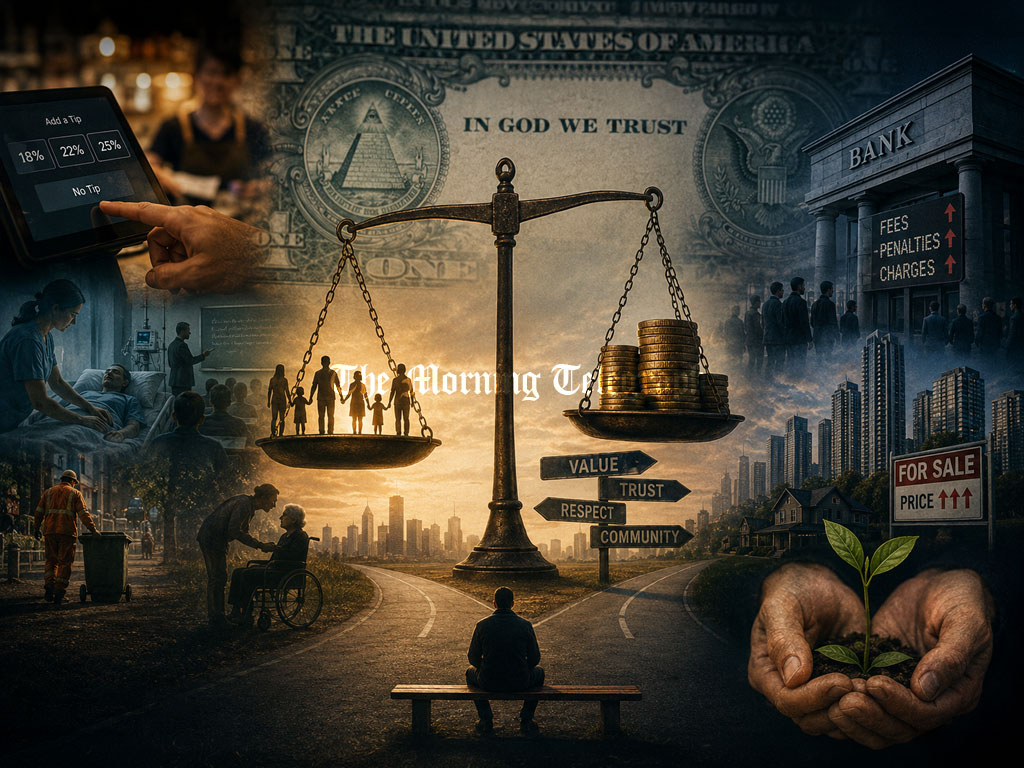
There is a particular kind of unease that does not announce itself. It settles quietly, the way a change in weather does, not in a single moment but across several small ones, until one day you realize it has been travelling with you for a while. I felt it recently during a weekend motorcycle ride. I had stopped at a small restaurant for something to eat. Nothing unusual. Just another stop along the road. When it came time to pay, the screen rotated toward me and presented several tipping options. Eighteen percent. Twenty-two percent. Twenty-five percent. Beneath them, in smaller text, another choice: No Tip. I pressed it. Almost immediately, sitting down with my meal, I found myself quietly justifying the decision, not to the person behind the counter, who had not even seen it, but to myself.
The feeling was difficult to explain because it was not really about the tip. The person who had served me had done nothing wrong. The restaurant was pleasant. The food was good. Yet a question had appeared in my mind and continued sitting there beside me while I ate. Why has this arrangement become so normal? When we pay for a product and a service, where does the responsibility for fairly compensating the people involved actually belong? Is it the employer? The customer? The marketplace? The community? The more I thought about it, the less interested I became in the amount itself and the more interested I became in the assumptions beneath it.

What made the feeling particularly uncomfortable was that I was aware of two things at the same time. Part of me was questioning an arrangement. The other part was looking at a human being. I was not reacting to the person behind the counter. I was reacting to a system. Yet the system had a face. The person standing there was simply trying to earn a living. They had not designed the arrangement I was quietly examining. I could not separate one from the other, and that may be the point. Many of the questions we face in modern life involve the same tension. We want to understand the structures we live within without losing sight of the people living inside them.
As I sat there another thought appeared. A nurse may spend an entire night caring for a patient and never expect a tip. A teacher may influence the course of a young person’s life and never receive one. A sanitation worker may help keep an entire community healthy without anyone reaching into their pocket afterwards. I am not suggesting one profession deserves more or less than another. Every honest contribution deserves respect. What interested me was the distinction itself. Why do we view some forms of service one way and others differently? What assumptions sit beneath those distinctions? What do they reveal about the way we assign value to human effort?
The road gives a person time to follow a thought further than they intended. A few days later I stopped for fuel and found myself noticing similar patterns elsewhere. Different prices for cash and credit. Additional fees attached to services that once seemed straightforward. Subscriptions that quietly increase year after year. Charges that appear after the advertised price rather than within it. None of these arrangements are necessarily wrong. Most are perfectly legal. Many make sense when viewed individually. Yet taken together they left me with the feeling that responsibility itself is constantly being rearranged, shifted from one place to another in ways we rarely stop to examine because they arrive gradually and become familiar before we have questioned them.
Somewhere in the middle of these thoughts I found myself remembering a small grocery and produce shop in my hometown. It was owned by a single man who seemed to know nearly everyone who walked through the door. I cannot remember the price of anything he sold. What I remember are the conversations. People stopped to talk. Families knew one another. News travelled through those conversations. If someone was struggling, arrangements were often made quietly and without much discussion because people understood they were part of the same community. Looking back, I do not remember anyone talking about trust. No one needed to. Trust was already there. It existed before money changed hands. The exchange itself was simply an expression of a relationship that already existed.
That memory stayed with me because it revealed something I had never really put into words. Trust may be one of the least discussed and most important elements of human life. We notice its absence immediately. We rarely stop to appreciate its presence. It sits quietly beneath our relationships, our communities, our institutions, and our exchanges with one another. Without it, almost nothing functions for very long.
That is why the words printed on every American dollar bill came back to me with a different weight.
“In God We Trust”.
I have seen those words countless times without giving them much thought. Yet on that particular day they arrived not as a statement but as a question.
Where does our trust actually reside?
Do we place it in one another, in shared responsibility, and in the values that allow human beings to live together?
Or have we gradually transferred it elsewhere?
The more I sat with these questions, the more examples seemed to appear. A piece of land may be worth one amount today and significantly more tomorrow even though nothing about the land itself has changed. The earth beneath it remains exactly as it was the day before. The trees are the same. The soil is the same. The land itself has done nothing. Only our agreement about its value has changed. Yet those changing numbers may determine whether a family can afford a home, whether a young couple can build a future, or whether an entire generation finds itself pushed further away from ownership. When the number rises in our favor we call it appreciation. When it rises beyond our reach we call it the market. Either way, the earth itself was never consulted.
The same thought followed me into another place most of us rarely stop to examine. A bank is built upon the deposits of ordinary people. Without those deposits there is no lending, no investment, no growth, and no institution as we know it. The trust of countless depositors forms the foundation upon which everything else is built. Banks provide important services and play an essential role in modern life. That is not in question. Yet I sometimes find myself looking at the relationship between the foundation and the structure built upon it. When the institution performs well, executives may be rewarded, shareholders may benefit, and the organization may grow stronger. When an ordinary depositor falls into difficulty, the response is often procedural. Fees appear. Penalties are applied. Terms are enforced. There may be sound reasons for this, but the contrast remains worth examining.
The question is not whether institutions should succeed. The question is whether the people whose trust makes that success possible remain visible once the system becomes successful. I keep returning to the memory of the small grocery shop in my hometown because the owner understood something simple. His wellbeing and the wellbeing of the people around him were connected. The larger and more sophisticated our systems become, the easier it becomes for that connection to disappear behind policies, procedures, reports, and numbers.
Trust begins when people feel seen.
It begins to weaken when they become invisible.
The more I looked around, the more I found myself returning to a distinction that seemed increasingly important.
Price and value are not the same thing.
The modern world has become remarkably skilled at assigning prices. We can place a number on almost anything. We can calculate market value, net worth, annual growth, shareholder return, property appreciation, and productivity. Yet we often struggle to recognize value itself.
A parent raising a child. A teacher changing the direction of a young life. A caregiver sitting beside someone during their most difficult days. A friend helping another through grief. A neighbour quietly helping when no one is watching. Much of what is most valuable in human life carries no obvious market price. Yet these are often the things we remember most, depend upon most, and miss most when they are gone.
The longer I sat with these thoughts, the less interested I became in tipping, banking, real estate, or even profit itself. What remained was a much simpler question.
For all our discussion about growth, success, wealth, and progress, do we actually know the difference between price and value?
That question may explain why enough has become so difficult to define. We know what more looks like. More income. More security. More comfort. More possessions. More recognition. More influence. Yet enough remains strangely elusive. Businesses seek growth. Markets seek expansion. Institutions seek greater returns. Individually we often pursue the same movement. We accumulate, achieve, acquire, and strive while the point at which we have enough seems to move further away.
The real difficulty may not be defining enough.
The real difficulty is recognizing value in a world increasingly trained to measure price.
The result is that we can become wealthier in measurable things while becoming poorer in the things that make life meaningful.
I do not know where the line exists between fair reward and excessive accumulation, and I am not sure a single answer exists for everyone. What I do know is that trust is difficult to build and easy to consume. Communities depend upon it. Relationships depend upon it. Every meaningful exchange depends upon it. The unease I felt during that meal was never really about a tip. It was pointing toward something else. It was asking me to pay attention to the relationship between trust, value, responsibility, and the way we live together.
The most important question it left behind is not whether we have enough.
The deeper question is whether we still recognize what is truly valuable.
Because a society that mistakes price for value may eventually become wealthy in things and poor in everything else.
Author’s Note
This reflection is not an argument against tipping, banking, markets, profit, or success. It is an invitation to look more closely at the assumptions we carry and the arrangements we rarely question. Every system we create reflects the values we choose to live by. If there is a purpose behind these observations, it is to encourage a moment of attention toward something that often goes unnoticed until it begins to disappear.
Trust.

Absolutely! The value of trust and all good things come back to reminisce good things in life when you are older. When you are younger, those values are frequently compromised because of the urgency to succeed, accumulate wealth and everything that is required to accomplish those goals. If we all pause occasionally at least, and take time to value things, the feeling of fulfillment will enrich our lives. It is worth the investment of time.