By Roy Denish
Sri Lanka’s media industry is facing an unprecedented crisis as soaring production costs, collapsing advertising revenue, digital disruption, and an exodus of experienced journalists force newspapers, broadcasters, and legacy media houses into survival mode. The transformation is reshaping the nation’s information landscape and raising concerns about the future of independent journalism.
A toxic cocktail of skyrocketing newsprint costs, bleeding ad revenue, and a massive talent drain has triggered a historic bloodletting across Sri Lanka’s newsrooms, leaving legacy print and electronic mastheads fighting for survival.
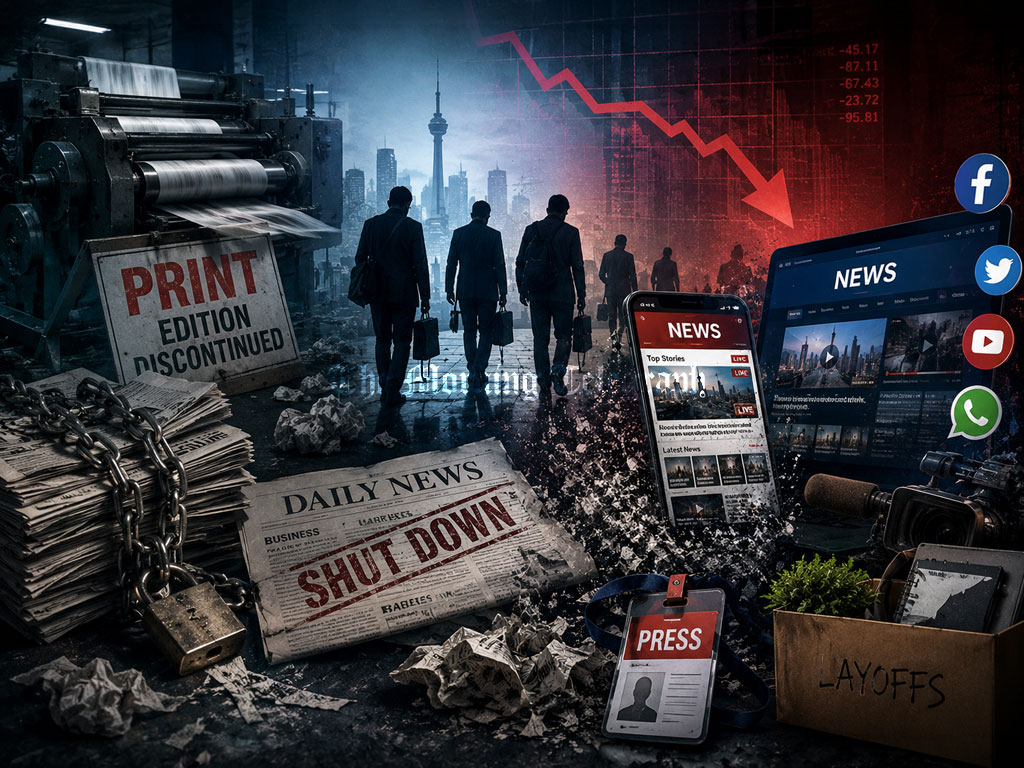
The structural collapse has forced old-school media houses to spike daily editions, slash page budgets, or shutter their operations entirely, radically reshaping the country’s media landscape. Industry insiders estimate that more than 50 titles have folded or killed their print runs over recent decades, with the industry slump hitting terminal velocity after the 2022 economic crash.

The crunch reached a boiling point when a severe forex crisis caused the landed cost of imported newsprint to skyrocket from 750 dollars a ton to well over 1,070 dollars. With paper, ink, and plates swallowing roughly 70 percent of production overheads, putting out a daily broadsheet became a deficit-generating operation.
In an unprecedented move to stop the financial bleeding, Upali Newspapers killed the Saturday print editions of its flagship English daily, The Island, and its sister Sinhala daily, Divaina, moving the copy exclusively to online e-papers. It was a sobering milestone for a legacy publisher that managed to keep its presses rolling uninterrupted through nearly 30 years of civil war.
To cross-subsidize operations, other publishing houses folded their weekday resources into their lucrative Sunday flagships—the traditional cash cows that still pull premium cover prices and capture the lion’s share of display ads from real estate, legal notices, and corporate syndicates. Dailies that managed to stay on the newsstands survived only by cutting page counts by a third or more, forcing desk editors to run truncated copy at the expense of deep investigative reporting and full-length op-eds.
The obituary for Sri Lankan print has grown long. Mainstream and political titles like Ravaya, Ada, Deshaya, and Rasa faced severe operational blocks that forced total digital migration or outright closure. Over a longer horizon, heavyweights like the Morning Leader, Lakdiva, Aththa, Davasa, Riviresa, and Iruresa have gone completely out of print. The crisis also killed off specialized niche titles, with legendary weekly supplements, arts tabloids, and kids’ papers like Mihira, Sarasaviya, Janatha, Lakjanatha, Sathsiri, and Sitthara permanently halting their printing wheels.
Compounding the print crisis is a massive audience shift toward media substitution. With internet penetration climbing toward 60 percent, readers are breaking away from appointment television and morning papers, tracking breaking news instead through independent digital channels, social feeds, and WhatsApp networks.
As a result, corporate ad spend has dried up for legacy networks, with ad revenue plunging by more than half during the peak of the crisis. Brands have systematically pulled their budgets from high-cost TV slots and print space, diverting them into target-precise digital channels.
The bottom-line hit has triggered widespread layoffs, salary stagnation, and delayed paychecks, driving a mass exodus from the press corps. Beyond the economic squeeze, newsrooms have faced long-standing editorial fatigue, with journalists working under tight institutional pressures, restrictive laws, and an entrenched culture of self-censorship on high-stakes socio-political and economic beats.
With public trust in polarized mainstream outlets eroding, a generation of veteran editors, investigative reporters, and seasoned broadcasters have permanently hung up their press badges. Many have crossed over to corporate public relations, transitioned to independent digital startups, or bought one-way tickets out of the country to chase media gigs abroad, leaving Sri Lanka’s domestic press corps facing a severe shortage of experienced newsroom leadership.