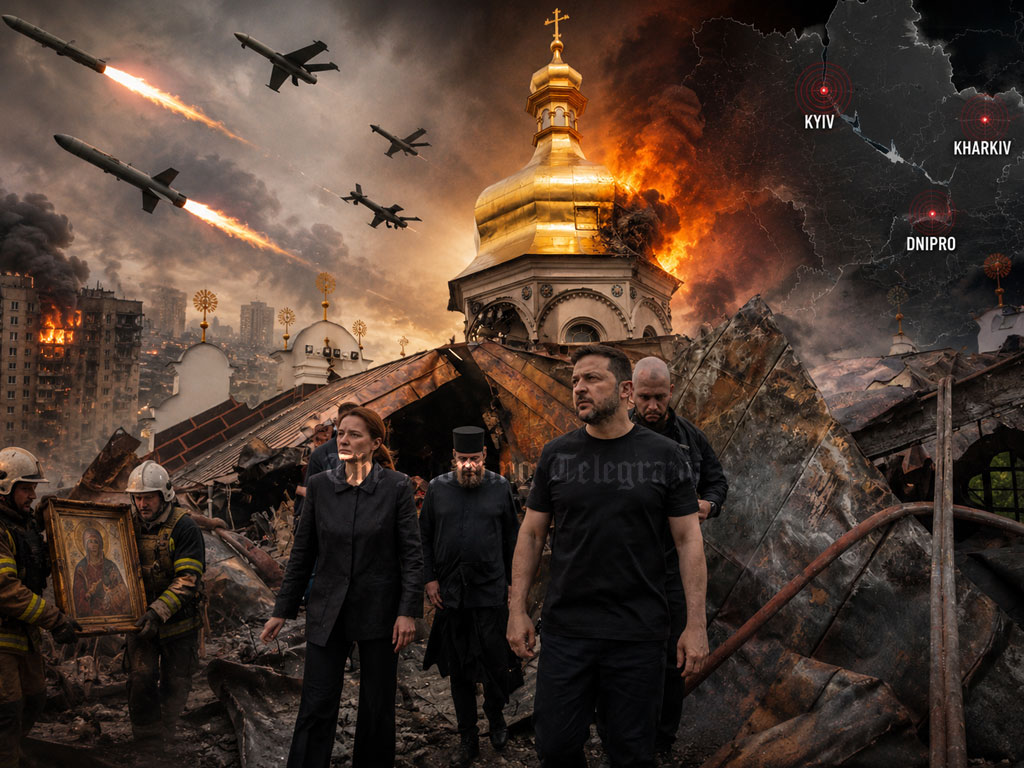
A devastating overnight Russian missile and drone barrage left at least 11 civilians dead, damaged critical infrastructure, and sparked a major fire at Kyiv’s historic Kyiv-Pechersk Lavra monastery, intensifying international condemnation and raising fresh concerns over the protection of cultural heritage during the war.
KYIV, June 15 (Agencies) – A massive Russian missile and drone barrage battered Ukrainian cities overnight, killing at least 11 people and igniting a major fire at the 11th-century Kyiv-Pechersk Lavra monastery, one of the holiest landmarks in Eastern Orthodoxy. The aerial assault, described by officials as one of the heaviest combined strikes on the capital in weeks, deployed a highly sophisticated arsenal of 70 missiles and 611 drones to saturate and overwhelm Ukrainian air defenses. While the Ukrainian Air Force reported intercepting 50 missiles and 582 drones, a Russian-manufactured Geran-2 kamikaze drone struck the roof of the landmark Dormition Cathedral inside the UNESCO-listed monastery complex. The impact ignited an 800-square-meter blaze across the upper structure, sending flames licking toward its iconic golden domes and forcing priests and emergency workers to form human chains to evacuate invaluable icons and liturgical relics.

Ukrainian President Volodymyr Zelenskyy strongly condemned the strike on Monday morning after visiting the smoldering site alongside Prime Minister Yulia Svyrydenko. Zelenskyy stated that the attack represents one of Russia’s most serious crimes against Christian culture to date, urging G7 leaders meeting in France to deliver a decisive response to the assault. The multi-layered Russian bombardment hit 16 locations across Kyiv alone, wounding dozens, knocking out power to 140,000 households, and severely damaging the Oleksandr Dovzhenko National Film Studios, where an irreplaceable repository of roughly 100,000 historic costumes was destroyed. Further casualties were reported across the country, including in Kharkiv, where five emergency workers were killed in a double-tap strike when a second drone hit an industrial facility while they were extinguishing a fire from an initial missile. In Dnipro, strikes heavily damaged a railway station, a college, and multiple commercial enterprises.
According to data compiled by the Ukrainian Air Force and state security services, Moscow utilized a diverse matrix of air, ground, and sea-launched assets to carry out the coordinated raid. Russia’s strategic bomber fleet, including Tu-95MS and Tu-160 platforms, operated deep within Russian airspace over the Vologda region to launch long-range, radar-evading Kh-101 cruise missiles. Simultaneously, six 3M22 Zircon hypersonic anti-ship missiles were fired from naval units and coastal systems in occupied Crimea, moving at extreme speeds to target critical infrastructure in the capital. Ground-launched ballistic and cruise missiles were also widely deployed, with mobile Iskander-M and Iskander-K systems firing from Russia’s border regions of Bryansk and Kursk, alongside repurposed S-400 air defense batteries firing heavy missiles on ground-attack trajectories.
To maximize the impact of these strikes, the aerial assault paired heavy strike platforms like the Shahed-131, Shahed-136, and Geran-2 with cheaper reconnaissance units, such as the Gerbera, Italmas, and Banderol loitering munitions. Cheap, unarmed Parodiya decoy drones made of plywood and fitted with specialized radar lenses were used extensively during the operation to draw air-defense fire away from incoming missiles and saturate local tracking networks.
The Russian Defense Ministry confirmed a massive precision strike but denied targeting the historic religious complex, claiming its forces strictly hit military-industrial targets. Moscow asserted, without providing evidence, that the fire at the Dormition Cathedral was instead caused by a malfunctioning, Western-supplied Patriot air defense missile fired by Ukraine. Ukrainian state security officers at the scene rejected the claim, displaying recovered debris from a Geran-2 drone found directly on the monastery grounds.
The strike triggered intense international outrage, drawing comparisons to devastating historical cultural losses. French Foreign Minister Jean-Noël Barrot compared the devastation of the millenary monastic center to a hypothetical bombing of the Notre Dame cathedral in Paris, while European Commission President Ursula von der Leyen said the strike underscored Moscow’s deliberate intent to target civilian and universal heritage. As morning broke over Kyiv, emergency crews brought the cathedral fire under control, and the monastery’s remaining bells rang out across the capital.
SOURCE:- REUTERS