By Roy Denish
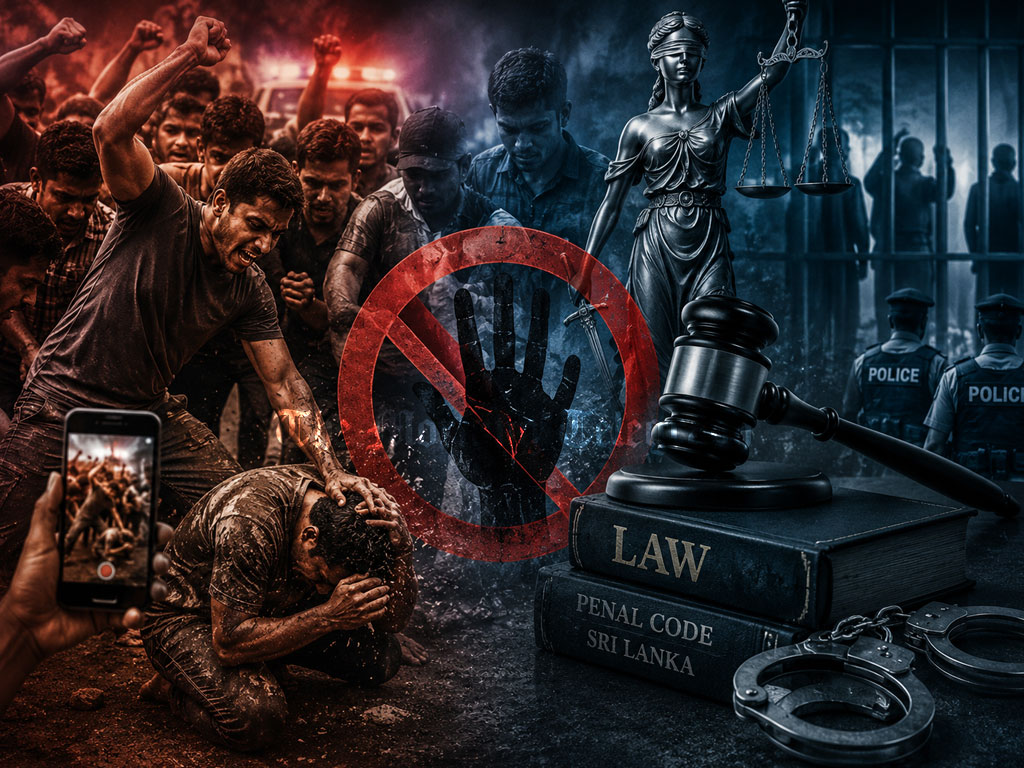
A suspected thief may deserve arrest, but not a public beating. As videos of mob-style “street justice” spread across Sri Lanka, one dangerous question now hangs over the country: are citizens helping the law, or becoming criminals themselves?
In recent times, a deeply unsettling subculture has begun to take root across Sri Lanka.
In town squares, village junctions, and across the digital colosseum of social media, street justice has morphed into a fashionable spectator sport.
For a vocal segment of the public, the tracking, cornering, and brutalizing of suspected petty thieves, fraudsters, or non-conformists has become an unregulated pastime.
Watching the video clips captured by triumphant onlookers, one could easily mistake these brutal public spectacles for an imaginary dress rehearsal before these self-appointed gladiators embark to participate at the world heavyweight boxing championships at the MGM Grand in Las Vegas.
But let us clear away the smoke of Sin City and look at the reality on the ground: this is not sport, it is not heroism, and it is certainly not justice.
It is cowardice disguised as moral righteousness.
When a mob surrounds a single, defenseless suspect, unleashing a barrage of blows under the pretense of cleaning up society, they are not defending the community.
They are eroding the very foundation of civilization.
A collective, urgent appeal is now being made by the saner corners of this nation to the law enforcement machinery of Sri Lanka.
It is time for the state to flex its institutional muscles, bring these lawless vigilantes to book, and prosecute them relentlessly under the established laws of the nation.

What Sri Lankan Law Actually Permits
To understand why vigilante justice is an existential threat to democracy, we must look at what our legal framework actually permits.
It is an established principle under Sri Lankan law that ordinary citizens have a role to play in public safety.
Under Section 35 of the Code of Criminal Procedure Act, No. 15 of 1979, a private individual is legally permitted to make a citizen’s arrest.
Any private person may arrest another who, in their view, commits a non-bailable and cognizable offence, which includes serious crimes such as robbery, murder, or rape, or who is a proclaimed offender.
However, the law explicitly dictates what happens next.
The private citizen is mandated to deliver the arrested person to the nearest police officer or police station without unnecessary delay.
Furthermore, Section 28 of the Code stipulates that the person arrested shall not be subjected to more restraint than is strictly necessary to prevent their escape.
Citizen’s Arrest Is Not Mob Punishment
What we are witnessing on our streets today is completely divorced from this legal right.
Dragging a suspect through the mud, tying them to lamp posts, stripping them, and administering savage beatings does not constitute restraint.
Assaulting an individual with the intention of causing grave injury is a flagrant, severe criminal violation.
When a mob takes it upon itself to act as investigator, prosecutor, judge, jury, and executioner, it ceases to be a gathering of concerned citizens and instead becomes an unlawful assembly.
The Penal Code Has Enough Teeth
The state cannot plead a lack of statutory tools to deal with this epidemic.
The Penal Code Ordinance No. 2 of 1883 contains a formidable arsenal of charges that can and must be brought against street vigilantes.
When law enforcement fails to act, they are implicitly validating the mob.
To reverse this dangerous tide, the police must systematically apply the provisions of the Penal Code to every single participant in a vigilante attack.
Unlawful Assembly and Criminal Liability
Sections 138 and 140 deal with unlawful assembly, showing that when five or more individuals gather with the common object of enforcing a perceived right or committing an offence by criminal force, they form a criminal entity where membership alone carries strict prison sentences.
Furthermore, Sections 314 and 316 cover voluntarily causing hurt and grievous hurt.
The moment a citizen inflicts physical pain, they cross into criminal liability, and if the assault results in broken bones, severe lacerations, permanent disfigurement, or puts the victim’s life in danger, it constitutes grievous hurt, carrying severe, non-negotiable prison terms.
Additionally, Sections 332 and 333 penalize wrongful restraint and confinement, which means preventing a person from proceeding in a direction they have a right to go, or keeping them confined within a bounded space, is explicitly punishable.
Finally, Section 486, targeting criminal intimidation, ensures that threatening injury to a person’s body, reputation, or property to cause alarm is a heavy criminal offence.
When vigilantes film their exploits and upload them to social media, they are not creating trophies; they are creating digital confessions that the state must use to trace, arrest, and indict every visible perpetrator.
Real-World Flashpoints Across Sri Lanka
This dark trajectory is already a matter of record, illustrated by real-world flashpoints across the country.
In Nilaveli, a simple traffic dispute erupted into a public confrontation where an aggressive crowd gathered, turning their fury directly onto the police officers who intervened to enforce standard regulations.
Rather than respecting the uniform, the mob assaulted and obstructed the officers, while onlookers eagerly filmed the entire breakdown of order.
Sri Lanka Police were forced to execute subsequent arrests, including of an individual who recorded the assault, proving that recording mob lawlessness merely preserves evidence for the prosecution.
Similarly, during the height of the economic crisis, severe fuel shortages turned petrol sheds into hotbeds of immense anxiety.
Long wait times and fury over line-cutting led to the formation of ad-hoc public security groups where anyone suspected of hoarding fuel or duplicating tokens was immediately cornered, interrogated, and physically assaulted before official security forces could arrive.
These actions bypass due process completely, turning routine civic panic into violent street tribunals.
Regional police divisions continue to report similar rural and suburban incidents where suspected petty thieves are caught by neighborhood residents, tied to public lamp posts, and subjected to brutal physical intimidation under the guise of community defense.
The Judiciary’s Warning Against Mob Rule
The judicial system itself has recently delivered a massive warning against the ultimate consequences of this mob mentality.
In February 2026, a Sri Lankan High Court sentenced 12 people to death over the killing of government parliamentarian Amarakeerthi Athukorala and his police security guard during the height of the 2022 public unrest.
This landmark verdict proves that the wheels of justice, though sometimes slow, will ultimately grind down those who participate in collective violence, regardless of the political or social justification they claim in the heat of the moment.
Slow Courts Do Not Justify Street Violence
The rise of street justice is often blamed on a slow, under-resourced judicial process, and true, systemic delays breed immense frustration.
But replacing a slow court with a chaotic, adrenaline-fueled mob is like setting your house on fire to cure a cockroach infestation.
Mob justice lacks the most basic prerequisite of civilization, which is due process.
A mob does not look at evidence, it does not hear a defense, and it does not account for mistaken identity.
If we allow this fashionable sport of street violence to continue unchecked, we are paving the way for total anarchy.
Today, the mob beats a suspected thief; tomorrow, the mob beats someone because of their ethnicity, their religion, or their political leanings.
Once the state surrenders its monopoly on the administration of justice, the rule of law collapses entirely.
Time to Make an Example Out of Vigilantes
Our police department and the Attorney-General’s department must reassert their dominance over public order.
The law enforcement machinery must show that the state’s muscles are infinitely stronger than those of any street thug dreaming of a Las Vegas ring.
It is time to make an example out of vigilantes.
Let them learn the hard way that the only arena waiting for them is not the MGM Grand, but a stark, uncompromising cell inside a state penitentiary.