By Marlon Dale Ferreira.
Sri Lanka cricket accountability is under scrutiny after the Galle defeat, with Shammi Silva gone and pressure shifting to Eran, players and coaches.
Sri Lanka cricket accountability is again under scrutiny after India’s 165-run victory in Galle. Shammi Silva is gone, yet the national team is still losing, forcing a question that can no longer be directed towards one familiar target.
For years, whenever Sri Lanka lost a Test, surrendered a series or exited another global tournament early, criticism frequently returned to the same man. The former Sri Lanka Cricket President became the public face of almost everything supporters believed was wrong with the game.
Lose a Test, crash out of a World Cup, get selections wrong or watch players fail, and the criticism often found its way back to Shammi Silva and the administration at Maitland Place. Sri Lankan cricket became so consumed by administrative battles that almost every poor result on the field was eventually traced back to the boardroom.

That argument now carries an uncomfortable complication. Shammi Silva is no longer there.
He and his Executive Committee resigned in April, after which Sri Lanka Cricket was placed under the Government-appointed Cricket Transformation Committee chaired by Eran Wickramaratne. The nine-member committee includes several respected figures associated with Sri Lankan cricket, among them Kumar Sangakkara, Roshan Mahanama and Sidath Wettimuny.
The committee arrived with an ambitious mandate. Wickramaratne spoke about meaningful change extending from the constitution and administration of SLC to what happens on the cricket field. Three months later, however, India have beaten Sri Lanka by 165 runs in the first Test at Galle.
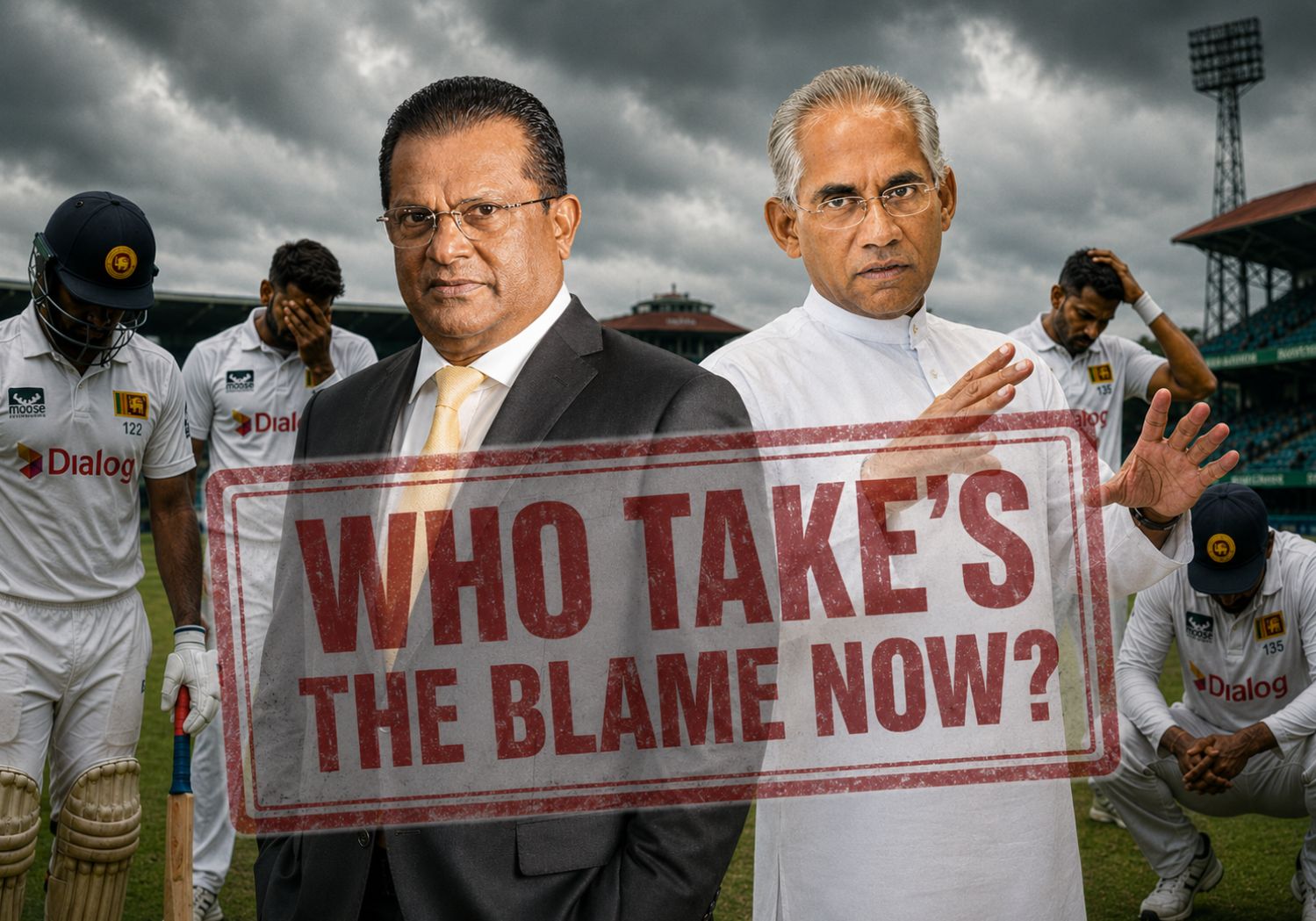
That leaves Sri Lankan cricket facing a question it can no longer avoid: who takes the blame now?
Sri Lanka Cricket Accountability Cannot Have Two Standards
There cannot be one standard of accountability for Shammi Silva and another for Eran Wickramaratne. If an elected SLC administration was expected to answer whenever the national team performed badly, then a Government-appointed committee controlling Sri Lanka Cricket cannot suddenly argue that results on the field have nothing to do with it.
Eran Wickramaratne and his committee were presented as the people entrusted with transforming Sri Lankan cricket. Their task was never portrayed as simply sitting at Maitland Place and rewriting a constitution. They arrived amid promises of governance reform, professionalism and improvement in the cricket itself.
Therefore, when things go wrong, questions must also reach their doorstep. However, there is an equally important qualification to that argument.
It would be ridiculous to simply replace “Blame Shammi” with “Blame Eran.” Galle demonstrated why Sri Lanka’s problems cannot be explained by administrators alone, regardless of who occupies the positions of authority.
At some point, the men wearing the national cap must accept responsibility for what happens between the boundary ropes. There were moments during this Test when Sri Lanka appeared to forget some of the most elementary disciplines required in the five-day game.
No administrator sitting in Maitland Place can correct a poor stroke after a batter has played it. No committee can take a catch once the ball has already been put down. Governance matters, but so do the decisions made by professional cricketers when the match is actually being played.
Has T20 Cricket Weakened Test-Match Instincts?
Modern cricket has changed enormously. T20 cricket has brought innovation, entertainment, money and extraordinary athleticism into the sport, but it has also created habits that can become dangerous when transported unquestioningly into Test cricket.
Batters are increasingly conditioned to manufacture scoring opportunities. They shuffle across the crease, chase width and attack deliveries that previous generations were often taught to leave. At times, simply allowing the ball to pass harmlessly through to the wicketkeeper appears almost unnatural.
Test cricket demands something very different. It requires patience, judgement outside off stump, disciplined footwork and an understanding of the match situation. Above everything else, a batter must appreciate that sometimes the best shot available is no shot at all.
Kamindu Mendis offered an example of the problem in Galle. On occasions, he poked at deliveries that could have been left alone, with little decisive foot movement accompanying the stroke. It was not simply a technical question because shot selection also came into the equation.
A batter of Kamindu’s quality should understand that Test cricket is not an endless search for scoring opportunities. Sometimes survival itself creates the opportunity, particularly when a bowler is enjoying a good spell and conditions favour restraint.
That discipline appears increasingly vulnerable in an era when cricketers spend enormous amounts of time preparing for shorter formats. The question is not whether players should compete in T20 cricket. It is whether they can adjust their instincts quickly enough when they return to the fundamentally different demands of a Test match.
For Sri Lanka, that adjustment matters. Talent alone will not compensate for poor judgement if batters repeatedly offer bowlers chances they were under no pressure to create.
Dhananjaya’s Slip Catching Was Another Warning
Captain Dhananjaya de Silva also produced moments that deserve examination. He took some very good catches during the match and that deserves acknowledgement, but those successful efforts made the opportunities he failed to hold even more frustrating.
At least two regulation chances went down, while his stance at slip also deserves scrutiny. Instead of remaining low, balanced and ready as the bowler entered his delivery stride, Dhananjaya was at times noticeably more upright, with his hands resting around his knees.
Slip catching is decided in fractions of a second. The lower the fielder remains, the better prepared he is to move quickly towards a low edge. A fielder standing too erect must first move down before moving towards the ball, and that tiny delay can become decisive at international level.
These are basics, and they matter even more against a side of India’s quality. Had Dhananjaya combined his successful catches with the chances that escaped him, Sri Lanka might have been discussing an excellent slip-catching performance from their captain.
Instead, those missed opportunities became another part of the post-match examination. Against India, dropped catches are rarely forgotten because good batting sides have a habit of making opponents pay for every second chance.
They usually return on the scoreboard with interest.
Dickwella’s Dismissal Exposed the Bigger Problem
Then came Niroshan Dickwella, who had already played an excellent innings of 80 in Sri Lanka’s first innings. Alongside Sonal Dinusha, he helped rebuild the innings through a 146-run partnership and gave Sri Lanka a route back into the contest.
Yet the manner of his dismissal was revealing. Prasidh Krishna delivered a ball Dickwella could have left, but instead he chased it with a loose push away from his body and edged behind.
The dismissal denied him what would have been his maiden Test century. More importantly for Sri Lanka, it ended the partnership that had dragged the home side back into the match.
Something later in the contest perhaps illustrated the mentality Sri Lankan cricket needs to examine even more clearly. During the final innings, Dickwella appeared determined to manufacture attacking opportunities and, at one stage, moved towards the leg side before the delivery in an apparent attempt to create room.
There had already been banter involving Yashasvi Jaiswal and the suggestion of hitting a six and securing an IPL contract. It may have been entertaining and it may even have been amusing, but Sri Lanka were not playing an exhibition match.
They were trying to save a Test.
The match situation demanded occupation of the crease, particularly with overcast conditions around Galle and the possibility that rain could still influence proceedings. Dickwella’s value at that stage was not necessarily how quickly he could score. It was how long he could remain at the crease and frustrate India.
Instead, Sri Lanka’s remaining resistance disappeared with alarming speed. That is where the comedy stops being funny, because entertainment cannot become more important than understanding what the team needs at a critical stage of a Test match.
Players Cannot Keep Hiding Behind Administrators
This is the uncomfortable conversation Sri Lanka cricket accountability now requires. Administrators must be accountable, selectors must be accountable and coaches must be accountable. The Transformation Committee must also answer for decisions that fall within its mandate.
But the players cannot repeatedly throw away promising positions, ignore match situations, drop catches and play unnecessary strokes, only for the national conversation to immediately shift towards whichever administrator happens to occupy the biggest office at Maitland Place.
Shammi Silva could not control Kamindu Mendis’ foot movement from the pavilion. Eran Wickramaratne cannot crouch at first slip on behalf of Dhananjaya de Silva. Kumar Sangakkara cannot leave a ball outside off stump for Niroshan Dickwella.
Likewise, a selector cannot reach through a television screen and stop a batter from playing an unnecessary stroke. At some point, professional international cricketers have to own the decisions they make in the middle.
Galle provided several examples where Sri Lanka were not simply beaten by superior opposition. They contributed towards their own defeat, and India were good enough to punish those mistakes.
That distinction matters. Administrators can build structures, selectors can choose squads and coaches can prepare players, but once the match begins, the cricketers wearing the national cap carry responsibility for execution.
If Sri Lanka want accountability to mean something, that responsibility cannot disappear whenever a defeat produces public anger.
Eran and Company Cannot Hide Either
None of this provides the Transformation Committee with immunity. When the committee assumed control, expectations were deliberately raised and the public was told that Sri Lankan cricket was entering a period of transformation.
If that transformation is genuine, supporters should eventually see evidence of it not merely in constitutions, committee structures and press conferences. It must also become visible in selection, preparation, discipline, development and performance.
The committee cannot accept applause for improvement while directing every defeat towards selectors, coaches and players. Leadership does not work that way. If Eran Wickramaratne and his colleagues have accepted responsibility for transforming Sri Lankan cricket, then uncomfortable results form part of that responsibility.
At the same time, the public must resist the temptation to search for another single villain. Replacing Shammi Silva’s photograph with Eran Wickramaratne’s photograph after every Sri Lanka defeat achieves absolutely nothing.
That is why Sri Lanka cricket accountability cannot stop at one office. The deeper problem appears to stretch across the system, involving administration, selection, coaching, preparation, technique, temperament and the decisions players make when a Test match begins to turn.
The national conversation therefore has to become more mature. Responsibility should follow the decisions being made rather than automatically landing on whichever individual currently attracts the greatest public attention.
If administrators get governance wrong, they must answer for it. If selectors make poor choices, those selections deserve scrutiny. If coaches fail to correct recurring weaknesses, questions should be asked. And when international cricketers make avoidable mistakes on the field, they too must answer for them.
SSC Must Be About More Than Changing the XI
Sri Lanka now move to the SSC for the second Test beginning on August 23, and there will inevitably be discussion about changes to the team. There should be, particularly after a defeat of this magnitude.
But replacing two or three names on the team sheet will mean little unless Sri Lanka also change the cricket being played by the eleven eventually selected. Personnel changes cannot solve problems of discipline, judgement and match awareness if the same mistakes simply reappear through different players.
Before the first ball is bowled at the SSC, every stakeholder in Sri Lankan cricket should confront several uncomfortable questions. Are batters still being taught the discipline required for Test cricket? Are players reading match situations, or are they merely playing according to instincts increasingly shaped by T20 cricket?
There are also questions about whether basic fielding disciplines receive enough attention, whether selectors are choosing players capable of adapting between formats and whether coaches are correcting technical deficiencies before they become costly at international level.
The Transformation Committee must ask whether it is creating an environment in which performance carries genuine accountability. Above everything else, however, the players themselves must decide whether they are prepared to accept responsibility when their own decisions contribute to defeat.
Sri Lankan cricket spent years believing that changing the men in the boardroom would change the fortunes of the men in the middle. The men in the boardroom have now changed, but the defeats have not disappeared.
That should tell Sri Lankan cricket something important.
Perhaps its greatest mistake was not that Shammi Silva was blamed too much, or that Eran Wickramaratne may now be blamed too quickly. Perhaps the mistake was believing there was ever one man to blame in the first place.
Before Sri Lanka walk onto the SSC on August 23, that is something Eran Wickramaratne, his Transformation Committee, the selectors, coaches and, most importantly, the eleven cricketers representing the country should consider very seriously.
Because this time, Shammi Silva is no longer standing there to take all the bullets.