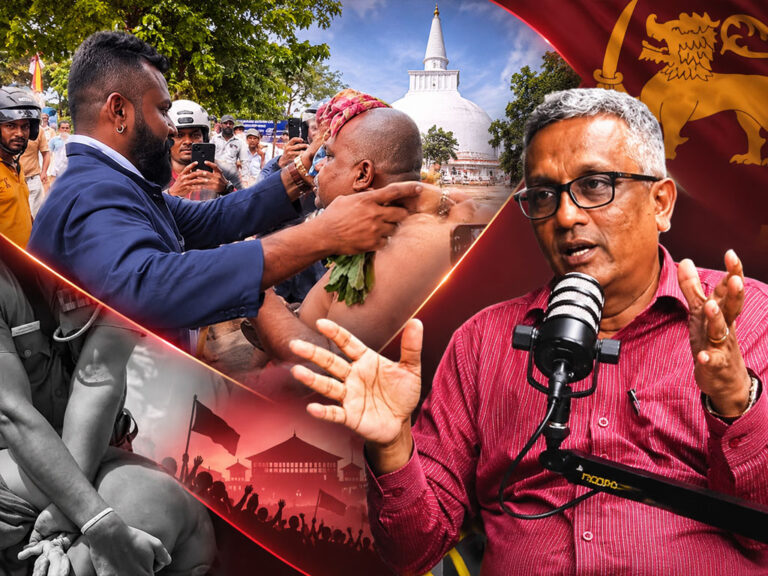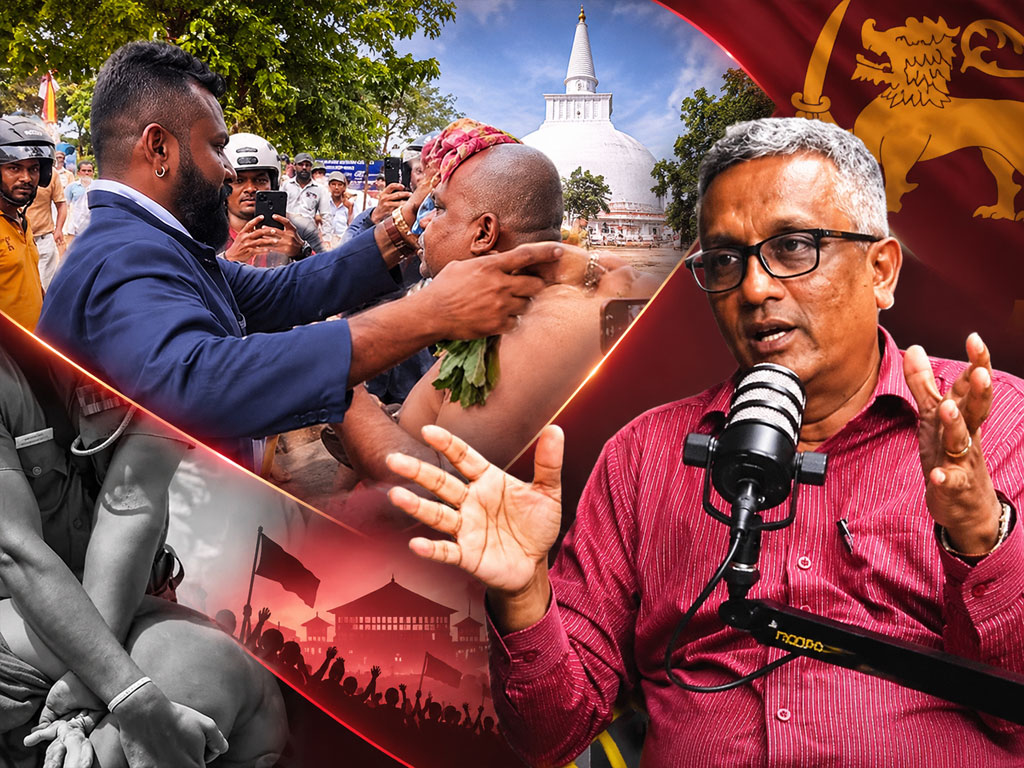
COLOMBO, November 14, 2026 – Political analyst Deepthi Kumara Gunaratne says the confrontation near Ruwanweli Maha Seya in Anuradhapura has achieved something Sri Lanka’s political left had failed to accomplish for 70 years: challenging the traditional political right’s dominance over Sinhala-Buddhist nationalism and religious identity.
Gunaratne argues that the November 12 clash, during which Rajanganaye Saddharathana sustained head injuries, represents a turning point in Sri Lankan politics that extends well beyond the confrontation itself.
Speaking on the Ideas Front programme hosted by senior journalist Narada Bakmeewewa, he suggested that the ideological ownership of “nation and religion”, which he believes shifted away from the left in 1956, is now being contested by the country’s left-wing political forces.
His assessment centres on the changing relationship between religious identity, political influence and the strategies used by opposition parties to mobilise voters.
According to Gunaratne, the events in Anuradhapura have disrupted a political arrangement that allowed conservative and nationalist parties to portray themselves as the principal defenders of Sinhala-Buddhist interests.

The 1956 Political Realignment and Sinhala-Buddhist Nationalism
Drawing on the work of sociologist Newton Gunasinghe, Gunaratne traced the origins of this political divide to the transformation of Sri Lankan politics in 1956.
He argued that, before that period, left-wing movements had played a prominent role in representing the economic and social grievances of ordinary people.
However, S.W.R.D. Bandaranaike, who had left the United National Party, successfully incorporated Sinhala-Buddhist nationalist sentiment into his political strategy.
Gunaratne maintained that this changed the balance of political influence.
From 1956 onwards, he argued, the political claim to represent the interests of the Sinhala-Buddhist majority increasingly became associated with the Bandaranaike family.
After 2005, he said, that influence shifted towards the Rajapaksa family.
The result, in his interpretation, was that left-wing political movements gradually lost their ability to claim a leading role in defending national and religious identity, despite their longstanding emphasis on the concerns of ordinary citizens.
Anuradhapura Clash Challenges Opposition’s Political Strategy
Gunaratne identified the confrontation at the Anuradhapura sacred site as a development that could change this established political arrangement.
The incident occurred near Ruwanweli Maha Seya, where a group of monks, including Balangoda Kassapa Thero, had been staging a protest against the proposed Anuradhapura Sacred City Development Plan.
Tensions escalated following the arrival of a group led by Rajanganaye Saddharathana.
Saddharathana sustained a head injury during the confrontation, which subsequently prompted police intervention and arrests.
Gunaratne’s argument is that the political consequences of the incident extend beyond the individuals involved.
He suggested that opposition parties had traditionally sought to characterise left-wing governments as hostile or indifferent to religion while presenting themselves as the principal protectors of Sinhala-Buddhist interests.
In his view, the events at Anuradhapura have made that strategy more difficult to sustain.
Religious and Nationalist Political Influence May No Longer Belong to One Camp
Gunaratne identified several potential consequences of the incident:
- Religious and nationalist influence divided: He argued that the political claim to defend national and religious interests, previously concentrated within one political camp, would increasingly be contested by both the government-aligned left and its opponents.
- Wickremesinghe–Pohottuwa strategy weakened: Gunaratne maintained that efforts by political groups associated with former President Ranil Wickremesinghe and the Sri Lanka Podujana Peramuna (SLPP) to consolidate Sinhala-Buddhist electoral support had suffered a strategic setback.
- Traditional media campaigns challenged: He suggested that political campaigns promoting established forms of ethnic nationalism through private television networks could lose some of their influence in the changing political environment.
- Changing realities on the ground: Despite his political disagreements with leaders of the Janatha Vimukthi Peramuna (JVP) and the Frontline Socialist Party, Gunaratne argued that the emerging shift in political influence should be recognised and examined objectively.
His analysis presents the incident as a potential redistribution of political influence rather than simply another confrontation between rival religious groups.
However, the extent of any lasting change in electoral support or political allegiance remains to be established.
Opposition Urged to Move Beyond Traditional Nationalist Slogans
During the discussion, programme host Narada Bakmeewewa observed that political conditions at the grassroots level, together with the strategies used to mobilise public support, were changing rapidly.
The discussion suggested that opposition parties could struggle to regain power if they continued relying on familiar ethnic and religious nationalist slogans without developing a credible alternative political programme.
Gunaratne argued that the opposition must recognise the changing political environment rather than assume that strategies used successfully in previous decades would remain effective.
He also linked the government’s economic and electoral approach to the wider political developments.
According to his assessment, the administration has sought to address middle-class interests through its Budget proposals while maintaining support among rural voters through developments occurring at the grassroots level.
He viewed these two factors as part of a broader political strategy that could make it more difficult for opposition parties to regain their previous influence.
A Policy-Based Alternative for Sri Lanka’s Opposition
Gunaratne’s central conclusion was that the opposition would need to move beyond familiar political slogans and develop a more substantial intellectual and policy-based alternative.
In his view, the traditional strategy of claiming exclusive ownership of Sinhala-Buddhist nationalism may no longer provide a reliable route to political power.
He suggested that political parties seeking to challenge the government must instead formulate credible policies capable of addressing the country’s contemporary economic, social and political concerns.
The argument reflects a broader debate over whether Sri Lankan politics is moving away from established divisions based on religious identity and towards competition over governance, economic policy and political credibility.
The Anuradhapura confrontation has already produced legal consequences, but its longer-term electoral significance remains uncertain.
Gunaratne nevertheless regards the incident as a symbolic moment in which the political left has challenged a form of nationalist influence that, in his interpretation, had remained largely beyond its reach since 1956.
Whether that represents a lasting realignment or a temporary shift in political debate will depend on how the government, opposition parties and voters respond in the months ahead.
SOURCE:- THE LEADER