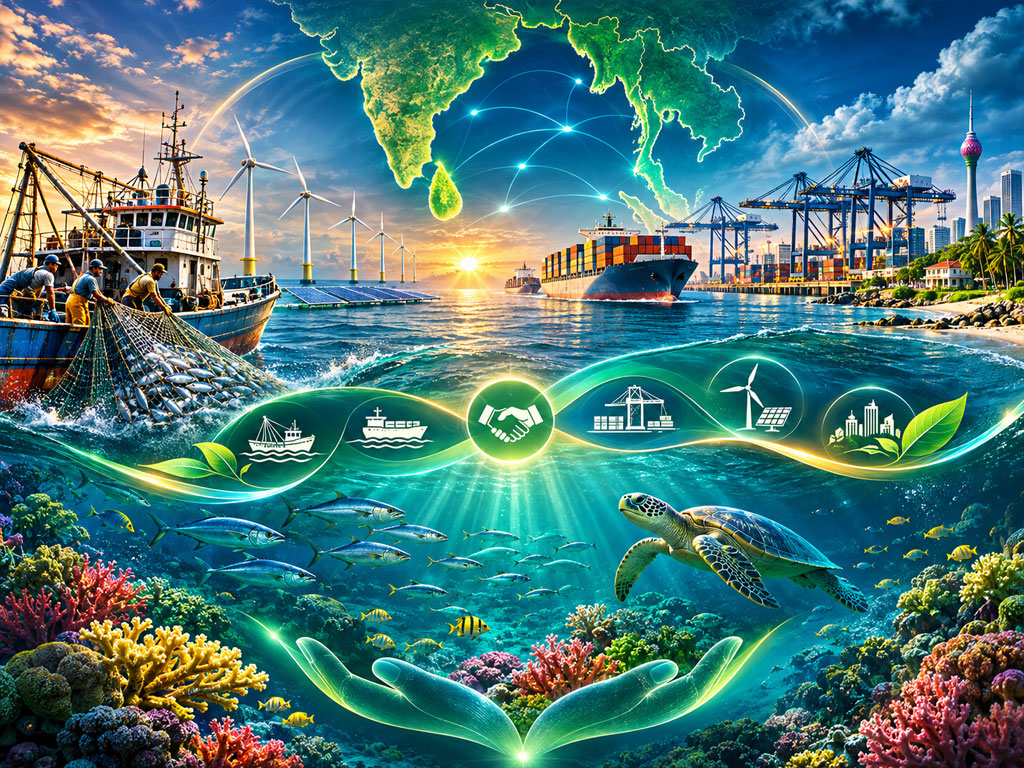
COLOMBO, November 14, 2026 – Sri Lanka, India and Bangladesh are exploring new opportunities in fisheries, aquaculture, ports, tourism and renewable energy as they seek to develop a sustainable blue economy. A recent Australian fellowship programme offers important lessons on how the region can expand ocean-based industries without damaging the marine ecosystems and coastal livelihoods on which its future depends.
The Bay of Bengal is entering an important period in its economic and environmental development. Sri Lanka, India and Bangladesh are increasingly recognising the opportunities offered by ocean-based industries, particularly as their economies face pressure to create employment, improve food security, attract investment and strengthen resilience.
Yet the central challenge is not simply how to generate more income from the ocean. It is how to pursue economic development without weakening the marine ecosystems, fisheries resources and coastal communities on which that development ultimately depends.
A sustainable blue economy must therefore be understood as more than an expansion of commercial activity at sea. It requires a different approach to managing marine resources, balancing economic opportunities with environmental protection, scientific evidence and the needs of communities.
Australia’s experience offers valuable lessons for countries seeking to achieve that balance.

A Sustainable Blue Economy Requires More Than Investment
The term “blue economy” is increasingly used to describe industries and economic activities associated with oceans and coastal resources.
However, not every activity conducted at sea automatically contributes to a sustainable blue economy.
Genuine sustainability requires healthy marine ecosystems, credible scientific research, effective regulation, community participation and institutions capable of managing competing demands on ocean resources over the long term.
These principles were central to the 2026 Australia Awards Fellowship programme, Enabling a Sustainable Blue Economy in the Bay of Bengal (Indian Ocean).
Funded by the Australian Government through the Department of Foreign Affairs and Trade (DFAT), the programme brought together 15 fellows from Sri Lanka, India and Bangladesh.
It was led by the Australian National Centre for Ocean Resources and Security (ANCORS) at the University of Wollongong.
The fellowship also connected several regional institutions with Australian researchers, policymakers and industry specialists.
Participating institutions included:
- Pathfinder Foundation (PF), Sri Lanka.
- National Maritime Foundation (NMF), India.
- Bangladesh Institute of Maritime Research and Development (BIMRAD), Bangladesh.
The programme provided an opportunity to examine how Australia’s ocean industries operate and, more importantly, how scientific research, regulation and government policy contribute to their development.
Connecting Marine Science With Government Policy
During study visits to Wollongong, Sydney, Canberra and Tasmania in February 2026, the fellows examined marine research, aquaculture, ocean governance, renewable energy and integrated ocean management.
One of the programme’s most important lessons was that these activities cannot be managed effectively as isolated industries.
They form part of a larger interconnected system in which economic development, environmental protection and public policy must work together.
The involvement of the Blue Economy Cooperative Research Centre demonstrated how researchers, industry representatives and government agencies can collaborate on offshore aquaculture, renewable energy and marine science.
Such cooperation helps ensure that scientific knowledge influences actual policy and investment decisions rather than remaining confined to academic research.
This approach is particularly relevant to Sri Lanka.
The country already possesses many of the basic resources needed to develop a blue economy, including its strategic maritime location, established fisheries industry, coastal tourism sector, important ports, aquaculture activities and diverse marine ecosystems.
The difficulty is not necessarily a shortage of opportunities.
It is whether Sri Lanka has sufficient research capacity, institutional coordination and regulatory safeguards to develop those opportunities sustainably.
Australia provides useful examples, but its systems should not be copied without considering Sri Lanka’s economic, environmental and institutional circumstances.
Australia’s Sustainable Ocean Plan Offers a Framework
Australia’s 2026 Sustainable Ocean Plan demonstrates how different marine industries and environmental priorities can be brought within a coordinated national framework.
The plan connects economic development with environmental protection, climate action, Indigenous First Nations participation, scientific knowledge and cooperation among government institutions.
It recognises that fisheries, renewable energy, tourism, biodiversity, maritime transport and coastal communities depend on the same ocean environment.
As a result, decisions affecting one sector can have consequences for several others.
The Australian approach highlights the importance of managing ocean resources collectively rather than through disconnected government programmes.
For Sri Lanka, the practical implications are substantial.
Fisheries policy cannot be separated entirely from coastal management. Marine tourism must consider sensitive ecosystems and the needs of existing resource users.
Offshore renewable energy development requires an understanding of fishing grounds, marine biodiversity and the environmental consequences of infrastructure.
Port development also affects coastal space, while climate change influences every major ocean-related industry.
An effective blue economy consequently requires coordination among institutions responsible for fisheries, the environment, tourism, ports, energy, scientific research and local government.
Without that coordination, policies designed to develop one industry could unintentionally damage another.
Scientific Management Essential for Sustainable Fisheries
Australia’s fisheries management system provides another important lesson for the Bay of Bengal.
The Australian Fisheries Management Authority (AFMA) uses formal harvest strategies to guide commercial fishing decisions.
These strategies connect scientific assessments of fish stocks with decisions about allowable catches.
Their objective is to achieve economically viable fisheries while giving priority to ecological sustainability.
The underlying principle is that decisions about how many fish can be harvested should reflect scientific evidence about fish populations and the ability of ecosystems to sustain fishing activity.
This approach has direct relevance for Sri Lanka, India and Bangladesh.
Fisheries remain economically and socially important throughout the region, but the industry faces several pressures, including overexploitation, climate change, habitat degradation and illegal fishing.
A sustainable fisheries strategy cannot be based solely on increasing catches, expanding fishing fleets or raising export earnings.
It also requires:
- Accurate assessments of fish stocks and marine ecosystems.
- Reliable fisheries data and scientific monitoring.
- Effective enforcement of fisheries regulations.
- Long-term management of commercially important species.
- Regional cooperation in monitoring shared marine resources.
- Protection of habitats and responsible management of bycatch.
Scientific transparency is particularly important because decisions about fishing limits affect employment, food supplies and the incomes of coastal communities.
Sri Lanka could strengthen fisheries management by investing more in research and ensuring that scientific findings are used consistently by regulatory and management institutions.
Marine resources also extend across national and administrative boundaries.
Regional scientific cooperation, data sharing and coordinated monitoring should therefore become essential components of the Bay of Bengal’s blue economy agenda.
Modern fisheries governance must consider more than the condition of commercially valuable fish stocks.
It must also address bycatch, habitat damage, ecosystem health and the economic viability of fishing communities.
Since fisheries support processors, traders, families and local businesses, decisions made at sea have consequences throughout coastal economies.
Tasmania Demonstrates Aquaculture’s Opportunities and Risks
The Australian experience also provides useful lessons on aquaculture development.
Study visits to Tasmania demonstrated the potential of modern aquaculture technology, specialist research facilities and scientific management to improve production.
Aquaculture can contribute to food security, employment and economic diversification.
However, expansion also introduces environmental and regulatory challenges.
Australia’s experience illustrates the importance of conducting environmental assessments, monitoring ecological impacts and maintaining public accountability as the industry develops.
For Sri Lanka, the objective should not simply be to attract additional aquaculture investment.
Expansion must be supported by reliable environmental baseline information, disease surveillance, carrying-capacity research and clear systems for monitoring and managing ecological impacts.
These safeguards are particularly important because environmental damage can become difficult and expensive to reverse once intensive production is established.
Research should therefore influence investment decisions before major developments proceed, rather than being used only to assess damage afterwards.
Universities Must Help Shape Ocean Policy
Universities and specialist research institutions play an important role in connecting scientific knowledge with practical decisions.
Institutions such as the University of Wollongong and ANCORS combine expertise in ocean law, fisheries governance, maritime security and blue economy policy.
ANCORS approaches the blue economy through the sustainable use of marine and coastal resources, placing particular emphasis on integrated and socially inclusive governance.
Sri Lanka also possesses considerable scientific and academic expertise.
Nevertheless, stronger connections are needed between universities, specialist research organisations, ministries, regulatory authorities and policymakers.
Research should not end when an academic report is published.
Its findings should contribute directly to fisheries management, assessments of coastal development and decisions concerning emerging marine industries.
Greater cooperation could be encouraged through joint research projects, postgraduate training, professional exchanges and technical partnerships with Australian universities and research centres.
Developing this relationship would help Sri Lanka strengthen the evidence available to institutions responsible for managing marine resources.
It would also support the development of professional expertise needed to oversee increasingly complex ocean industries.
Bay of Bengal Countries Face Shared Maritime Challenges
The Australia Awards Fellowship brought together participants from countries with different economic circumstances, institutional arrangements and development priorities.
Despite these differences, Sri Lanka, India and Bangladesh face many common maritime problems.
Climate change, marine pollution, illegal fishing, declining fisheries resources and maritime trade challenges cannot be addressed effectively through isolated national efforts.
Regional cooperation is therefore essential.
An institutional foundation already exists through the Bay of Bengal Initiative for Multi-Sectoral Technical and Economic Cooperation (BIMSTEC).
The organisation has incorporated the blue economy into its areas of cooperation, while fisheries are addressed through its agriculture and food security structure.
The next challenge is turning regional commitments into practical activities.
Potential areas for cooperation include:
- Joint fisheries research and scientific assessments.
- Professional training and technical exchanges.
- Marine data sharing and coordinated monitoring.
- Marine spatial planning.
- Blue carbon research and ecosystem protection.
- Coastal resilience and climate adaptation.
These activities would allow countries to address shared environmental pressures while building stronger economic and scientific relationships.
Cooperation does not require Sri Lanka, India and Bangladesh to adopt identical policies.
Each country has its own resources, expertise and priorities.
India contributes substantial marine research and strategic capabilities. Bangladesh offers experience in aquaculture and coastal adaptation, while Sri Lanka brings fisheries expertise, a strategically important maritime location and established institutions.
Australia can contribute specialist knowledge in ocean science, fisheries management, governance and institutional capacity building.
Regional cooperation is most effective when these strengths complement one another.
Australia Offers Principles, Not a Model to Copy
The purpose of examining Australia’s blue economy experience should not be to reproduce its institutions and policies throughout the Bay of Bengal.
The region has different economic conditions, social structures, marine ecosystems and development requirements.
A more useful approach is to identify the principles that support Australia’s experience and adapt them to regional circumstances.
Those principles include connecting scientific research with policy, basing fisheries decisions on credible evidence, establishing environmental safeguards before industries expand and coordinating activities that compete for the same ocean space.
They also include investment in monitoring and enforcement, meaningful participation by coastal communities and recognition that healthy ecosystems are valuable economic assets.
Australia’s Sustainable Ocean Plan reflects this approach by treating the ocean as an interconnected system.
It links environmental health with the long-term success of ocean industries and recognises that no single government institution, industry or community can manage ocean challenges independently.
The implications for the Bay of Bengal extend beyond the development of new industries.
Millions of people across the region depend directly or indirectly on marine and coastal resources.
Fisheries support food security and livelihoods, while coastal ecosystems provide environmental protection, biodiversity and economic value.
If development damages these foundations, short-term economic expansion could undermine the long-term prospects of the industries it was intended to support.
Sri Lanka Can Help Shape a Regional Blue Economy
Sri Lanka has an opportunity to contribute to a more sustainable approach to ocean development.
At the national level, this requires stronger connections between marine science and government policy, improved fisheries management, coordinated planning among ocean-related industries and greater investment in environmental monitoring.
Coastal communities must also have a meaningful role in decisions affecting their resources and livelihoods.
At the regional level, Sri Lanka can strengthen research and policy cooperation with India and Bangladesh through institutions and mechanisms such as BIMSTEC and the Indian Ocean Rim Association (IORA).
These partnerships could help establish practical systems for sharing knowledge, managing common resources and responding to environmental challenges.
The Bay of Bengal does not lack ocean resources or economic ambition.
What it needs is a stronger institutional and scientific foundation capable of transforming those opportunities into sustainable development.
For Sri Lanka and its neighbours, Australia’s experience demonstrates the value of integrating research, policy, regulation and environmental protection rather than treating ocean industries as separate economic opportunities.
A sustainable blue economy should not be understood as another phase of exploiting marine resources.
It represents a different approach to governing economic development, one that recognises the relationship between environmental health, food security, coastal livelihoods and long-term prosperity.
Whether the Bay of Bengal’s growing interest in ocean-based industries produces temporary economic gains or lasting regional prosperity will depend on how effectively those principles are translated into policy and practice.
SOURCE:- LANKA LEADER