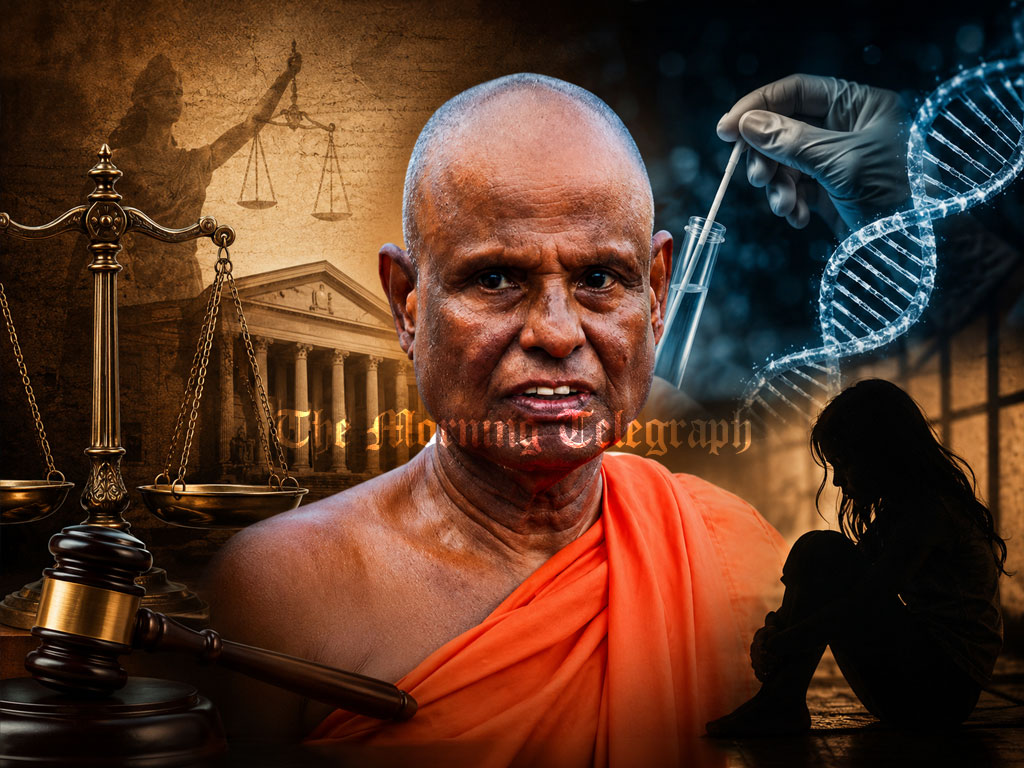
DNA test order in former Atamasthanadhipathi Pallegama Hemarathana Thero case highlights law, science, and public trust in justice.
DNA test proceedings involving former Atamasthanadhipathi Pallegama Hemarathana Thero have brought renewed attention to the relationship between law, science, and society in Sri Lanka.
The former Atamasthanadhipathi Thero is facing a serious allegation of sexually abusing a minor girl. The Anuradhapura Court, after releasing him on bail, has ordered him to appear before the Government Analyst’s Department in Colombo for a DNA test.
This development marks a critical stage in the legal process and exposes several important dimensions within Sri Lanka’s judicial system and socio-political environment. Based on this incident, it is important to examine the connection between law, scientific evidence, and public responsibility in an impartial manner.

The core foundation of any democratic society is equality before the law. In a country such as Sri Lanka, where religious and cultural values are deeply rooted, allowing a prominent figure who once held the highest religious leadership position to face a normal legal process shows how the rule of law is applied in practice.
This sends a powerful message that no person, regardless of rank, religious robes, or social status, can stand above the law. When the police and judiciary act impartially in such sensitive matters, public confidence in justice institutions is further strengthened.
In today’s society, where rumours and opinions spread rapidly through social media and mainstream media, separating truth from falsehood has become increasingly difficult. Against that complex background, the use of modern scientific tools such as DNA testing plays a vital role in the administration of justice.
Such scientific evidence helps the court move beyond personal views, emotions, political claims, or rumours. DNA testing is globally recognized as one of the most accurate tools in forensic science. It can support the confirmation of an allegation, and it can also help scientifically prove the innocence of a suspect if the allegation is false.
At this sensitive moment, the public must also remember the basic legal principle that every suspect is presumed innocent until proven guilty. Since the former Atamasthanadhipathi Thera remains a suspect before the law at this stage, people must avoid acting as judges on social media.
A mature society must allow the court process to continue without pressure. Groups supporting or opposing the proceedings should wait patiently for the final verdict, based on scientific evidence, rather than reaching conclusions through personal ideology or emotion.
This legal matter is not merely an issue between two individuals. It is a complex case with wider implications for Sri Lankan society, the elite class, and especially the Sangha community.
Although such a grave allegation may create shock within Buddhist institutional structures, allowing a transparent legal process to proceed without obstruction demonstrates that institutional integrity can be protected through law.
At the same time, because the case involves a minor girl, ensuring justice for the victim while protecting her identity, dignity, and safety must remain a central priority.
In conclusion, the legal process surrounding the DNA test of former Atamasthanadhipathi Pallegama Hemarathana Thera has become an important reflection of the impartiality of Sri Lanka’s justice system and the importance of modern scientific evidence.
The results of this examination will help determine, through a fair process, whether the allegation is true or false. Therefore, the urgent need at this critical moment is to set aside emotions, prejudice, and premature judgment, allow the law to function independently, and accept the truth whatever it may be.