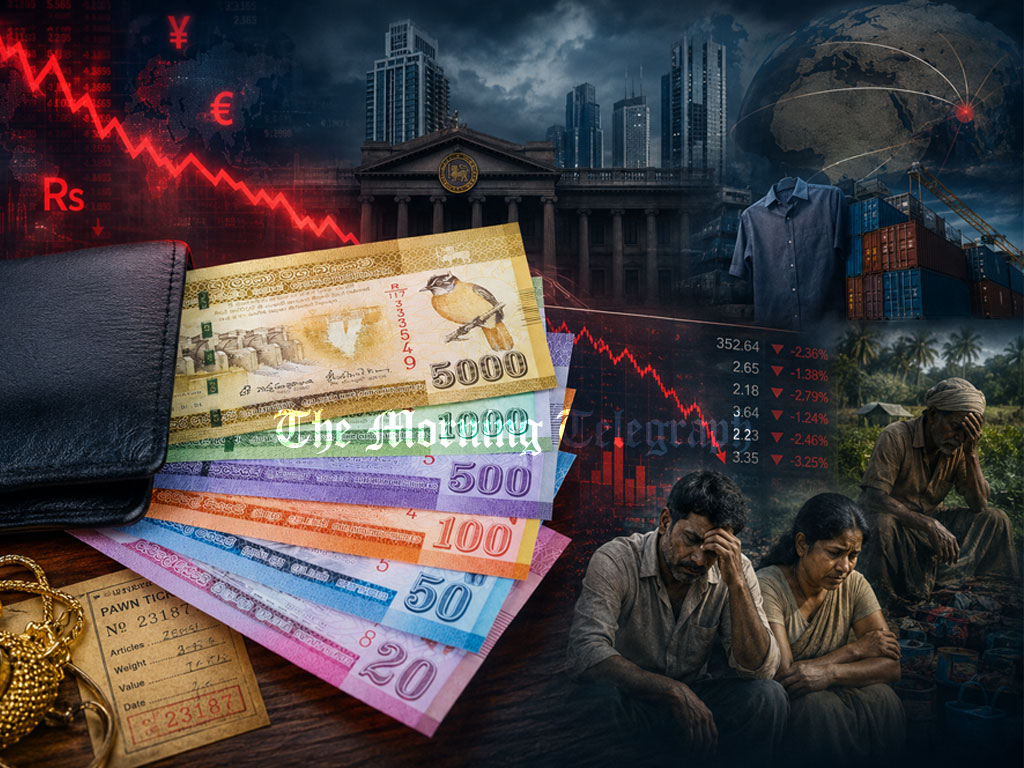
Sri Lanka economic crisis deepens as new exporter dollar rules raise fears over reserves, investors, credit cards and gold pawning limits.
Sri Lanka economic crisis concerns have intensified after Professor Sunanda Maddumabandara warned that recent policy decisions by the Government and the Central Bank of Sri Lanka are creating fresh uncertainty over the country’s financial stability.
The following article, written by Professor Sunanda Maddumabandara, is an in-depth commentary on the true nature of Sri Lanka’s present economic and financial crisis, as well as the practical impact of policy decisions taken by the Government and the Central Bank of Sri Lanka.

At the centre of the discussion is the 30-day foreign exchange conversion limit imposed on exporters through Financial Order No. 02 of 2026. The article examines both the immediate and long-term adverse consequences this decision could have on the wider economy.
Professor Maddumabandara argues that the measure exposes domestic financial instability while also sending a damaging signal to foreign investors. The order abruptly reduces the 90-day period previously granted to exporters to convert foreign exchange earnings into rupees, bringing it down to just 30 days.
The article also highlights the severe pressure such restrictions place on major industries such as apparel, which require foreign exchange to import raw materials. It further points to the contradiction between political claims that the economy is stable and the Central Bank’s decision to introduce financial regulations stricter than those used during the COVID-19 period.
The commentary also focuses on the growing socio-economic strain placed on the middle class and farming communities through higher credit card interest rates and new restrictions on gold pawning.
Overall, the article argues that Sri Lanka needs formal policies shaped by a long-term national vision, designed to reduce public hardship, rather than temporary band-aid solutions to manage an economic crisis.
Crisis Warning From Professor Sunanda Maddumabandara
It now appears that serious uncertainty about the country’s financial stability is building due to decisions and announcements made from time to time by the Government and the Central Bank of Sri Lanka.
Through Financial Order No. 02 of 2026, issued on June 10, the Central Bank imposed new regulations on foreign exchange brought into the country by Sri Lankan exporters.
Previously, exporters were given 90 days to convert foreign exchange earnings from exports into Sri Lankan rupees. However, the new announcement has reduced that period to 30 days.
In simple terms, exporters must now convert the dollars they bring into the country through the export of goods or services into Sri Lankan rupees before 30 days pass.
This column has previously discussed the Central Bank’s attempt to control the exchange rate. The Central Bank held a meeting with exchange agencies in the country and influenced the value of the dollar.
Although the Central Bank informed these institutions of the suitable exchange rate, the foreign exchange market operated according to that direction only for a very short time. The rupee once again began to depreciate. As a result, it appears that the above 30-day regulation was imposed.
Even during the COVID-19 disaster, there were occasions when regulations were introduced specifying a time period for converting export income into rupees. However, during those periods, exporters were allowed to retain 25% of the foreign exchange.
Under the current announcement, however, all foreign currency, except amounts needed for specified expenses, must be converted into rupees.
Exporters usually decide what to do with the dollars they bring into the country by observing the behaviour of the foreign exchange market. They expect to convert their foreign exchange into rupees at the highest possible rate.
But shortening the conversion period in this manner causes export institutions to face unexpected losses.
The apparel industry is the export sector that brings the largest amount of foreign exchange into the country. Around 80% of the raw materials required for apparel production must be imported from foreign countries.
Exporters normally use foreign exchange accumulated through export income to import these inputs. However, because of the restrictions now imposed, exporters are forced to approach banks and financial institutions to obtain foreign exchange for raw materials and other requirements.
Government ministers claim that there is no foreign exchange crisis in the country. A minister responsible for financial affairs recently stated that the depreciation of the rupee is not harmful to the economy.
They also point out that export income has increased during the early part of this year and that foreign remittances have risen significantly. Sri Lanka has now received the fifth and sixth tranches of the International Monetary Fund loan.
If that is the situation, why has the Central Bank of Sri Lanka been compelled to tighten financial regulations in a way not even implemented during the economic crises linked to the COVID-19 pandemic? Is the reason not that Sri Lanka is facing a severe foreign exchange crisis?
Due to the new regulations imposed on converting export income into Sri Lankan rupees, exporters must give their foreign exchange to banks and obtain rupees. The result is an increase in the supply of dollars in the foreign exchange market.
This happens because the dollars held by exporters flow into the market. In such a situation, the increased supply of dollars may temporarily stop the depreciation of the rupee and strengthen its value.
However, the long-term consequences of such a regulation are extremely harmful to the country. The fundamental message sent to foreign investors and those doing business with Sri Lanka by reducing the previous 90-day period to 30 days is that uncertainty surrounds Sri Lanka’s economy.
This law sends a negative signal to foreign investors who hope to invest in Sri Lanka, as well as those who wish to invest in the stock market and other areas.
Such regulations emphasize the risk connected to the foreign exchange they send into the country. It must be pointed out that, in such an environment, a highly disadvantageous situation arises for investment.
The recent significant reduction in foreign purchases on the Colombo Stock Exchange appears to have been largely influenced by the Government and Central Bank’s attempt to address the economic crisis through temporary band-aid solutions.
Three main factors appear to have contributed to the present foreign exchange crisis. One reason is the need to import more fuel to compensate for the shortfall in electricity generation caused by importing substandard coal.
The second reason is importing fuel at high prices. The third reason is the release of the Central Bank’s foreign reserves into the foreign exchange market due to the inability to manage that market effectively.
Officials of the Ceylon Petroleum Corporation recently stated before a parliamentary committee that, because they were unable to obtain dollars from the market for fuel imports, they had to obtain dollars from the Central Bank.
Under the loan agreement with the International Monetary Fund, the Central Bank of Sri Lanka must work to increase the country’s official reserves. However, what is now happening is the use of dollars from already accumulated official reserves to defend the rupee and reduce the dollar shortage faced by importers.
There does not appear to be a unified approach between the Government and the Central Bank in responding to the economic crisis.
Although increasing interest rates is one method that can be followed to strengthen the rupee, it should be implemented in a way that minimizes damage to the economy.
For example, the interest rate charged on credit cards has been increased by 2%. These interest rates are now determined by the Central Bank.
Although reducing cash usage and increasing credit card usage has been Government policy, even on this occasion, credit card interest rates have been increased without any reasonable justification.
Credit cardholders are now being forced to pay the highest interest rate for credit card transactions. This is even higher than the interest charged by moneylenders.
Despite this, the Central Bank of Sri Lanka has increased those interest rates, placing severe pressure on the country’s middle class.
In a few days, the main cultivation season, known as the Maha season, will begin. Most farmers meet their financial needs by pawning their gold jewellery.
Instead of obtaining agricultural loans that require guarantors, it is easier for them to meet their financial requirements by pawning gold jewellery. However, by limiting gold pawning loans to 70%, many people, including farmers, are being pushed into hardship.
At this moment, it is an undeniable fact that Sri Lanka is facing a severe economic crisis. In seeking remedies, some difficult decisions must be made.
However, those decisions should be taken in a way that minimizes pressure on the people. Otherwise, what happened to the barber who tried to cover one thing while exposing another may also happen to the Government.