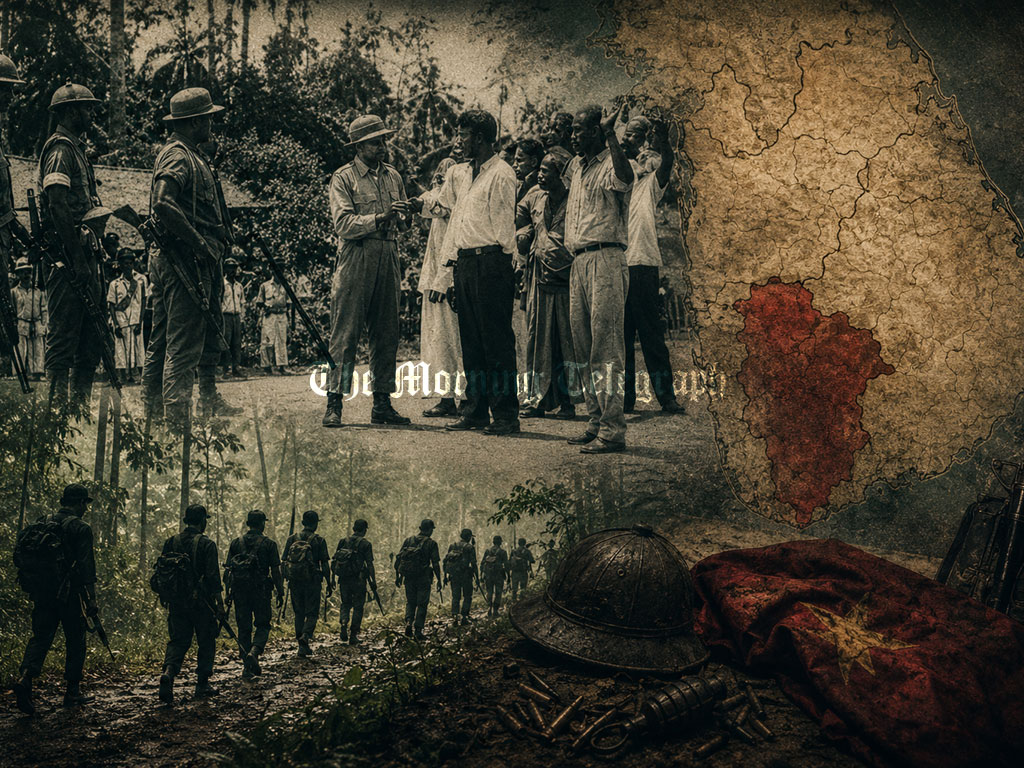
Kurunegala JVP uprising history reveals how the district became a 1971 rebel stronghold before survivors retreated to Wilpattu.
Kurunegala JVP uprising history remains one of the most overlooked chapters of the 1971 rebellion, from its district camps to the long retreat toward Wilpattu.
Kurunegala District played a decisive role in the April 1971 uprising. At the time, district committee leaders in both Kurunegala and Kegalle were selected by members themselves, rather than being appointed only according to the wishes of the JVP leadership.
The JVP leadership in Kurunegala also worked at the forefront without factional divisions, alongside activists such as Jayakody, who had broken away from the Dharmasekara faction. Even after the rebellion was defeated, the Kurunegala district leadership of the 1971 uprising managed to retreat to Wilpattu and continue giving leadership to its comrades.
During the April rebellion, the military coordinator for Kegalle District was Sarath Weeraratne, a commanding officer in the Air Force. Between 1968 and 1970, key activists in Kurunegala District included Kuliyapitiya Fernando, Gokarella Wimal, Rambadagalle Dharmaratne, Alawwa Samarakoon, also known as Gunathilaka, Mawathagama Sugath, and several others. After the factional conflict, a number of individuals linked to the Dharmasekara group were pushed aside.

Bola Samarase And The Kurunegala Command
The Kurunegala District leader was Samaratunga Devage James, born in Pahalamedagoda, Narammala, on 2 December 1943. He was also known as Bola Samarase, alias Piyal or Loku Aiya. His father, Devage Malhoda, was a farmer, while his mother, Maria, was from Mirigama. The couple had seven children.
Bola Samarase graduated from the University of Peradeniya. He entered the Faculty of Arts in March 1965 and graduated in 1968. While at university, he began his political journey with Nihal Dias’s Socialist Union. In 1968, he became the JVP’s Monaragala District leader. Four months later, he was appointed Kurunegala District leader. He later spent nearly a decade at his home in Narammala reflecting on his experiences and writing his autobiography.
During the 1970s, Kurunegala District divisional leaders included H. W. Jayathilaka of Polgahawela, Dharmaratne of Dodangaslanda, Sediris Hami of Wariyapola, Jayakody of Kurunegala, Cyril Somasiri of Gokarella, Herath alias Pulta of Mawathagama, Samarakoon Gunathilaka of Alawwa, K. D. Somasiri of Pothuhera, and Ranasgalle Gunadasa of Kuliyapitiya, among others. Samaratunga later observed that many capable activists later rose into leadership roles.
Political Camps Across The District
During the April rebellion, hundreds of political camps operated throughout Kurunegala District. Among them were three major camps, each with more than 100 participants. The strongest divisions were in Alawwa, Gokarella, Dodangaslanda, Kuliyapitiya, and Wariyapola.
By 5 April, around 750 rebels had joined the attacks. However, they failed to capture any police station. Kurunegala District alone had around 60 firearms and 2,500 improvised tin bombs. Only five firearms were available for the attack on the Kurunegala Police Station.
The Rebel Attacks
Nearly 150 rebels took part in the attack on the Kurunegala Police Station from several locations. Wickrama, a former student leader of Maliyadeva College, was killed while advancing in front of the station. Samaratunga, Jayakody, Salinda Dissanayake, and several others led the assault.
According to Bandara Tennakoon, who joined the operation, rebels attacked the Gokarella Police Station with a stockpile of weapons and bombs. However, the group dispersed under heavy police resistance. The Rambodagala group failed to arrive as planned.
Despite this, police were compelled, for tactical reasons, to abandon police stations at Ambanpola, Alawwa, Galgamuwa, Gokarella, Polgahawela, Mahawa, Kuliyapitiya, Mawathagama, and Wariyapola. Areas such as Ambanpola, Galgamuwa, Madahapola, Rambodagala, and Mahawa came under temporary rebel control.
By 1970, Sri Lanka had 266 police stations staffed by around 10,605 police personnel.
Dodangaslanda And The Rebel Base
Among the most determined and militant groups in the April 1971 uprising, Kegalle and Kurunegala held a prominent place. In terms of caste composition in Kurunegala District, a large number of rebels belonged to the Devapura or Wahumpura community.
In percentage terms, the largest number of rebels came from the Dodangaslanda Electoral District, which also suffered the highest casualties.
Several villages, including Pothuwapitiya, Maduragoda, Dehigama, Bulugoda, Katupotha, Ridigama, Melsiripura, Madahapolakanda, Poththewela, Wewagama, Rambodagala, Thalwatte, Rawketikanda, Diyadora, and Kavisigamuwa, became JVP strongholds. Rebel operations were organized from these bases across the district.
Camps After The Defeat
After the defeat of the April Rebellion, four major camps were established in Kurunegala District. Around 200 rebels gathered at a school in Madahapolakanda, Gokarella; around 80 were stationed at Ranthetikanda, Rambodagala; around 100 were based in Galgamuwa and Wewagama near Kuliyapitiya; and around 70 operated near Pallekele.
The leadership of these camps included Dharma, Mahinda Jayawardena, also known as Bullet Mahinda, Appuhami, Sumathi, Herath, Cyril, Kamal Nissanka, Dharmaratne, Thilake, and others. Smaller deployments were also established in several places, including the Arankelle forest.
The Pothuhera Group
Although the Pothuhera, Alawwa, and Polgahawela groups also retreated toward Wilpattu, this remained largely unknown to the public. Kamal Nissanka, one of the group’s leaders, later emphasized that several rebels were killed and many others were arrested by security forces while trying to escape in small groups.
Kamal joined the JVP through Wanathamulle Osman de Silva while studying at Wesley College, Colombo, in 1969. He attended classes conducted by Mabole Milton Fernando, one of the founders of the JVP. Today, Kamal Nissanka is a well-known lawyer.
Reflecting on his experiences, Nissanka said that by December 1970, he and his group had recruited more than 200 people through educational classes held in Kohilagedara, Wattegedara, Kudumbawa, Malagane, Bulugolla, Katupitiya, and Bolgodakanda within the Pothuhera Police Division. Activists raised money for gunpowder and ammunition by working on rented paddy fields.
On the night of 5 April, the Pothuhera Police Station was attacked. The exchange of fire lasted around ten minutes. Somasiri, the officially designated rebel leader of Pothuhera, did not join the operation, and leadership passed to Handugala K. Jinadasa.
After the attack, the group withdrew and established a camp in the Managala Hills, near Kudumbawa village on the border between Kurunegala and Kegalle districts. Many local supporters assisted the camp, and firearms were collected from nearby areas. Somasiri, who had not been seen since 5 April, returned to the camp on 10 April. By 15 April, around 40 people had gathered there.
On 25 April, the Air Force bombed the Managala camp. The remaining 30 members retreated to Yogamuwakanda, Polgahawela. On 9 May 1971, the Rambukkana group arrived at Parape Kanda and joined them. The Pothuhera, Alawwa, Polgahawela, and Rambukkana groups later merged under Tilak Weerasena of Rambukkana. Only a small number eventually reached Wilpattu.
The Retreat To Wilpattu
Although a retreat plan had been prepared in case the attacks failed, no specific destination had first been chosen. Eventually, the Kurunegala group decided to withdraw to Wilpattu, and the Kegalle group agreed to join them.
Their route passed through Mampitiya Temple, Ragala Temple, across the Ma Oya, Hambeli Kanda, Medagoda, Hurukgamuwa Kanda, Nathagane, Yakdehigala, Madahapolakanda, Pallekele, Galgiriya, and Palugolla Devalaya before finally reaching Wilpattu. Along the way, they faced repeated attacks from the Army and Air Force. Several people were killed, and the group often split and regrouped while evading security forces.
By then, nearly two months had passed, and only a fraction of the original force remained. Many had abandoned the journey, while others had been killed or captured. Among those killed were Kagama Upasena and Sujatha Hadagama.
The surviving group reached Wilpattu on 17 June 1971. It included Samaratunga, Thulihiriye Ari, Podi Disa, George, Rahula, and others. They were joined by around 60 rebels from Anuradhapura led by Kalu Wijé, including Vipulasena, Marasinghe, Heenbanda, Wilbert, and Gamini Samaranayake. The combined force was divided into five groups, each assigned responsibilities such as coordination with Colombo and establishing farms in Siyambalanduwa and Namal Oya.
Surrenders To The Government
During the first four days of May 1971 alone, 3,978 rebels surrendered to the government across the country. Of them, 164 were from Kurunegala District.
In some areas, entire families joined the rebellion. One notable example was the Kahagallage family. The parents were Karnis Singho Kahagallage and Podinona of Parape Dewayala. They had nine children, including four sons.
One son, Jinadasa, served as deputy leader of the group that attacked the Pothuhera Police Station. Several rebels, including Podi Appuhami, were killed during the operation. Jinadasa was later killed on 14 April 1971 in Ranmalgoda village.
Other family members, including Piyadasa, Daya, Kanthi, Violet, Nimal, Sunil, Rosaline, and Latha, joined the Pattharagala camp during the uprising. They were later arrested and reportedly subjected to different forms of torture.
Rewards For Samaratunga And Jayakody
On 8 November 1974, the government announced a reward of Rs. 30,000 for information leading to the arrest of James Samaratunga, and a further Rs. 15,000 reward for the officer who captured him. According to the IGP’s notice, he was wanted in connection with rebellion-related activities in Polonnaruwa, Dambulla, Hingurakgoda, Kegalle, Kurunegala, and Alawwa.
Similarly, on 22 December 1971, the IGP announced a reward of Rs. 3,500 for information leading to the capture of Jayakody Arachchige Gunaratne, the second-ranking leader in Kurunegala District.
Jayakody, the 41st accused in the April case, initially joined the JVP through the Dharmasekara group. However, during the conflict between Wijeweera and Dharmasekara, he left that faction and aligned directly with the JVP. Samaratunga later said the contribution made by Polgahawela Jayakody, who served as a military officer within the Kurunegala organization, was invaluable.
After the rebellion was defeated, Samaratunga led a large group that retreated to Wilpattu through Kegalle and Pallekele. Although he was arrested in Nugegoda in 1974, he escaped. He was eventually rearrested by the Terrorism Investigation Division in Siyambalanduwa, Monaragala, on 1 July 1976.
After the Criminal Justice Commission was abolished, Samaratunga was released with other rebels on 2 November 1977. He later married Leela Senaratne of Dikella, Kegalle, in May 1978. They had two children. Their eldest son, Janaka, became an engineer, while the younger son, Indika, later served as a Grama Niladhari.
The Criminal Justice Commission completed not only the main investigation into the April 1971 rebellion but also around 140 related investigations by 4 November 1976. The accused were charged under Section 115 of the Penal Code with conspiring to wage war against the Crown between 1 January 1968 and 31 December 1971.
Investigations In Kurunegala
The Pothuhera Investigation, conducted under Case No. 32, charged 45 suspects, including G. K. W. Nissanka, alias Kamal, with conspiring to wage war in Pothuhera, Kohilagedara, Kudumbawa, Bulugolla, and surrounding areas.
The Polgahawela Investigation, conducted under Case No. 33, involved alleged conspiracies at Polgahawela, Yogamuwakanda, Godawela, and other locations. Twenty-eight suspects, including H. W. Jayathilaka, were charged.
Under Investigation No. 35, relating to Alawwa, S. M. A. S. P. Gunathilaka, alias Samarakoon Gunathilaka, and 69 others were charged with conspiring to wage war in areas including Alawwa, Yasaragama, Walakumbura, and Bujjomuwa.
In addition, five other commissions of inquiry were conducted in Kurunegala District concerning the deaths of police personnel in Kuliyapitiya, Mahawa, Kurunegala, and Giriulla.