By Roshan Jayasinghe
Human progress comes into focus during an eight-day motorcycle journey across the American West, raising questions about knowledge, dignity and legacy.
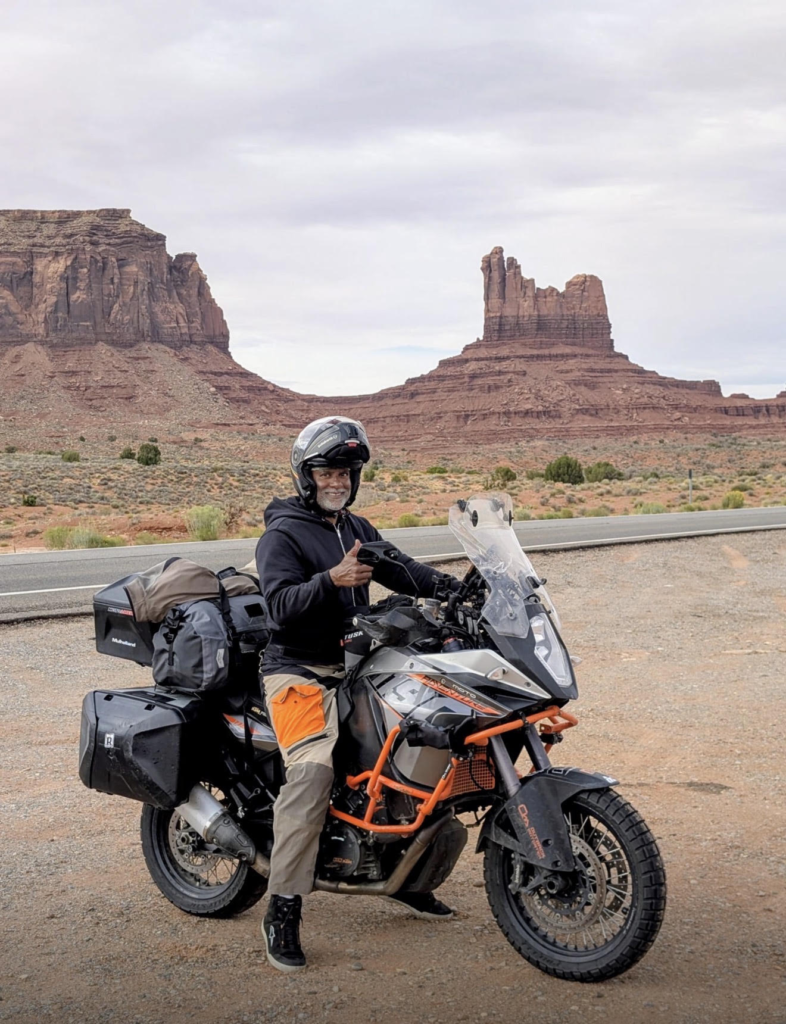
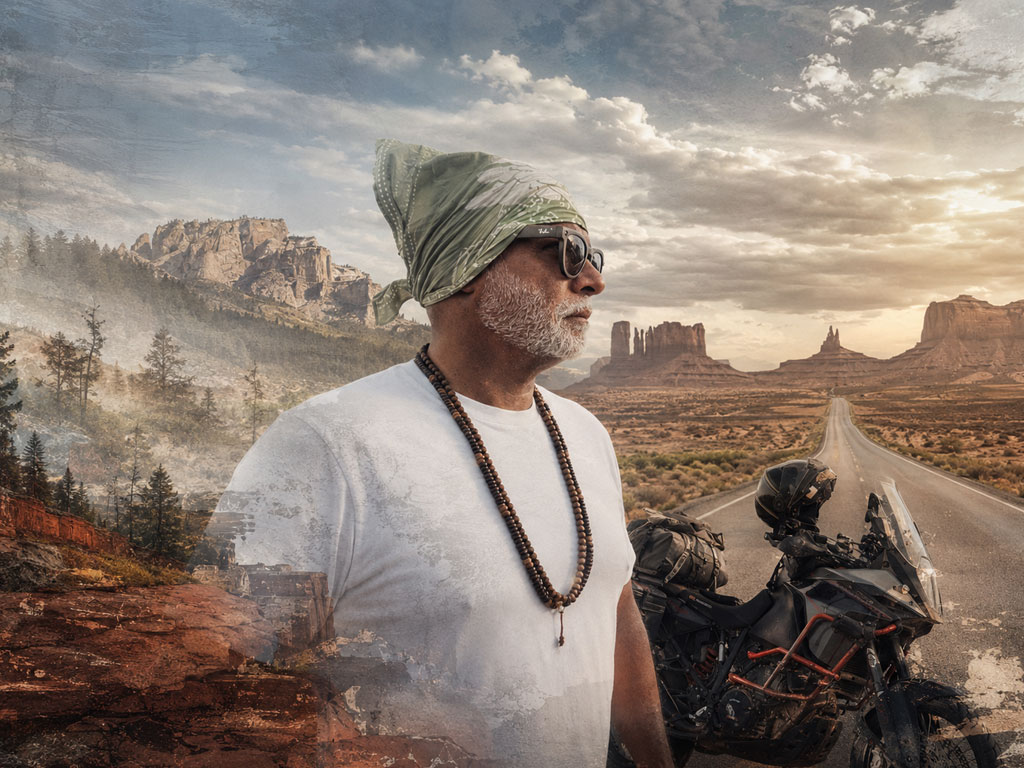
For the past eight days I have been travelling on my motorcycle through Utah, Wyoming, South Dakota, Colorado and Arizona. When you travel this way there is very little separating you from what surrounds you. You feel the temperature changing as you climb and descend, the dryness of the desert, the cold coming through the mountains, the wind moving across enormous open spaces. Vegetation changes, sometimes within a surprisingly short distance, and you begin noticing different forms of life existing within the particular conditions around them. Most of all, I found myself continuously looking at the mountains, canyons and extraordinary rock formations and asking a simple question: how did all of this come to look the way it does?
Utah seemed to have one character, Colorado another. Wyoming opened itself into enormous spaces, while South Dakota presented formations completely different again, and Arizona changed the picture once more. Sometimes within the same day’s ride the Earth seemed capable of changing its appearance entirely, the colors, the rocks, the elevation, the vegetation, the living beings around me all shifting together, and yet everything I was seeing belonged to the same planet beneath my wheels.

I am not a geologist, astronomer or biologist, and I did not find myself riding through these places trying to become an educator on any of them. I was simply trying to comprehend what I was seeing through what I understand from the knowledge humanity has accumulated before me. As I understand it, the Earth beneath us formed billions of years ago, and these landscapes were shaped over periods of time almost impossible for me to grasp. Movement within the Earth, water, wind, ice, heat, pressure and erosion continuously worked upon what existed before, and over millions of years the extraordinary formations I was now riding through became what I could see today.
Once I began looking at them that way, the mountains and canyons became something more to me than scenery. Those exposed walls seemed almost like time made visible, one layer resting upon another, each carrying something from a period that existed long before us. What I was looking at as one canyon or one mountain was actually the accumulated consequence of everything that had happened before it. Nothing standing there today existed independently from its history, and the same thought began extending to everything living around me. We have created classifications for life because they help us understand and communicate what we observe, but looking across those landscapes I found myself thinking less about the categories and more about the simple fact of life itself: different living beings, different forms, different conditions, all occupying this same Earth, all products of an extraordinary length of adaptation that eventually produced the diversity we see around us, and eventually produced us.
And here we are, another living form within this enormous process, but with a capacity that has changed our relationship with everything around us. We can experience existence and then turn around and examine it. We can look at a canyon and ask how it formed, look at the Moon and calculate where it is, study stars whose light has travelled distances almost impossible for me to imagine. Most remarkably, we have learned how to preserve what one human being discovers so that another does not have to begin again. One generation observes, another inherits the observation, questions it, measures it, corrects it, teaches it, and knowledge accumulated across thousands of years and countless lives can eventually be placed before a child within minutes. When I really think about that, our ability to accumulate knowledge is almost as extraordinary to me as some of the landscapes I was riding through.
There was a time when human beings looked at the Moon and could only wonder what it was. Today we know something about its formation, its distance from us, its relationship with our planet, and human beings have actually stood upon it. None of this knowledge removes the mystery or beauty for me. If anything, knowing even a little about what I am looking at makes our existence here more extraordinary, not less.
But another realization became important to the direction of my thoughts during this ride. I was admiring all of this natural formation, but I was able to reach so much of it because human beings had created a way for me to get there. Beneath my motorcycle was a road built by people I will never know, carrying me across mountains, deserts, rivers and distances that would otherwise have stopped me. And then there was the motorcycle itself, something especially close to me because of how much I simply love riding one. Nature did not give me that machine. Human imagination did, generations of accumulated knowledge, engineering and experimentation eventually producing something that let me travel through five states in eight days and place myself in front of formations that took millions of years to become what they are. A human creation was allowing me to experience natural creation, and that reminded me that I do not see human constructs themselves as something negative. A road can connect us. A bridge can carry us across something that once separated us. Medicine can preserve life. Human construction can be magnificent when it serves human possibility.
And this is where the ride began reconnecting with thoughts I have carried for years. If human beings have developed enough intelligence to understand events that happened to the Earth billions of years before we existed, and enough to build roads through mountains and machines that carry us across continents, why do we still have such difficulty applying that same intelligence to the way we live with one another? We can calculate the movement of planets and determine the age of ancient rock, yet one human being can still look at another living through exactly the same tiny moment of Earth’s history and decide that one is somehow superior to the other.
That contradiction has troubled me for years, and what I saw during these eight days did not give me a new philosophy so much as reaffirm what I have increasingly come to understand. Human constructs are not the problem; we need them. Language is a construct. Governments, laws, economies, schools, businesses and communities are constructs through which billions of people cooperate, and I am not imagining a world without them. What I keep returning to is something closer to a responsibility that comes with being able to build at all: if our capacity to construct is this extraordinary, we might owe it to ourselves to stay conscious of what those constructs are actually meant to serve. Whatever we build, whether a government, an economy, a school or simply the way we run our own household, the question I keep asking is whether the human beings living inside it are being given the same worth and dignity we expect for ourselves. That is not a question belonging to one country or one political idea. Our cultures can remain different, our languages different, our traditions different, without human equality requiring human sameness. Difference does not require superiority, and disagreement does not need to curdle into hatred.
When I looked at nature during this journey, another observation kept returning to me. The mountain does not know the border drawn across it. The river does not understand the political system it passes through. I am not using that to argue against civilization; it simply reminds me of the difference between what existed before us and what we constructed afterward, and maybe the trouble begins when we forget that we built these things ourselves, which means we remain entitled to examine them again. Capitalism, corporations, governments, borders and monetary systems are human constructs. They have contributed real innovation and real opportunity to the world we live in, but none of them arrived from nature as a permanent condition of human existence, and human beings have changed them before. My concern is not replacing one rigid system with another and declaring the new one correct, because that would just be another construct claiming superiority and possibly repeating the very condition we were trying to escape. The question is simpler than that: whatever name we give a system, is it serving humanity? Where it is, strengthen it. Where the evidence shows it repeatedly undermines dignity or wellbeing, we should have the courage to reconsider it, the same way we redesign an engineering failure or correct a scientific error once we know better.
That responsibility does not belong only to governments, because governments are made of human beings, and so are corporations, communities and families. Eventually every large structure returns to individual minds making decisions within it, which means I have a share in that responsibility too, and so does anyone with the freedom to participate. Not because any of us holds the final answer, but because accepting an inherited construct without ever questioning its consequences is itself a choice.
Maybe this is another way to measure progress. We measure economic growth, technology, productivity and wealth, and all of that tells us something about what humanity has become capable of doing. It does not necessarily tell us what humanity has become. Progress might also mean asking whether our accumulated knowledge is reducing unnecessary suffering, whether we are learning to disagree without needing to hate, whether we recognize equal human dignity regardless of where someone happened to be born. I do not claim to have answers to those questions. I have simply come to believe more strongly that we already have enough accumulated knowledge to ask them seriously.
Everything I was able to understand while looking at those landscapes came from people I will never know, who studied the rocks and the movement of the Earth, who recorded history and documented what war and exploitation produced alongside what cooperation and compassion produced. None of us created that knowledge individually. We inherited it, and maybe our responsibility now is not simply to keep adding to the inheritance but to start using what we already know more consciously, on behalf of each other.
I am not imagining another ideology or another authority telling every human being how to live. Something simpler seems possible: preserving what we have learned, being honest about what strengthened human life and what repeatedly caused suffering, staying open to correction, and passing it forward. No generation should imagine it holds the final answer. Ours certainly does not. The people who follow us will know things we do not, and they should question us and improve on what we leave them, the same way accumulated knowledge has always moved forward.
And this brings me back to those canyon walls. Everywhere I looked I saw layers, one resting upon another, each carrying evidence of what happened before it, and no single layer had created the canyon on its own. I began seeing humanity the same way. We are standing on human layers left by generations before us: language, medicine, art, science, law and engineering, and darker layers too: conquest, slavery, exploitation and dehumanization. We cannot remove those layers because we dislike what they contain; we inherited their knowledge along with their ignorance, their achievements along with their mistakes. But standing before those canyon walls left me with one difference I cannot set aside: the canyon cannot choose its next layer, and we can.
We do not have to create the final human layer. We could not, even if we tried. We only need to use what we already know to make our layer better than what has already failed before, and leave it open for whoever follows to question it, correct it and build on it again. Every nation should be able to do that. Every community should. Every home should. The objective was never the victory of capitalism or socialism, one government or another, one party or one religion over another. The objective was always the human being.
The mountains I rode through will keep changing long after I am gone. Rivers will keep cutting through rock, wind and weather will keep shaping the surface, and new material will eventually become part of Earth’s history. Humanity is forming a layer too, right now, through what we create, what we accept, what we reject and what we choose to pass forward.
After eight days trying, in my own way, to comprehend what I was seeing, I came home not with an entirely new understanding but with a strong reaffirmation of something I have felt for years. We already know much about what strengthens humanity, and we already know much about what undermines it. Maybe our next progress is not another discovery at all. Maybe it is becoming wise enough to use what we have already discovered.
The canyon cannot choose what comes next. We can. We are not required to create the final human layer, only the one we are creating now, and it does not need to be the final layer to matter.
It only needs to leave something worth building on.
Author’s Note
This reflection is not offered as a scientific, political or economic prescription, nor as a claim to possess answers for humanity. It is simply an observation from one human being, shaped by what I have experienced, what I have learned from the accumulated knowledge of others, and what this journey reaffirmed in me. I believe every generation inherits both the achievements and mistakes of those before it. Our responsibility is not to claim the final answer, but to examine what we inherit honestly, improve what we can, and leave those who follow us a human layer worth building upon.
About the Author
Roshan Jayasinghe is a writer and observer of human systems. His work explores the gap between man made constructs and lived humanity, with a focus on how economics, trade and everyday choices intersect with questions of fairness, responsibility and inner alignment. Through essays for publications in The Morning Telegraph, he aims to remind readers that they are not passengers in a fixed machine, but active custodians of a shared world.