By Roy Denish.
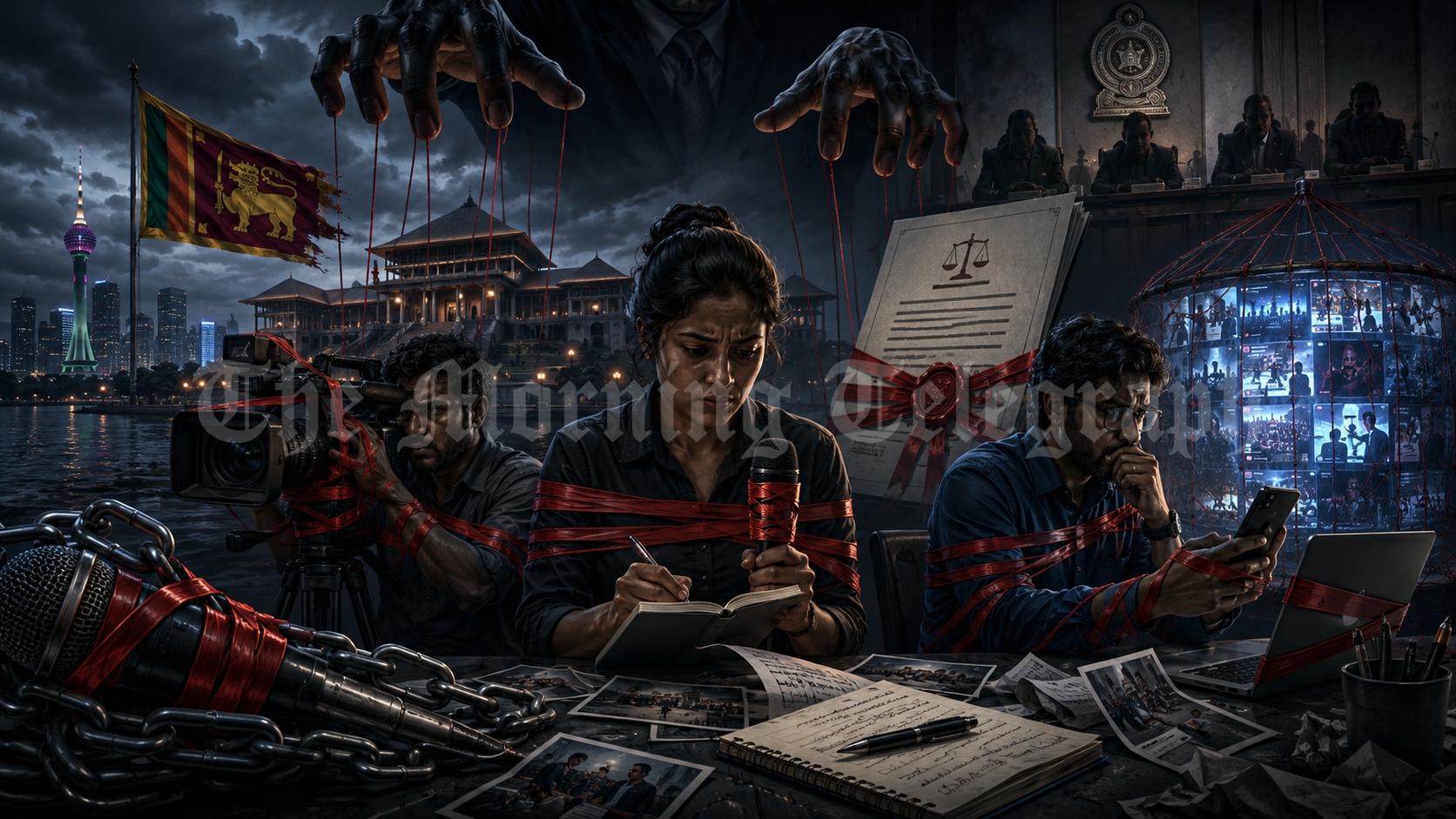
Sri Lanka’s new media bill, with its vague misconduct rules and political control over its first council, has triggered fears that censorship is being disguised as professional reform.
Legislation Driven by Fear, Not Statecraft
The gazetting of the Chartered Institute of Media Professionals of Sri Lanka Act is not an exercise in statecraft. It is an exercise in political cowardice.
By drafting legislation that seeks to shackle the press and police the digital public square, lawmakers have signalled a profound and trembling fear of public scrutiny.
True governance demands the strength to withstand criticism.
Yet this administration appears to prefer the fragile comfort of an engineered echo chamber, choosing to weaponise the law rather than confront the unfiltered reality of public opinion.
Political Control Built Into the Institution
The structural architecture of the bill exposes deep institutional insecurity.
Granting the subject Minister unilateral authority to appoint an Interim Council suggests that the proposed institute was never intended to operate as an independent guardian of journalistic integrity.
Instead, it risks becoming a bureaucratic instrument for suppressing dissent.
A body created to regulate journalism cannot claim credibility or independence when its foundational leadership is selected directly by a political authority.
Undefined Misconduct Creates a Blank Cheque
The decision to leave the meaning of “professional misconduct” undefined is particularly alarming.
This legislative ambiguity appears less like an oversight and more like a calculated tactic.
It effectively gives those in control a blank cheque to decide which reporting is acceptable and which journalists should be penalised.
Any report exposing corruption, incompetence or systemic failure could potentially be classified as an ethical violation if those definitions remain entirely in the hands of a politically influenced council.
Independent Journalists Could Be Silenced
Such vague disciplinary powers could be used to punish truth while maintaining the appearance of professional regulation.
Investigative reporters may be forced to reconsider stories that challenge powerful officials.
Editors may avoid publishing politically sensitive material, while journalists could begin censoring themselves to escape disciplinary inquiries or professional penalties.
The result would not be improved journalism.
It would be journalism weakened by fear.
Digital Creators Pulled Into Regulatory Dragnet
The decision to extend the proposed regulatory framework to independent creators on YouTube, Facebook and TikTok further reveals the anxiety gripping the legislative establishment.
Unable to control public narratives through traditional and more easily influenced channels, lawmakers now appear determined to extend their authority into the open internet.
Independent digital platforms have allowed citizens, journalists and commentators to bypass established gatekeepers and communicate directly with the public.
Bringing these spaces under a politically shaped statutory system threatens that independence.
Self-Censorship Appears to Be the Real Objective
The wider effect of the bill could be the cultivation of extreme caution among journalists and content creators.
Even when no formal penalty is imposed, the threat of investigation may be enough to produce widespread self-censorship.
This could deprive the public of independent ideas, competing interpretations and critical scrutiny.
The vibrant diversity of Sri Lanka’s civic commentary risks being reduced to hollow compliance, with creators saying only what they believe the authorities will tolerate.
The Internet Cannot Be Colonised by the State
The digital public square does not belong to ministers, political parties or government-appointed councils.
It belongs to the citizens who use it to debate, question, investigate and hold authority accountable.
Any attempt to place independent online expression under the supervision of a politically appointed institution should therefore be treated with extreme caution.
Regulation presented as professionalisation can quickly become censorship when definitions are vague, appointments are political and disciplinary powers are sweeping.
Authoritarian Systems Eventually Trap Their Creators
History offers a brutal warning to legislators who mistake temporary authority for permanent immunity.
Governments that construct legal machinery to suppress free expression often find themselves trapped within the same authoritarian structures they created.
Political power changes hands, but repressive laws remain.
The mechanisms designed today to silence one government’s critics may tomorrow be used against those who originally created them.
A Government Afraid of Criticism Is Already Failing
A State that treats criticism as an existential threat has already demonstrated intellectual and political weakness.
Confident governments answer allegations with evidence, reform and transparency.
Insecure governments respond with disciplinary bodies, vague offences and statutory intimidation.
Attempts to suppress uncomfortable reporting do not erase corruption, incompetence or failure.
They merely reveal how deeply those in power fear exposure.
Bill Must Be Withdrawn
If lawmakers retain any genuine commitment to the democratic principles they invoke for political survival, they must withdraw this draconian legislative overreach.
Journalistic standards should be strengthened through independent self-regulation, transparent ethical systems and professional development led by the media community itself.
They should not be imposed through a structure whose first leadership is selected by the Minister it may later be required to scrutinise.
Accountability Cannot Be Legislated Away
No government can legislate accountability out of existence.
No disciplinary council can permanently silence public frustration.
No statutory definition can sanitise the failures of a governing class that fears the people it was elected to serve.
The public will continue to question, investigate and demand answers.
The only choice available to lawmakers is whether they respond through democratic accountability or expose their insecurity by attempting to criminalise and discipline those who speak.
#SriLankaMediaBill #PressFreedom #MediaFreedom #DigitalExpression #FreedomOfSpeech #IndependentJournalism #MediaRegulation #DigitalCreators #SelfCensorship #SriLankaPolitics #TheMorningTelegraph