By Roy Denish
Sri Lanka’s X-Press Pearl legal battle has reignited fierce debate over institutional accountability, the Attorney General’s Department, and the country’s pursuit of environmental justice after one of the world’s worst maritime disasters.
The parliamentary floor recently became a heated battleground over institutional accountability and the slow execution of the state’s landmark environmental rulings. Samagi Jana Balawegaya lawmaker Ajith P. Perera raised sharp questions regarding the government’s progress on its policy pledge to establish an independent Prosecutor’s Office alongside a special Parliamentary Ombudsman. Perera argued that such a mechanism is vital to ensure aggrieved citizens can formally challenge decisions made within the Attorney General’s Department, preventing high-profile jurisdictional missteps from repeating.

Justice and National Integration Minister Harshana Nanayakkara responded to the chamber that while the government remains fully committed to positioning the Ombudsman to oversee potential deficiencies, final implementation must await an upcoming comprehensive report detailing the exact division of powers between the traditional Attorney General’s Office and the proposed independent prosecution system. Later in the session, Perera clashed with ruling party lawmaker Ajith Niroshana over allegations involving Dulanjali Jayakody, the sister of Opposition Leader Sajith Premadasa, clarifying that she had not been charged with possessing forged currency notes but had only discovered counterfeit bills when attempting a bank deposit from a loan repayment.
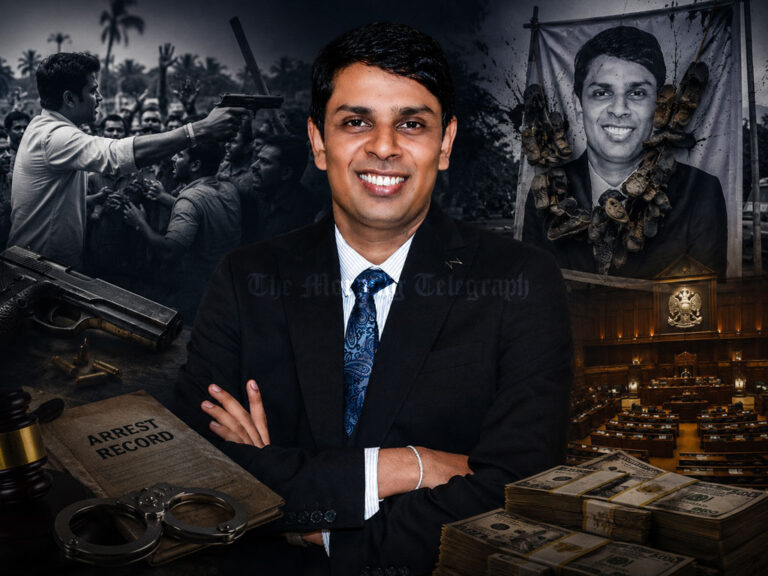
This intense legislative debate directly mirrors the sweeping judicial condemnation of the Attorney General’s Department over its handling of the MV X-Press Pearl maritime disaster, which has ignited an intense national debate regarding institutional accountability and the professional future of former Attorney General Sanjay Rajaratnam. While critics and civil society groups have called for extreme punitive measures against the former state law officer, leading legal analysts argue that demands for his formal disbarment cross a dangerous line from structural reform into unprecedented professional overreach.
The controversy surrounding Rajaratnam formidably peaked following a landmark three hundred and sixty-one page judgment issued by the Supreme Court of Sri Lanka in a Fundamental Rights case. The five-judge bench, led by outgoing Chief Justice Murudu Fernando, ordered the vessel owners to pay one billion USD in interim compensation directly to the state, bypassing a parallel civil claim filed by the state in Singapore. In its ruling, the court explicitly flayed the initial decision to grant the Singapore International Commercial Court exclusive jurisdiction, labeling the move as unreasonable, irrational, and arbitrary. The justices noted that because the vessel sank within Sri Lanka’s twelve nautical mile territorial waters, the state possessed absolute sovereign jurisdiction which was effectively sidelined by its own legal apparatus.
The Supreme Court further observed that the department under Rajaratnam had willfully ignored a government-appointed expert committee and scientific panels that explicitly advised against a foreign venue, where international maritime conventions strictly cap corporate liability. By moving the litigation out of the Commercial High Court of Colombo, the department risked decimating Sri Lanka’s estimated six point four billion USD environmental damage claim. Compounding the judicial rebuke, the court noted long-standing public anxieties regarding potential high-level collusion or interference, prompting a directive for the Criminal Investigation Department and bribery officials to aggressively investigate the decision-making process.
The debate over accountability for the X-Press Pearl handling is heavily colored by Rajaratnam’s broader, highly polarized record during his tenure from May 2021 to June 2024. Throughout his thirty-six months in office, his administration faced persistent public pressure for failing to implement the critical recommendations of the Presidential Commission of Inquiry into the 2019 Easter Sunday suicide bombings. He also drew heavy fire from human rights groups for facilitating prolonged pretrial detentions under the Prevention of Terrorism Act, and from opposition lawmakers who pointed to a systematic pattern of dropping or altering indictments against prominent politicians facing financial fraud and corruption charges. The friction culminated at the end of his term when executive attempts to grant him a six-month service extension past the mandatory retirement age were repeatedly blocked by the Constitutional Council.
Despite this deeply controversial administrative record and the severe rebuke by the highest court, the threshold for removing an attorney from the professional roll remains a distinct legal standard that a tactical litigation failure cannot satisfy. Disbarment under Sri Lankan law requires definitive proof of moral turpitude, professional malpractice, or criminal fraud. The Supreme Court’s finding that a legal strategy was irrational or arbitrary constitutes a rejection of departmental logic, but it does not automatically equate to personal professional misconduct. Legal scholars emphasize that an erroneous or highly flawed interpretation of jurisdictional advantage does not meet the stringent criteria of ethical depravity required to strip a lawyer of their professional livelihood.
Furthermore, the decision to file the civil compensation claim in Singapore was not an isolated, rogue maneuver conducted by Rajaratnam in a vacuum. The strategy was explicitly backed by extensive consultations with retained international maritime legal firms and ultimately received formal Cabinet approval. Punishing a former law officer with disbarment for executing a state-vetted litigation strategy would create an untenable precedent, effectively holding an individual personally and professionally liable for collective executive decisions.
Attempting to disbar a former Attorney General over a contested litigation strategy risks dealing a devastating blow to the operational independence of future state counsels. Law officers representing the state must be permitted to evaluate legal risks, assess foreign enforcement mechanisms, and make complex jurisdictional choices without the looming threat of professional annihilation if those strategies are subsequently overturned by a court. While the Supreme Court has rightly stripped the department of its autonomy over the X-Press Pearl compensation by appointing an independent commission, maintaining the separation between a deeply flawed institutional decision and individual professional decertification remains vital to preserving the rule of law.
Amidst these profound legal disputes, the current administration has maintained a conspicuous public silence regarding systemic punitive actions against the former leadership of the legal department. This reticence stems from acute diplomatic and operational considerations, as the government is actively attempting to avoid actions that could disrupt the delicate collection mechanism of the newly ordered one billion USD interim settlement from the Singapore-based parent company. Initiating aggressive domestic prosecutions against the former state law officers who engineered the prior legal agreements could inadvertently provide corporate defense teams in Singapore with legal ammunition to delay payments or argue bad faith, thereby jeopardizing the recovery of funds crucial for environmental restoration.
The executive branch is seeking to prevent a complete collapse of institutional morale within the Attorney General’s Department, where career state counsels have expressed profound anxiety over the prospect of criminal exposure for past strategic decisions authorized by the state. This silent posture also reflects the ongoing transition within the legal framework, as government officials prioritize long-term structural changes, specifically the impending separation of prosecutorial powers and the creation of an independent ombudsman rather than pursuing polarizing, retroactive penalties that could fracture the state’s existing legal operations.
As the scrutiny surrounding his long career persists, the academic and institutional training underpinning Rajaratnam’s decades in public service has become a point of renewed attention. Born into a prominent legal family, his father was a seasoned advocate and his grandfather was a crown proctor. Rajaratnam pursued his foundational schooling at St. Peter’s College, Bambalapitiya, and later at Royal College, Colombo, before entering the formal legal academy. He received his professional qualification from the Sri Lanka Law College, where he qualified as an attorney-at-law prior to joining the Attorney General’s Department as a state counsel in April 1988. Rajaratnam subsequently pursued postgraduate legal education abroad, obtaining a Master of Laws degree from Queen Mary University of London, which enabled him to qualify as a solicitor in England and Wales. This advanced international training in civil and corporate frameworks eventually supported his appointment as a President’s Counsel in November 2014, preceding his subsequent elevations to Solicitor General and ultimately the head of the state’s legal apparatus.
The legal debate triggered by the MV X-Press Pearl encapsulates a classic conflict between classic international maritime treaties and evolving international environmental law. When the Attorney General’s Department elected to file the civil compensation claim in the Singapore International Commercial Court, the legal strategy relied on traditional private international law rules. Because the vessel was flagged in Singapore, its operators, managers, and registered owners were corporate entities domiciled within that jurisdiction, making it an attractive venue for executing a potential multi-billion dollar judgment.
However, this commercial framework directly collided with global liability restrictions. Singapore is a signatory to the 1976 Convention on Limitation of Liability for Maritime Claims, commonly known as the LLMC. Under the LLMC, a shipowner’s civil liability is strictly capped based on the gross tonnage of the vessel. For a container ship of the X-Press Pearl’s size, these rigid international caps threatened to limit total damages to a fraction of the actual economic and environmental loss. Local legal experts repeatedly warned that Sri Lanka’s extensive claims would be decimated under Singapore’s maritime limitation laws. By applying public law remedies through a Fundamental Rights framework, the Supreme Court of Sri Lanka chose to bypass these restrictive commercial treaties entirely. The court’s baseline argument was that a sovereign nation has an inalienable right to protect its territorial waters, which extend twelve nautical miles from its coast. Because the chemical explosion and subsequent sinking took place well within this zone, domestic jurisdiction was paramount. The five-judge bench effectively elevated the Polluter Pays Principle—a well-established tenet of customary international environmental law above the private commercial protections provided to shipowners by global maritime shipping pacts.
The global maritime industry, led by the vessel’s operator, X-Press Feeders, and its protection and indemnity insurer, The London P&I Club, has expressed deep alarm over the domestic judgment, viewing it as a destabilizing departure from unified maritime laws. The sector’s defense focuses heavily on procedural due process and the disproportionate allocation of operational fault. Shipping representatives argue that unilateral domestic judgments ordering massive, absolute penalties undermine the global predictability that maritime insurance and international trade rely on. By overriding standard treaty caps, the ruling introduces severe financial risks that could dramatically elevate international freight insurance premiums for vessels traversing the Indian Ocean.
The industry has strongly condemned the court’s public condemnation of the vessel’s Master, Captain Vitaly Tyutkalo, who has been under a strict domestic travel ban in Sri Lanka for several years. Maritime groups argue that evaluating the Master’s operational decisions within a civil fundamental rights case, where he lacked direct legal representation—amounted to pre-judging a separate criminal trial and using ship personnel as human collateral to force financial compliance from foreign owners. The maritime sector contends that the judgment unfairly shifts the entirety of the blame away from state authorities. The defense maintains that the ship’s crew made repeated, documented pleas for help regarding a leaking nitric acid container, which were summarily rejected by consecutive ports in Qatar, India, and Sri Lanka. Furthermore, the industry highlights that local environmental authorities failed to issue timely directives to tow the burning vessel into deeper waters, an omission that severely exacerbated the ultimate coastal contamination. While the maritime sector acknowledges that catastrophic environmental damage occurred, it maintains that final reparations should be governed strictly by independent, scientifically verified assessments rather than unilateral sovereign decrees that sidestep accepted international maritime law.