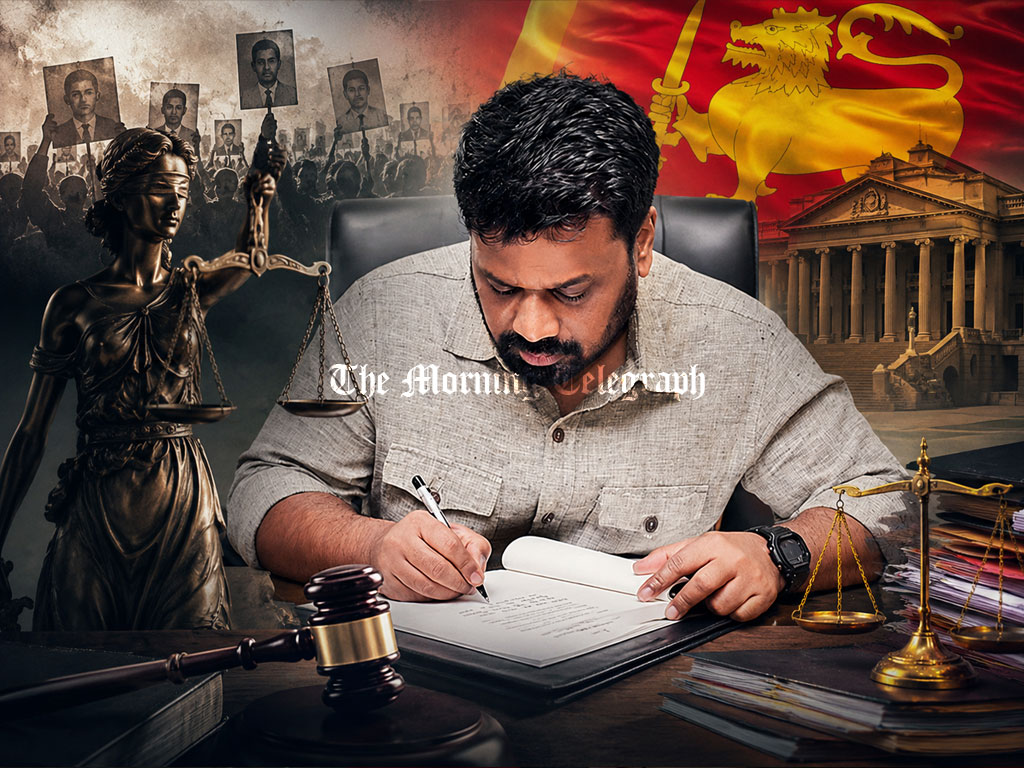
Anura Dissanayake’s justice pledge raises a difficult question over whether accountability will also confront the JVP’s own violent past.
Anura Dissanayake’s justice pledge has placed accountability at the centre of his government’s message, but it also raises a difficult question about whose crimes will truly be investigated.
When President Anura Kumara Dissanayake recently declared in Parliament that no crime committed in Sri Lanka would go unheard, he again placed justice at the heart of his government’s political narrative. It was a statement meant to resonate with a country carrying decades of unresolved wounds: disappearances, political assassinations, corruption allegations, abuse of state power and families still searching for answers about loved ones lost to violence. But justice is not a decorative phrase to be displayed from the podium of power. It is a demanding principle that becomes meaningful only when it reaches the places where political convenience ends. A government does not prove its commitment to justice by pursuing only the crimes of its predecessors. It proves it by showing the courage to investigate uncomfortable questions within its own political history, institutions and circle of influence.

The President’s recent parliamentary remarks also raised a fundamental question about the gap between promising accountability and practising it. While he spoke of crimes being investigated and justice being delivered, several questions raised in Parliament over alleged financial irregularities and reported issues linked to ministries and institutions under his government’s authority remained without comprehensive answers. The issue is not whether every allegation is true. Allegations must be tested through evidence, investigation and due legal process. But a government that demands public confidence cannot at the same time expect public silence when questions arise about its own administration. Transparency cannot be selective. Accountability cannot be a one-way road where scrutiny flows only towards political opponents while allies and institutions connected to the government remain shielded by political discomfort.
The deepest test of President Dissanayake’s promise lies not in investigating the failures of others, but in confronting the unresolved chapters of his own movement’s past. If no crime committed in Sri Lanka should go unheard, then that principle must include the victims of the Janatha Vimukthi Peramuna’s second insurrection between 1987 and 1990, one of the darkest periods of political violence in the country’s modern history. During that time, thousands became victims of brutal violence involving multiple actors. Among them were student leaders, university activists, trade union members, political organisers, academics, journalists and ordinary civilians targeted because of their political identity, social links or simply because they were trapped in an atmosphere of fear and ideological conflict.
Names such as Daya Pathirana, a prominent student leader assassinated in 1986, remain part of the painful historical record of political violence linked to that era. Numerous student activists and youth leaders were abducted, tortured and killed during the period of JVP militancy. Many families have spent decades carrying unanswered questions, not knowing whether the state, political movements or individuals responsible for those crimes would ever face meaningful accountability. Their suffering has remained suspended between history and justice, remembered during political speeches but rarely addressed through serious institutional processes.
This is where the credibility of President Dissanayake’s promise will ultimately be measured. It is easy for governments to investigate the crimes of defeated opponents. It is politically rewarding to expose corruption linked to previous administrations. It is far more difficult to examine the allegations, controversies and historical responsibilities connected to one’s own political family. Yet that is precisely the difference between genuine justice and political theatre.
A movement cannot demand moral superiority while refusing to examine the uncomfortable parts of its own past. A government cannot claim to be building a new political culture while inheriting the same habits of selective memory that have defined Sri Lankan politics for generations. The language may change. The faces may change. The slogans may change. But if accountability continues to operate according to political convenience, then the structure of impunity remains untouched.
President Dissanayake has repeatedly spoken about a civilised political culture and a different standard of governance. But such a culture is not created by controlling criticism or asking citizens to place unquestioning faith in powerful institutions. It is created when those institutions are strong enough to withstand criticism. Recently, the President asked the public to avoid criticism of individuals appointed to sensitive positions connected to criminal investigations, public security, anti-corruption mechanisms and other areas of state authority. Institutional independence is essential, but independence does not mean immunity from public scrutiny. Those entrusted with extraordinary power must also accept extraordinary responsibility.
Sri Lanka’s history shows the danger of allowing political movements to become judges of their own morality. Governments have repeatedly justified actions in the name of security, stability or national interest, only for later generations to question whether those powers were abused. The Prevention of Terrorism Act remains one of the clearest examples of how exceptional powers can create serious human rights concerns when safeguards become weak. Any leader who speaks about justice must also confront the possibility that the state itself has previously failed to deliver justice.
The irony is that President Dissanayake’s political rise was built largely on public anger against corruption, privilege and the failures of traditional political elites. That anger was legitimate and reflected genuine frustration among citizens. But once a movement enters government, it inherits a greater responsibility. It must be judged not by what it promised while outside power, but by what it does when holding power.
Justice cannot have a political boundary. A victim does not become less worthy because the accused belongs to a movement that now governs. A crime does not become less serious because acknowledging it creates political discomfort.
If President Anura Kumara Dissanayake truly believes that no crime in Sri Lanka should go unheard, then that principle must begin with every victim, including those who suffered during violence associated with the JVP’s own history. The first investigation into political violence should not always begin with the enemies of the government. Sometimes, the most important investigation begins inside one’s own political house. History does not ultimately remember leaders for the accusations they made against others. It remembers whether they had the courage to confront the truths that were hardest for themselves to accept.