SLBFE compensation fund of Rs. 5 billion faces scrutiny after unpaid Kuwait worker money was allegedly kept in banks for 30 years.
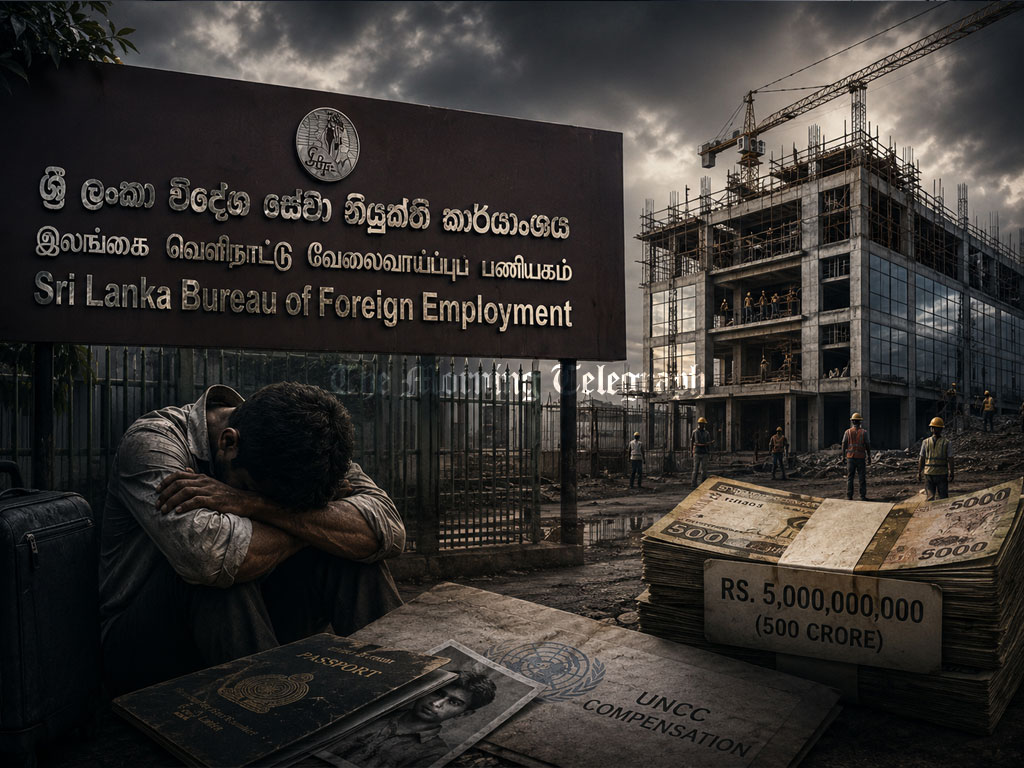
SLBFE compensation fund concerns have intensified after reports that Rs. 5 billion linked to unpaid Kuwait worker compensation may be used to construct a new building.
A massive fund reportedly kept in banks for 30 years without paying a single rupee to some rightful claimants, while interest continued to accumulate, is now allegedly being prepared for use in the construction of a new building for the Sri Lanka Bureau of Foreign Employment.

Rightful Owners Unpaid, Money in Fixed Deposits
Through the intervention of the United Nations Compensation Commission, a compensation sum of US$320 million was provided to Sri Lanka for nearly 90,000 workers who were sent back to the country due to the war situation at the time.
It is said that compensation was distributed to 87,000 workers.
However, the amount of Rs. 2 billion owed to the remaining 948 workers has allegedly not been paid to the rightful owners. Instead, it has reportedly been kept in fixed deposits by the Bureau of Foreign Employment.
With interest accumulated over 30 years, the value of the fund has now reportedly risen to Rs. 5 billion, or 500 crore.
Why Was the Bureau Silent for 30 Years?
The Bureau cites the lack of official verification of documents and certificates of these 948 workers, as well as the lack of information about some individuals, as the reason for not paying the compensation.
But the most serious question is why, in an era of advanced technology where information can be traced at village level, the Bureau of Foreign Employment has not taken any systematic or progressive action over 30 years to find these workers and pay them what they are owed.
Is it the responsibility of a state institution to keep the money of helpless workers in banks and earn interest, while washing its hands of the matter by saying there are “no documents”?
A Building Planned With Workers’ Tears
The latest information now reveals that authorities are planning to use this Rs. 5 billion fund, whose owners they failed, or did not attempt, to find, to construct a new building for the Bureau of Foreign Employment.
This arbitrary decision has already drawn strong opposition from within the Bureau as well as from many external parties.
A serious question now arises over what legal or moral basis exists to use a compensation fund received in the name of Sri Lankans who suffered in the Middle East and helped bring foreign exchange to the country for constructing physical buildings.
Questions That Must Be Answered
Authorities must now answer serious questions regarding this Rs. 5 billion fund.
First, what official steps were taken over 30 years to find these 948 workers or their family members?
Second, under the conditions of the United Nations Compensation Commission, is there legal permission to use unclaimed compensation funds for other administrative activities or building construction?
Third, why can this fund not be further allocated to a special project to find the compensation claimants, or to support the welfare of workers currently stranded or abandoned abroad?
Is this a robbery of the rights of innocent people who once fled for their lives? Or is it the unavoidable result of yet another failure and inefficiency within the state machinery?
SOURCE :- HARI DESHAYA