By Dwayne Ferreira
Virtual net metering could widen solar access in Sri Lanka, but fair selection, billing transparency and scale remain the real tests.
Virtual net metering sits at the heart of Sri Lanka’s latest clean energy announcement, and the issue goes far beyond panels on rooftops.
The Asian Development Bank’s approval of a $57.4 million financing package for rooftop solar aggregation and virtual net metering carries a larger message. It points to a possible shift in how Sri Lanka shares the benefits of renewable energy, especially with people and businesses left outside the rooftop solar boom.
The headline figure matters. The project will support a total estimated investment of $80.5 million. That includes a $35 million concessional loan, grants from the European Union and the Japan Fund for the Joint Crediting Mechanism, and counterpart funding from local implementing agencies.
Yet the real takeaway is not only the money.
It is the model.
For years, rooftop solar in Sri Lanka has mainly benefited those who had three advantages: a suitable roof, access to capital, and control over the building they occupied. As a result, many small businesses, renters, apartment dwellers, community groups and low-income consumers remained outside the system.

How Virtual Net Metering Expands Access
Virtual net metering aims to change that.
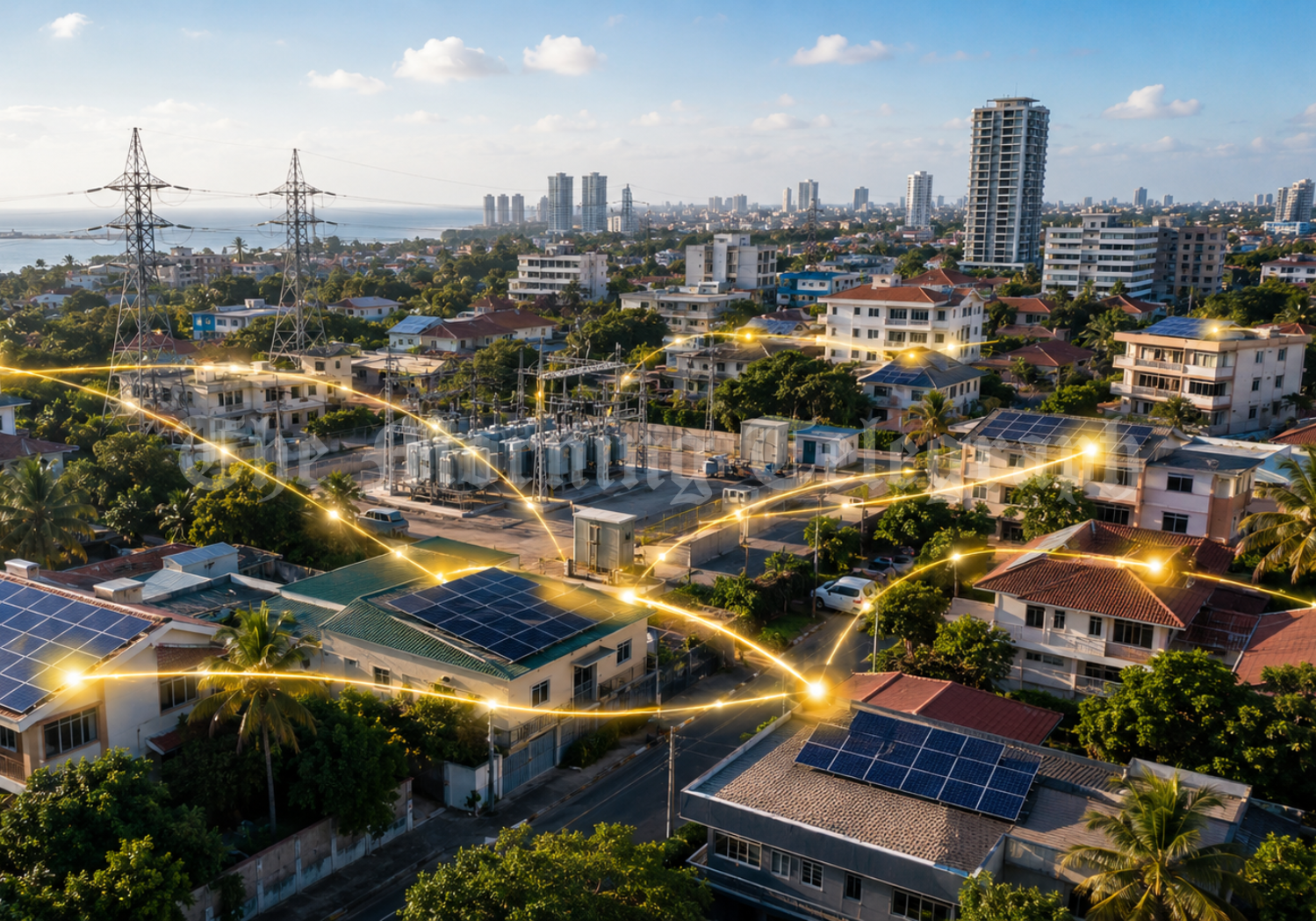
Under this model, electricity generated from larger rooftop solar installations is pooled through the grid. Eligible consumers then receive solar credits on their electricity bills, even if the panels are not on their own roof.
In simple terms, a small shop or community organisation may be able to benefit from solar power without owning panels, finding roof space, or making a major upfront investment.
That is why this project matters.
It is not a promise of free electricity. It is not a nationwide solar rescue package. Nor is it large enough, at around 25 megawatt-peak of rooftop solar installations, to transform the entire power sector overnight.
Instead, its importance lies in whether it can prove that clean energy benefits can be shared more fairly.
Sri Lanka’s power sector has long suffered from fuel dependence, tariff shocks, weak planning and public distrust. Renewable energy is often presented as a national solution, but the benefits can still be uneven in practice. Those with money install systems and reduce their bills. Those without money remain trapped inside the same tariff structure.
This project tries to address that imbalance.
Why The Target Group Matters
The ADB-backed scheme specifically targets micro, small and medium enterprises, as well as community organisations that cannot install rooftop solar because of financial or space constraints. That focus is significant because MSMEs are among the most vulnerable to electricity price increases. For many small businesses, power bills are not a side cost. They are a survival cost.
If officials implement the project properly, it could reduce operating costs for selected small businesses and community bodies. It could also create a pathway for more inclusive renewable energy schemes in the future.
However, success will depend on execution, transparency and regulation.
One major question is who will receive the solar credits. If the beneficiary selection process is vague, politically influenced or poorly monitored, the project’s social purpose could weaken. A scheme designed to help those without access to rooftop solar must not become another benefit captured by those with connections.
Another question is whether the utilities can manage the system efficiently. Virtual net metering requires accurate billing, digital tracking, grid readiness and public confidence. If consumers do not understand how credits are calculated, or if bills become confusing, trust will collapse quickly.
A third question is whether this model can be scaled. A 25 MWp project is useful, but modest. Sri Lanka’s energy transition requires much more generation, storage, grid strengthening and policy clarity. For that reason, this project should be treated as a pilot with national importance, not as a final solution.
A Broader Test For Sri Lanka
There is also a wider policy lesson.
Sri Lanka cannot build a modern renewable energy sector only by encouraging private rooftop investment among those who can afford it. The country needs mechanisms that bring renters, small traders, religious institutions, community groups, schools and low-income consumers into the clean energy transition.
That is where virtual net metering becomes politically and economically important.
Its core innovation is simple. It separates the benefit of solar power from physical roof ownership. In doing so, it allows solar energy to become a shared economic tool rather than a private asset limited to property owners.
The project also includes grid modernisation, digitalisation, green skills training, support for women’s participation in the clean energy sector, and capacity building in low-carbon technologies. These additions matter because renewable energy is not only about panels. It is also about people, systems and institutions.
Still, Sri Lanka must avoid celebrating the announcement too early.
The country has seen many donor-funded programmes launched with impressive language but weak delivery. This project’s credibility will depend on measurable outcomes: how many consumers benefit, how much their bills fall, how transparently they are selected, how quickly the solar systems are connected, and whether the model is expanded after the pilot phase.
In that sense, the ADB package is best understood as a test.
It will test whether Sri Lanka can use international climate finance to help ordinary consumers, not only institutions and contractors. It will also test whether state-linked utilities can run a modern digital energy credit system. Just as importantly, it will test whether renewable energy policy can become inclusive rather than exclusive.
The promise is clear. Solar power should not be only for those who can afford panels.
Now the real question is whether Sri Lanka can turn that promise into a fair, transparent and scalable system.
#VirtualNetMetering #SriLankaSolar #SriLankaEnergy #RenewableEnergy #CleanEnergy #ADB #RooftopSolar #MSME #EnergyTransition #SolarPower #TheMorningTelegraph