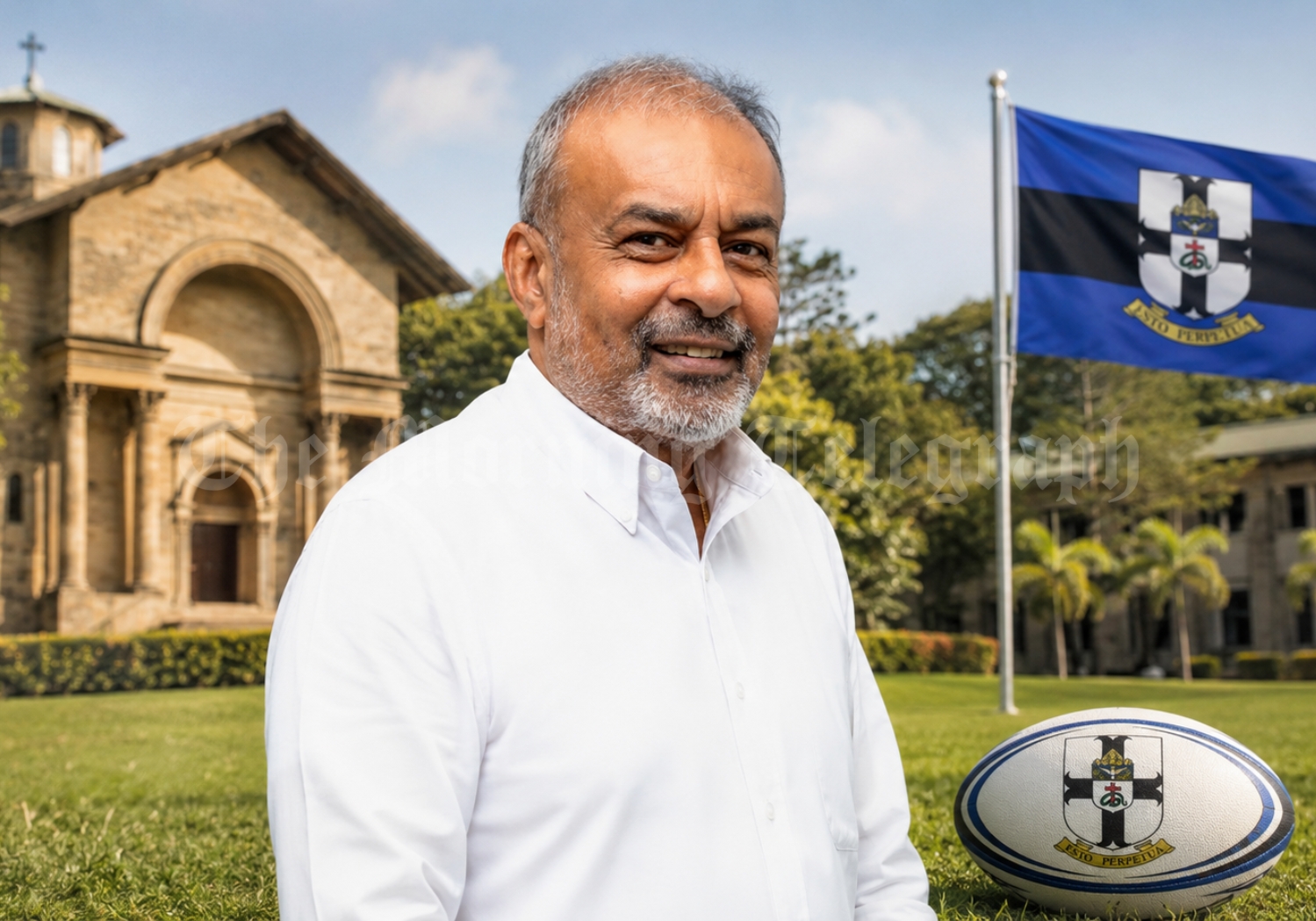
P. L. Munasinghe stands as one of the rare Thomian sporting figures whose life moved with equal force from school fields to corporate boardrooms. Commonly known as PL, he built a name first as a gifted S. Thomas’ College athlete, rugby captain and leader, before becoming a Sri Lankan-born chartered accountant and a senior business executive in Fiji.
A Fellow Member of the Institute of Chartered Accountants of Sri Lanka and the Chartered Institute of Management Accountants in the United Kingdom, Munasinghe began his professional journey in 1979 at Ford Rhodes Thornton & Co., a Colombo firm of chartered accountants.
He later relocated to Fiji, where he developed a distinguished career across the private and public sectors. His most prominent corporate role came at Courts (Fiji) Limited, which later rebranded as Vision Investments Limited. From March 2011 to January 2023, he served as chief executive officer and led the company through transformation, diversification and growth.
Under his leadership, Vision Investments strengthened its position as a major retail and investment group in the South Pacific. After retiring as CEO, Munasinghe returned to the company in February 2023 as company secretary and executive support, continuing his association with the organisation he helped guide for more than a decade.

He also accepted major public responsibilities in Fiji. These included serving as chairman of the Water Authority of Fiji board in 2017 and as a board member through 2020, where he contributed to the oversight of water and wastewater services.
The arc of his life also shows why Munasinghe remains a figure of interest beyond one school or one profession. His career joined Sri Lanka and Fiji through accounting, retail management, investment leadership and public governance. It also joined schoolboy sport with later corporate responsibility.
In Sri Lanka, he first came through the disciplined environment of S. Thomas’ College. In Fiji, he became part of a business community that recognised him for executive reliability and institutional service. Between those two worlds, the same habits appear repeatedly: preparation, loyalty, structure and the ability to perform under pressure.
His story therefore speaks to several audiences at once. To Thomians, it recalls a respected school leader and match-winning rugby captain. To rugby followers, it recalls a centre three-quarter who shaped one of the great Royal-Thomian comebacks. To professionals, it points to a chartered accountant who built a long record in finance, management and governance.
That combination gives the tribute its strength. Munasinghe’s sporting achievements did not stand apart from his later professional life. They anticipated it. The discipline that produced colours in rugby and athletics later supported a corporate career that lasted more than four decades across two countries.
P. L. Munasinghe And His Thomian Foundation
Munasinghe’s story began at S. Thomas’ College, Mt Lavinia, where he completed his secondary education and built the foundation for his later achievements in leadership, sport and professional life.
At school, he served as Head Prefect in 1976, a role that reflected the trust placed in him by the Thomian community. In recognition of his service, conduct and contribution to school life, he received the Victoria Jubilee Gold Medal, one of the school’s most respected honours.
His years at S. Thomas’ also revealed the athletic range that later became central to his reputation. Munasinghe played for the school’s first XV rugby team from 1973 to 1976. He captained the side in 1975, a season that remains strongly linked with his name.
He earned colours in both rugby and athletics, showing excellence across more than one discipline. Those awards reflected not only ability, but also commitment to the wider life of the school.
The pattern was clear from his youth. Munasinghe did not build his reputation through one role alone. He combined leadership, sporting courage and discipline, then carried those qualities into a long accounting and management career.
Athletic Colours And A Versatile School Career
During his school years, Munasinghe also made his mark in track and field. His sporting identity was not limited to rugby, even though rugby produced some of his most memorable achievements.
He was part of a successful relay team that included Ishak Shahabdeen, Devaka Fernando and Michael Jayasekera. That team underlined his contribution to collective athletics and showed the depth of sporting talent at S. Thomas’ during that period.
Munasinghe’s athletics colours placed him among students who gave the college distinction beyond the classroom. His record showed speed, discipline and reliability, all qualities that would later define his rugby performances.
The same qualities helped him stand out in a generation that valued all-round schoolboys. In that era, a Thomian athlete often carried expectations across many fields. Munasinghe met that standard through his work in rugby, athletics and school leadership.
His achievements also placed him alongside other respected names from the college. Michael Jayasekera, for example, stood out as another multifaceted athlete of the same period. The comparison helped frame Munasinghe as part of a wider Thomian sporting culture built on versatility and courage.
Centre Three-Quarter With A Captain’s Mind
Munasinghe emerged as a leading name in S. Thomas’ College rugby during the 1970s. He played as a centre three-quarter in the school’s first XV in 1973, 1974 and 1976, while captaining the side in 1975.
His position demanded pace, judgment and courage. A centre three-quarter had to read defensive patterns, exploit gaps and support coordinated attacks. Munasinghe did all three with conviction.
His 1975 captaincy brought important success, including victory over Royal College in the annual Royal-Thomian Rugby Match.[10] That result became one of the defining moments of his school rugby career.
Munasinghe earned recognition as a versatile sportsman at S. Thomas’, not only because he excelled in rugby, but because he fitted into a broader tradition of multi-sport excellence. His name often appears beside Michael Jayasekera, another outstanding college athlete of that era.
Together, they formed one of the finest backline partnerships of the decade. Munasinghe added speed, intelligence and tactical awareness to the Thomian attack. His play helped give the team rhythm, confidence and cutting edge.
S. Thomas’ rugby in the mid-1970s benefited from strong team balance. A powerful forward pack supported a fluid backline, while the team placed value on classical moves and coordinated attacks. Munasinghe’s role in that structure helped lift the school’s rugby reputation.
The team consistently challenged leading rugby schools, including Trinity and Royal. In doing so, it built a culture of resilience, skill and tactical discipline. Munasinghe’s contribution reflected that era’s belief in all-round performers who strengthened both individual and collective performance.
Havelocks, Sri Lanka Rugby And National Recognition
After his school rugby career, Munasinghe moved into club rugby and represented Havelock Sports Club. Havelocks remains one of Sri Lanka’s premier rugby union clubs, with a history that reaches back to the early 20th century.
His move from school rugby to club rugby showed that his ability could travel beyond the school arena. It also placed him within one of the country’s recognised rugby environments.
Munasinghe also earned selection for the Sri Lanka national rugby team. That achievement placed him among the S. Thomas’ College players who went on to gain international recognition in the sport.
He represented the country as a centre. His national involvement came during a period when local talent carried the game and foreign imports did not dominate selection.
For a schoolboy athlete, national recognition marked a major step. It showed that Munasinghe’s qualities as a centre three-quarter had weight beyond college rivalries. His ability to defend, attack and read the game translated into the wider rugby setting.
That part of his story matters because it connects the schoolboy hero to the national sporting pathway. Munasinghe was not only remembered for one school match. He became part of a broader rugby tradition that linked S. Thomas’, Havelocks and Sri Lanka.
The 1975 Royal-Thomian Rugby Turning Point
The Royal-Thomian rugby match of July 1975 remains one of the landmark moments in Sri Lankan schoolboy rugby. Munasinghe captained S. Thomas’ College to a dramatic 8-3 comeback victory over Royal College and secured the Michael Gunaratne Trophy.
The result carried extra weight because Royal entered the match as the favoured side. The game took place at Longden Place, where the Thomians produced an upset built on resilience, defensive strength and tactical sharpness.
Munasinghe’s performance defined the contest. He scored two match-winning tries in almost identical fashion, a feat described as a “spectacular sensation.” On both occasions, he cut through the Royal defence with sharp sidesteps, froze the opposing stand-off and grounded the ball under the posts.
Those tries changed the direction of the match. They overturned an early deficit and displayed his speed, balance and evasive skill as centre three-quarter. They also showed how well he fitted into the Thomians’ structured attacking approach.
Defence mattered just as much. Munasinghe helped anchor a formidable Thomian back division that formed what reports called a “virtual stone wall.” Alongside fullback Shane Pinder and wing three-quarter Devaka Fernando, he tackled with fierce intensity.
The Ceylon Daily Mirror praised the unit for stopping Royal advances “as if their life depended on it.” The report also credited Munasinghe’s leadership in marshalling a defensive line that held firm against superior physicality.
One key support play reflected the team’s unity. Devaka Fernando collected a grubber kick near the try line, while Munasinghe provided crucial backing to keep territorial pressure alive.
Teammate Mahesa Abeynayake later pointed to the “Thomian grit” that shaped the victory. He described a spirit forged through loyalty, determination and players willing to risk injury for the team.
The match etched Munasinghe’s name into school rugby lore. It also captured the enduring force of the Royal-Thomian rivalry, where defensive resolve and opportunistic scoring carried S. Thomas’ to the trophy.
From Sporting Discipline To Accounting
After his athletic pursuits, Munasinghe moved into accounting and qualified as a chartered accountant by profession. The transition from competitive sport to finance became a defining feature of his life story.
He achieved Fellowship status with the Institute of Chartered Accountants of Sri Lanka, known as CA Sri Lanka. That status recognised his advanced professional standing in the accounting field.
He also became a Fellow of the Chartered Institute of Management Accountants in the United Kingdom. This qualification further strengthened his standing in management accounting and broadened his professional base.
His early career began in 1979 at Ford Rhodes Thornton & Co. in Colombo. The firm gave him a formal entry point into the profession and placed him within Sri Lanka’s chartered accounting sector.
For Munasinghe, the move from sports to accounting did not represent a break in identity. Instead, it continued the same habits that had shaped his school years. Rugby required discipline, planning and calm under pressure. Accounting and management demanded the same traits in a different arena.
That connection gives his tribute its central meaning. The centre three-quarter who read gaps on a rugby field became an executive who read balance sheets, markets and institutions.
Fiji Boardrooms And Vision Investments
Munasinghe later built a major executive career in Fiji’s business landscape. He used his background in finance and management to lead corporate growth and support public sector work.
He became chief executive officer of Courts (Fiji) Ltd., a major retail entity. In that role, he led the company during important operational moments and expansion phases.
One such moment came after the 2020 fire at the Nadi branch. Munasinghe assured staff that the company would redeploy them to other locations. He also confirmed that there would be no job losses while the company awaited damage assessments.
His leadership also covered expansion. Courts introduced the “Courts Essentials” product line at new branches, including the Nakasi store. The range focused on affordable, high-quality goods and aimed to broaden market reach across Fiji.
In parallel, Munasinghe served as group chief executive officer of Vision Investments Limited from March 2011 to January 2023. During that period, he oversaw diversification, transformation and expansion at one of Fiji’s largest listed entities on the stock exchange.
After stepping down as CEO, he moved into the role of company secretary and executive support. That transition allowed him to continue contributing to strategic operations while no longer holding the top executive post.
His business career showed the same steady leadership that marked his school captaincy. He did not merely hold titles. He guided institutions through growth, pressure and change.
Public Service Through The Water Authority Of Fiji
Munasinghe also played an important role in Fiji’s public sector. Records confirm his leadership at the Water Authority of Fiji as early as 2015 and continuing through at least 2020.
He served as chairman of the Water Authority of Fiji board in 2017 and remained a board member through 2020. In those roles, he helped oversee services that affect daily life across the country.
His work included board decisions on executive recruitment and operational transitions. One key moment came in 2017, when the authority searched for a new chief executive officer after the previous incumbent’s contract ended.
The Water Authority role placed Munasinghe at the intersection of governance, public utility management and institutional accountability. It also showed that his career in Fiji extended beyond retail business.
By bridging private sector innovation and public utility governance, he became recognised as a significant company executive and public board figure in Fiji. His professional record linked finance, administration and service delivery.
That journey gave him a profile larger than one company. He became a Sri Lankan-born professional who carried Thomian discipline into the South Pacific and built credibility across boardrooms and public institutions.
The professional record also deserves attention because it shows continuity after retirement from the main executive chair. Munasinghe stepped down from the group chief executive role in January 2023, but he did not sever ties with Vision Investments. Instead, he returned the following month as company secretary and executive support. That move reflected continuing trust in his institutional knowledge.
For many former athletes, memory often stops at the final match. In Munasinghe’s case, the larger story continued for decades. His post-school life carried the same marks that shaped his rugby: responsibility, measured action and service to a team larger than himself. Whether the team wore blue and black or sat around a board table, he appeared to understand the value of role, timing and collective purpose.
A Tribute To A Thomian Great
P. L. Munasinghe’s life story carries several layers. He was a Thomian head prefect, a Victoria Jubilee Gold Medal winner, a rugby captain, an athletics coloursman, a Havelocks player, a Sri Lanka rugby representative, a chartered accountant and a senior executive in Fiji.
Each part of that journey connects to the next. His sporting career showed speed, courage and decision making. His school leadership showed discipline and trust. His accounting career demanded precision. His executive work required calm judgment and long-term vision.
The 1975 Royal-Thomian rugby victory remains the most dramatic sporting image attached to his name. Two tries, a defensive wall and an 8-3 comeback over Royal gave S. Thomas’ a triumph remembered for grit and belief.
Yet his later career proves that his contribution did not end when he left the field. From Ford Rhodes Thornton & Co. in Colombo to Courts (Fiji) Limited, Vision Investments Limited and the Water Authority of Fiji, Munasinghe carried his leadership into institutions that shaped business and public service.
That is why this tribute is more than a sports memory. It is the story of a Thomian great who turned athletic discipline into professional achievement and carried the S. Thomas’ tradition far beyond Mt Lavinia.
#PLMunasinghe #SThomasCollege #ThomianRugby #SriLankaRugby #RoyalThomian #HavelockSportsClub #VisionInvestments #FijiBusiness #CharteredAccountant #TheMorningTelegraph