Former Election Commission Chairman Mahinda Deshapriya says delaying Provincial Council elections violates the Constitution and weakens democracy.
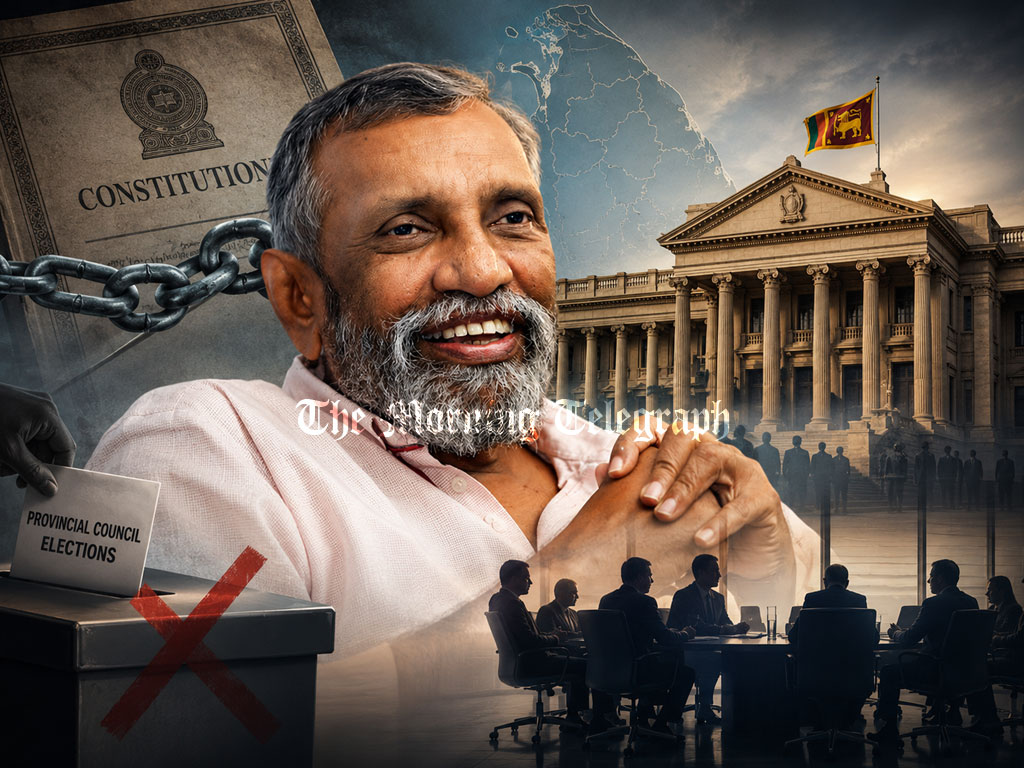
Provincial Council elections have remained in limbo for years, prompting former Election Commission Chairman Mahinda Deshapriya to warn that the continued postponement amounts to an ongoing violation of Sri Lanka’s Constitution. He argues that allowing Provincial Councils to function without elected representatives is one of the gravest constitutional failures facing the country today.
Every government in Sri Lanka has come to power pledging to uphold the rule of law and ensure accountability. Yet successive administrations have often enforced the law vigorously against political opponents while showing leniency towards wrongdoing within their own ranks. Although governments frequently condemn alleged constitutional violations, Deshapriya says they have collectively ignored what he describes as a continuous breach of the nation’s supreme law.

Speaking during a recent interview with Hiru TV, Deshapriya strongly criticized the prolonged administration of Provincial Councils by bureaucrats instead of elected representatives. As is characteristic of his outspoken style, he stated that allowing unelected officials to run the councils constituted a serious violation of the Constitution. He stressed that every political party must accept responsibility for this prolonged failure, insisting there is no greater offence against democracy than postponing elections. He maintained that Provincial Council polls must be held without further delay. Election monitoring organizations have also urged the government either to conduct the long-overdue Provincial Council elections or abolish the Provincial Council system altogether.
The last Provincial Council election was held in Uva on September 20, 2014. Prior to that, several Provincial Council elections were conducted on a staggered basis in 2012 and 2013. Article 154E of the Constitution states that a Provincial Council shall, unless dissolved earlier, continue for a period of five years from the date appointed for its first meeting, after which it automatically stands dissolved. As a result, several Provincial Councils have remained without elected representatives since 2017, following amendments introduced through the Provincial Council Elections Act by the UNP-led Yahapalana government. At the time, no political party represented in Parliament raised significant objections or voted against the legislation, despite concerns over provisions inserted during the committee stage.
Deshapriya argues that Parliament bears ultimate responsibility for allowing officials to continue administering Provincial Councils in the absence of elected councillors. He says the most practical solution is for Parliament to adopt the private member’s motion submitted by Tamil National Alliance MP Shanakiyan Rasamanickam on June 5, 2026. The proposal seeks to conduct Provincial Council elections under the Proportional Representation system until comprehensive electoral reforms are finalized. Meanwhile, an 11-member Parliamentary Select Committee chaired by Minister Vijitha Herath has been appointed to examine reforms to the Provincial Council electoral system and resolve the legal obstacles preventing elections. Deshapriya believes the elections could be held relatively quickly if Rasamanickam’s proposal is referred to the committee, endorsed, and implemented without delay.
Rasamanickam’s private member’s Bill, formally titled the “Bill to amend the Provincial Council Elections Act, No. 2 of 1988,” was seconded by MP M. Nizam Kariapper. Consisting of four substantive sections together with three formal provisions, the Bill proposes that the provisions of the Provincial Council Elections Act No. 2 of 1988 become operative once again, notwithstanding amendments introduced by Act No. 19 of 2017. It further states that this restoration would take effect from the date the amendment becomes law, without affecting actions carried out between September 22, 2017, and the commencement of the new Act, provided those actions are not inconsistent with the original 1988 legislation. If Parliament approves the amendment, Provincial Council elections could once again be conducted under the Proportional Representation system. Deshapriya believes such a move would make it possible to hold the elections within four months. He has also cautioned that if authorities insist on implementing the proposed mixed electoral system first, Provincial Council elections are unlikely to take place this year either.
The present government enjoys a two-thirds majority in Parliament, giving it sufficient constitutional authority to amend the Provincial Council Elections Act whenever it chooses. Furthermore, according to its election manifesto, the administration pledged to conduct both local government and Provincial Council elections within one year of assuming office.
Some observers believe the government might have proceeded with Provincial Council elections last year had its performance at the local government elections matched its expectations. Instead, critics argue that the administration now appears intent on delaying the polls until it considers the political environment more favourable, using the ongoing delimitation process as justification. However, this strategy may carry significant political risks, as reluctance to face the electorate is widely perceived as a sign of political weakness. In politics, public perception often carries as much weight as reality itself, and pressure on the government to conduct Provincial Council elections continues to grow.