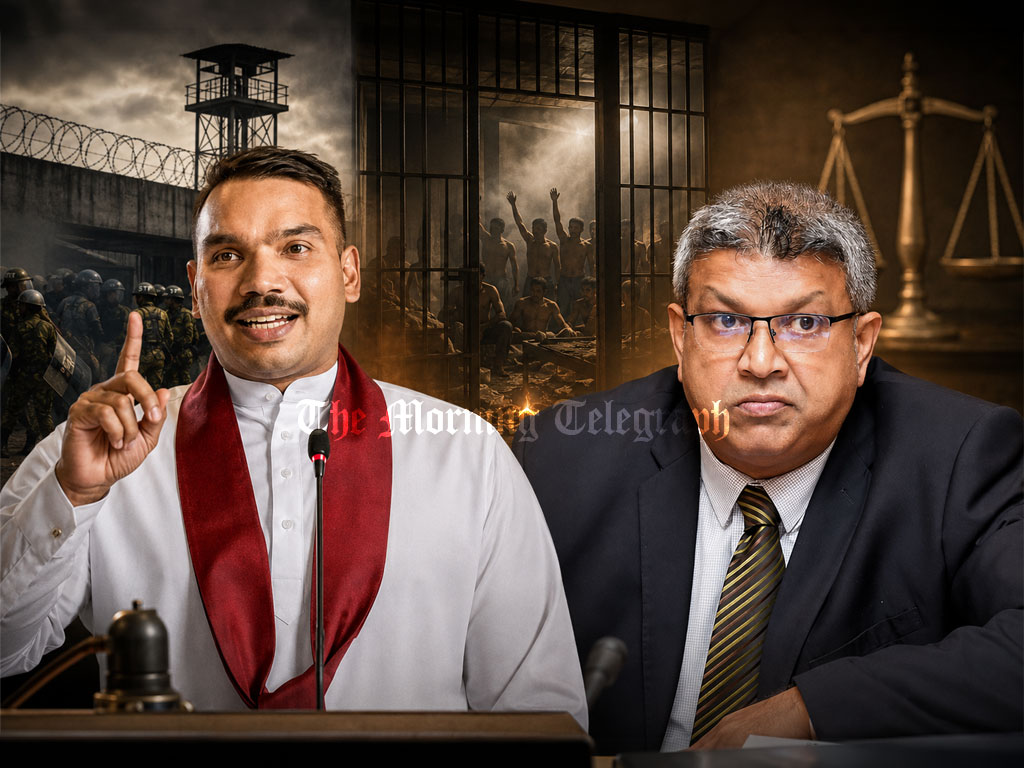
Namal Rajapaksa says the Negombo Prison incident demands ministerial accountability after 27 deaths and about 150 hospitalizations.
The Negombo Prison incident has triggered a fierce parliamentary attack from SLPP National Organizer and MP Namal Rajapaksa, who said the line minister must accept direct responsibility.
Rajapaksa told Parliament that the government cannot escape by saying it will “take responsibility and look into it later.”
He said 27 people had died, while about 150 others were in hospital. He also claimed that no one in Parliament had yet made a statement with proper responsibility.
“Political statements are being made, but this is not a political statement, Mr. Deputy Speaker,” Rajapaksa said. “The government needs to make a statement in this Parliament with responsibility.”
He added that waiting for the President to “come running” and make a statement would not solve the issue.

Namal Demands Responsibility for Negombo Prison Incident
Addressing Parliament further, Rajapaksa accused the government of beginning its term with misplaced priorities.
He referred to past claims about archaeology and treasure. He said that when the government came to power, it first “dug for treasure.”
“You remember, don’t you?” he asked. “The government started by saying that by unearthing that treasure, they could uplift the entire country.”
Rajapaksa claimed a minister had observed the matter and submitted a report. He also alleged that the government used the army and the STF for the digging.
“So we know who dug it,” he said. “We’ll wait and see about those matters now.”
He then argued that the government had failed to solve people’s problems. Instead, he said, it had allowed crises to grow.
Rajapaksa cited the “Ditta” storm as an example. He alleged that the government failed to act in time and waited until 300 lives were lost.
“Even now, over 35,000 people are still in temporary housing,” he said. “Either in tents, or paying rent, still.”
He argued that many of those 300 lives could have been saved if the government had acted earlier.
Dengue, Medicine and Prison Conditions
Rajapaksa then turned to dengue and public health.
He claimed officials now say fumigation requires a cluster of dengue cases. According to him, at least 10 patients must appear before a village is cleaned under “Clean Sri Lanka.”
“More than 50 people have died from dengue by now,” he said. “Every hospital is overflowing with dengue patients.”
He said reports suggested the prison unrest had begun because of dengue-related concerns.
Rajapaksa also raised the issue of health facilities for inmates and remand prisoners. He claimed there was no medicine in the prison and no medicine even in village hospitals.
“Back then, these people used to jump up and down talking about medicine,” he said. “But today there is no sound.”
He then returned to the Negombo Prison incident, arguing that early action could have reduced the damage.
“If the government had acted in time, it could have been brought under some control,” he said.
Instead, he claimed, authorities allowed the night to pass. He said they tried their “usual tricks” the next morning and another riot broke out.
“In the end, 27 people, including seven officers, lost their lives,” he said.
Prison Overcrowding and Past Warnings
Rajapaksa recalled how the current President had spoken in Parliament about a similar incident during a previous government.
He said the President had then argued that the government must take full responsibility.
Rajapaksa also referred to a 2020 prison incident. He said that after that event, the minister was removed, a new state minister was appointed and a committee was established.
He questioned what happened to the recommendations of those committees.
He said Sri Lanka’s prison system could hold around 10,000 to 11,000 people. However, he claimed that 40,000 to 45,000 people were now held under the government’s “Clean Sri Lanka” approach.
“When you put 40,000 to 45,000 there, a social problem arises,” he said. “That social problem later becomes a struggle. That is what happened in Negombo.”
He said the prison capacity was around 10,000 to 12,000, while 40,000 to 45,000 people were being held on remand.
Rajapaksa said the government had been in power for nearly two years. He questioned what steps it had taken to speed up chemical examiner reports.
He also asked what program the government had implemented to recruit prison officers.
“In the end, seven innocent officers were simply killed,” he said.
Commissioner Post and Social Media Remark Criticized
Rajapaksa also criticized the handling of the Prisons Commissioner position.
He referred to a presidential pardon granted to a government supporter after the government came to power. He alleged that the former Commissioner was removed, remanded and imprisoned in connection with efforts to cover up that matter.
He said the Human Rights Commission later issued a recommendation to reemploy him.
However, Rajapaksa said the government had still not taken steps to appoint a Commissioner.
“The government did not act,” he said. “That means the government did not look into it.”
He argued that the situation had now reached breaking point.
He then criticized a minister who allegedly said he had not checked social media.
“My goodness! This is really shocking,” Rajapaksa said. “A good lawyer gentleman. He speaks by looking at social media and checking social media.”
He compared this with a former president who, he said, spoke after reading morning newspapers.
“Now we have a minister who speaks after checking social media,” he said.
Rajapaksa accused the minister of failing to act responsibly and trying to save himself.
Rehabilitation, Judges and House Arrest Law
Rajapaksa again referred to the 2020 prison incident and said a committee had been appointed after it.
He mentioned Anuradha Jayaratne, who was a State Minister at the time. He also referred to Minister Lohan and said later recommendations were not implemented.
He said a rehabilitation program should have been developed but was not pursued.
According to Rajapaksa, statistics at that time showed that about 60% of those linked to drugs were one-time or two-time users.
He argued that when such people are placed inside prisons, they become connected with major traffickers.
“That is why orders were given to rehabilitate them,” he said.
He also said a new prison had been proposed. According to him, land had been given, infrastructure had been built and a program had been developed.
However, he claimed later governments put those plans aside.
Rajapaksa then criticized the government’s interest in extending judges’ tenure.
He said the government appeared eager to act on that issue but showed no interest in solving practical problems in the justice system.
He claimed the government had no urgency to pass the already drafted law on house arrest.
He argued that the law could help solve people’s problems, but the government had failed to expedite it.
“This government does not want to intervene in things that solve problems,” he said. “You want to intervene in things that create problems.”
‘Line Minister Must Take Responsibility’
Rajapaksa accused the government of using oppression and threats instead of answering public concerns.
He said the government could not rule through what he described as a bullying attitude.
He also accused government figures of throwing microphones at the media, while previously speaking about media freedom when others behaved that way.
He then repeated his central demand on the Negombo Prison incident.
“The line minister must take this responsibility,” Rajapaksa said. “You can’t escape by saying, ‘I’ll take responsibility and look into it later.’”
He repeated that 27 people had died and about 150 were in hospital.
He said Parliament still had not received a responsible statement.
“The government needs to make a statement in this Parliament with responsibility,” he said. “That won’t work, waiting for the President to come running and say something.”
He said the line minister must make a responsible statement to Parliament.
Farmers, Fertilizer and Wider Governance Criticism
Rajapaksa then shifted to farmers’ problems.
He said fertilizer was not being sent on time. He said the government tells Parliament that subsidies are being given, but farmers still do not receive fertilizer.
“What happens to the farmer?” he asked. “They need fertilizer.”
He said farmers cannot wait until the government delivers fertilizer. As a result, he claimed, they buy it from the black market or private sector for Rs. 18,500 to Rs. 20,000.
He said this means farmers do not receive the fertilizer subsidy.
Rajapaksa said tea farmers and corn farmers face the same problem. He also claimed paddy farmers do not receive a fair price when paddy is purchased.
He criticized the government for importing rice when it prepares to buy paddy.
“So are they going to protect the local farmer by importing rice from abroad?” he asked.
He also criticized a policy of giving unsold rice to government employees on lease at Rs. 20 per kilo.
Rajapaksa said the minister had still not explained how that lease system works.
He said farmers now take to the streets to demand rights, income and fertilizer. However, he alleged that the government calls them “cassipukarayo,” meaning drug addicts.
Rajapaksa said the government must practically intervene in farmers’ problems.
He said the government cannot solve national issues by threatening, oppressing or intimidating people.
He also criticized the government for not answering questions raised by the opposition in Parliament.
Rajapaksa urged the government to listen to farmer leaders. He recalled that when the current government was in opposition, farmer leaders went into paddy fields and ate paddy stalks.
“Bring those farmer leaders, bring them and discuss with them,” he said.
He also urged the government to bring fisheries leaders for discussions and provide practical solutions.
The speech ended with a clear political message. Rajapaksa said the government must stop avoiding responsibility, whether on the Negombo Prison incident, public health, prisons, justice reforms or farmers’ concerns.