By Roy Denish.
Police protection misuse in Sri Lanka raises concerns over taxpayer funds, political privilege, police shortages, and weak oversight.
Police protection misuse in Sri Lanka has become a serious test of institutional accountability, public finance discipline, and the fair use of state security resources.
For years, critics have condemned the deployment of active police officers to guard people who do not legally qualify for such protection. These include former politicians, private businessmen, and politically connected individuals. The practice has now become a symbol of political entitlement and a deeper failure to shield state institutions from executive pressure and political influence.

Legal Limits Ignored In Security Allocations
At the heart of the controversy lies a clear gap between the law and day-to-day bureaucratic practice. Under the Police Ordinance and established national security protocols, elite units such as the Presidential Security Division (PSD) and the Ministerial Security Division (MSD) must protect specific sitting state officials.
Private citizens and former office holders do not automatically qualify for state protection. They can receive it only after a rigorous and independent threat assessment by the Sri Lanka Police Intelligence Services. That process should determine whether a genuine personal risk exists.
However, investigative findings and institutional audits show that officials often bypass these formal procedures. The most common abuse happens during political transitions. After the dissolution of parliament or provincial councils, many former representatives continue to keep their security details for long periods.
As a result, a temporary state resource becomes a permanent personal privilege. In some cases, high-ranking officials issue ad-hoc directives. In others, individuals allegedly manipulate security complaints to create an artificial basis for personal risk.
Police Protection Misuse Weakens Public Safety
The damage from this unregulated system goes far beyond administrative misconduct. Operationally, the diversion of thousands of trained officers into private-style bodyguard roles weakens local police stations across the country.
Community crime prevention, criminal investigations, public safety patrols, and daily law enforcement functions all suffer when frontline stations lose manpower. Therefore, ordinary citizens pay twice. They fund the protection, and they receive weaker policing in return.
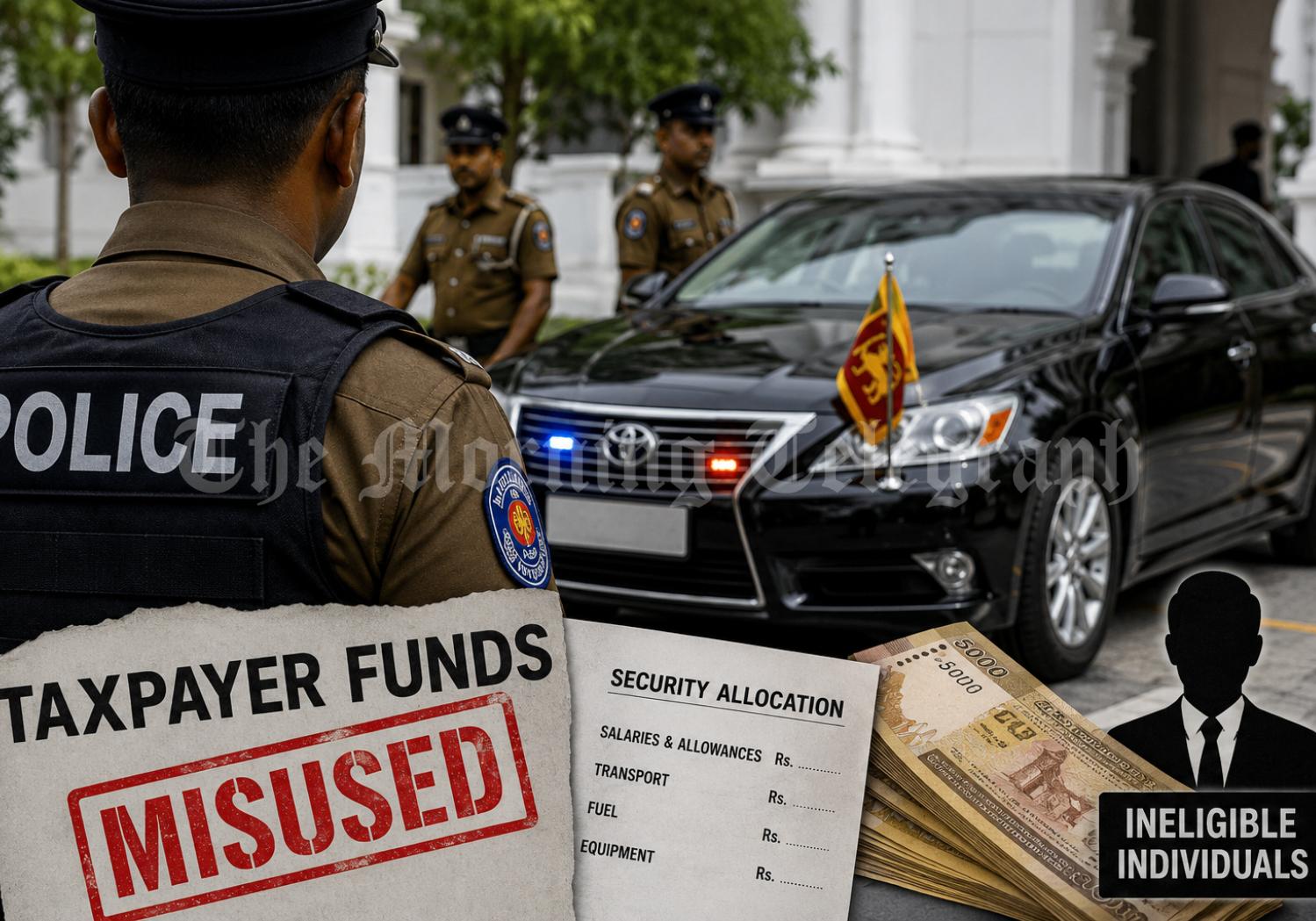
The financial burden also falls fully on taxpayers. The state pays the salaries and allowances of officers assigned to these unauthorized details. It also carries secondary costs, including transport, fuel, and equipment.
In an economy shaped by fiscal consolidation and tighter scrutiny of public spending, police protection misuse creates an unsustainable drain on state resources. It forces the public to subsidize private security arrangements that serve political convenience rather than public necessity.
Ultimately, these privileges for ineligible individuals corrode public trust in the rule of law. When state protection becomes a badge of influence, patronage, or social status, it deepens the perception that the powerful enjoy one system while ordinary citizens live under another.
Sri Lanka cannot fix this lapse through periodic recalls alone. It needs a transparent and independent audit of every security allocation. Law enforcement resources must serve public need, not personal comfort, political loyalty, or inherited privilege.
For stronger oversight, the issue also demands scrutiny from institutions responsible for public security and parliamentary accountability, including the Ministry of Public Security and Parliamentary Affairs and the Parliament of Sri Lanka.