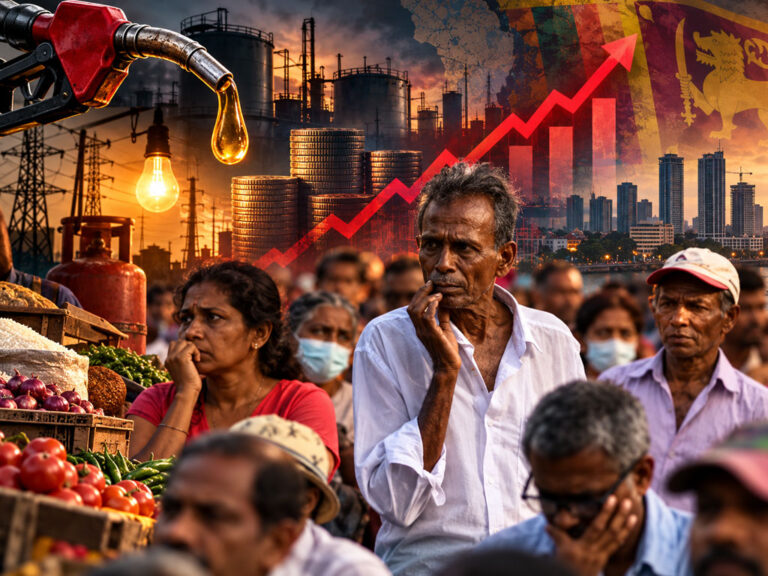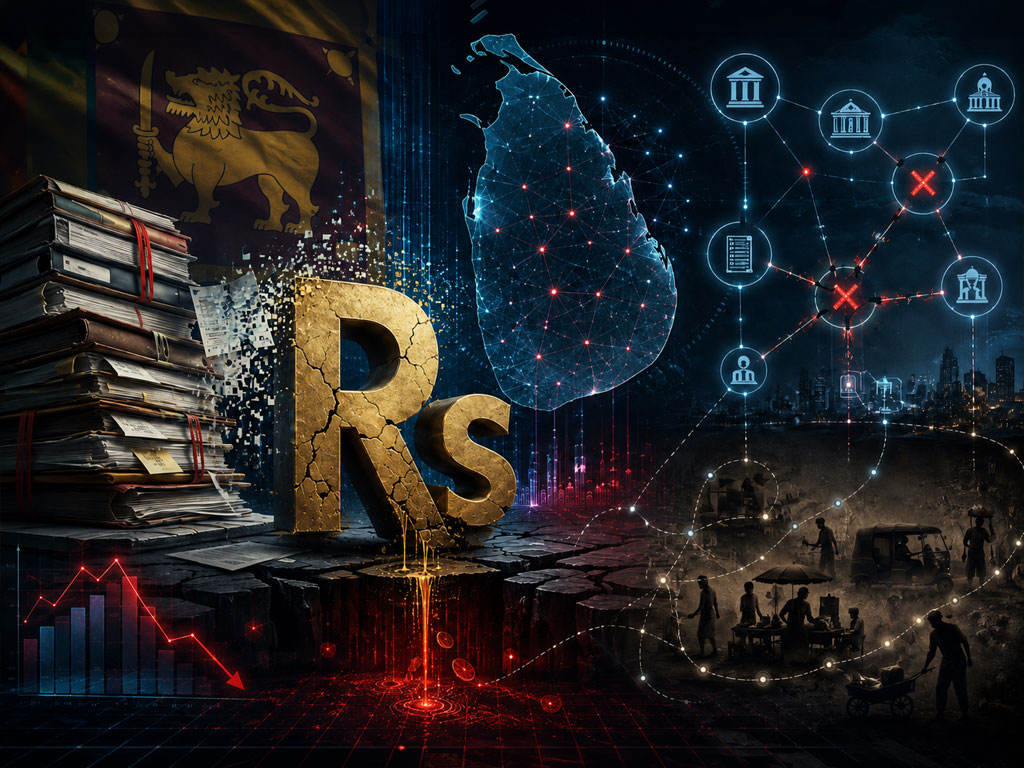
Sri Lanka tax arrears exceed Rs. 1 trillion as weaknesses in RAMIS, digital integration and the informal economy challenge revenue collection.
Sri Lanka tax arrears exceeding Rs. 1 trillion have placed renewed attention on weaknesses in tax administration, digital integration and the Government’s ability to broaden the revenue base.
Sri Lanka has significantly increased revenue under its IMF-backed economic programme. However, the latest IMF assessment projects tax revenue at about 14% of GDP in 2026 and total Government revenue at 15.1% of GDP, rather than the 16.6% tax-to-GDP figure sometimes cited publicly.
The improvement nevertheless reflects a major recovery from the severe revenue collapse that contributed to the economic crisis.
Parliamentary scrutiny has increasingly focused on whether the country can sustain that progress without repeatedly increasing tax rates or relying heavily on temporary revenue sources.

Revenue Growth Must Become Sustainable
Sri Lanka’s central challenge is no longer simply raising headline tax revenue.
The larger issue is how efficiently the Government collects money already due and whether more economic activity can be brought into the formal tax system.
Temporary factors, including the reopening of vehicle imports, can generate significant Government revenue. However, such sources cannot provide a permanent foundation for fiscal stability.
Long-term revenue growth requires a broader tax base, stronger enforcement and systems capable of identifying income and transactions across different parts of the economy.
That makes technology increasingly important.
Sri Lanka Tax Arrears Put RAMIS Under Scrutiny
The Revenue Administration Management Information System, or RAMIS, was introduced as part of a wider effort to modernise Sri Lanka’s tax administration.
The Asian Development Bank-supported fiscal management programme included RAMIS as a key component designed to strengthen revenue administration and modernise Government financial systems.
However, concerns remain over whether the system has delivered its full potential.
A central weakness is the lack of seamless real-time information exchange among institutions handling taxation, imports, vehicles, property and financial transactions.
Without effective integration between the Inland Revenue Department, Sri Lanka Customs and other Government databases, authorities face greater difficulty identifying undeclared income, false transactions and potential tax evasion.
Audit findings have repeatedly highlighted weaknesses in tax administration and internal controls at the Inland Revenue Department.
The problem therefore extends beyond software.
Digitalisation works only when Government institutions actually exchange reliable information and act on the data available.
Trillion-Rupee Arrears Raise Collection Questions
Figures cited from Auditor General findings show how serious the collection problem has become.
Tax arrears reportedly increased from around Rs. 579 billion in 2019 to approximately Rs. 1.066 trillion by the end of 2023.
The report further states that only about 22% of that amount was considered recoverable.
VAT represents one of the largest areas of concern, with approximately Rs. 454 billion reportedly remaining uncollected.
Sri Lanka’s National Audit Office has separately raised concerns over weaknesses in VAT collection and the Inland Revenue Department’s failure in some cases to recover revenue in the manner most advantageous to the Government.
The article also cites approximately Rs. 22 billion in older VAT liabilities where recovery has become difficult because of statutory and legal limitations.
Such figures expose a basic contradiction.
Compliant businesses and individuals can face higher taxes while substantial amounts already assessed remain trapped in appeals, administrative delays or ineffective collection processes.
Informal Economy Keeps Millions Outside the Tax Net
Another challenge is the scale of Sri Lanka’s informal economy.
The report estimates that roughly 67% of the workforce, representing around 5.5 million people, operates within informal economic activity.
Many remain outside both conventional taxation and comprehensive social-security systems.
That creates an increasingly uneven burden.
Businesses operating formally must comply with registration, accounting, VAT and income-tax requirements. Meanwhile, substantial economic activity can remain difficult for authorities to trace.
Simply increasing rates on existing taxpayers may therefore weaken compliance and place greater pressure on companies already operating within the legal tax system.
Tax-refund delays can create additional problems, particularly for exporters who depend on predictable cash flow.
Persistent uncertainty can also damage the wider investment environment.
Digital Integration Is Now the Real Test
Sri Lanka cannot solve its fiscal challenges simply by repeatedly raising taxes.
The priority should instead be structural reform.
That means creating real-time data links among the Inland Revenue Department, Sri Lanka Customs, financial institutions and other relevant Government agencies.
Authorities also need stronger legal mechanisms to recover collectible Sri Lanka tax arrears while distinguishing genuine disputes from deliberate avoidance.
At the same time, policymakers must systematically formalise more of the informal economy instead of placing additional pressure on the same limited pool of compliant taxpayers.
RAMIS and other digital tools can play a central role.
But technology alone cannot repair weak administration.
Sri Lanka needs integrated databases, enforceable laws, accountable institutions and officials capable of acting quickly when discrepancies appear.
Only then can higher tax revenue become sustainable rather than simply another burden placed on those already paying.
The trillion-rupee arrears problem is therefore more than an accounting issue.
It is a test of whether Sri Lanka can build a tax system that is digital, enforceable and, most importantly, fair.
A special “Red Alert” television programme examining the digital and administrative weaknesses surrounding the tax system is expected to be released shortly.