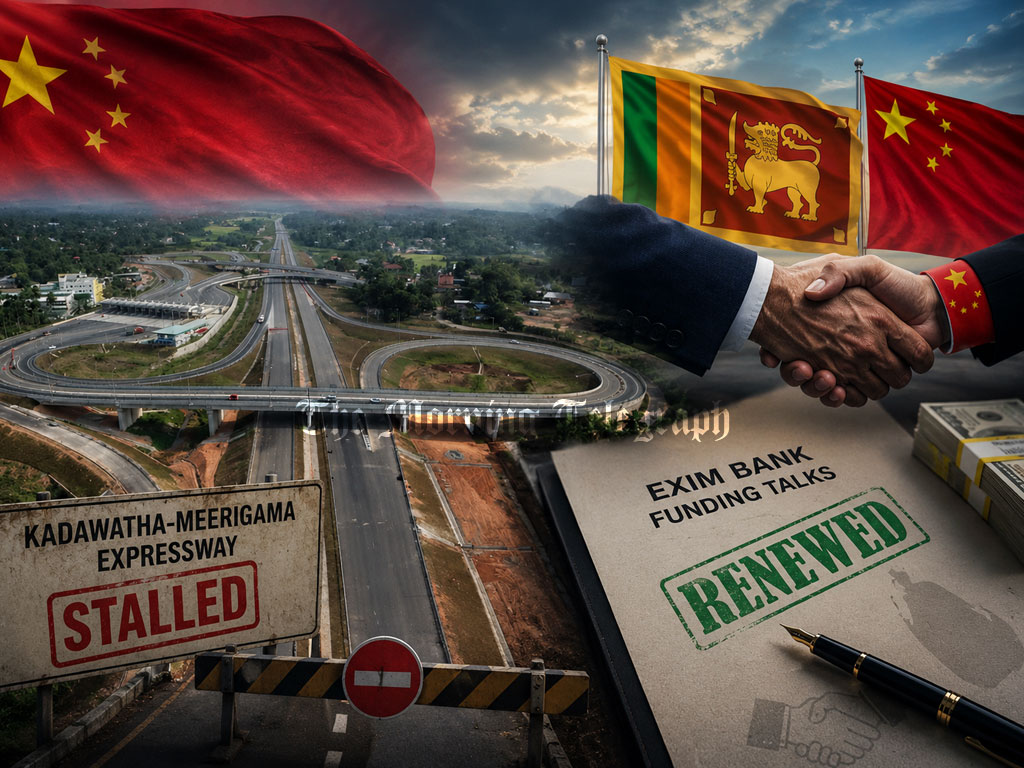
China Sri Lanka strategy faces fresh scrutiny as Exim Bank moves to restart the stalled Kadawatha-Meerigama expressway project.
The China Sri Lanka strategy question has returned after fresh moves to restart the stalled Kadawatha-Meerigama expressway project.
Construction of the China-funded highway came to a halt in 2022 as Sri Lanka’s economic crisis deepened. Work had started under an agreement that combined Chinese loans with Sri Lankan government contributions. However, the project stalled midway when the crisis struck.
In August 2025, President Anura Kumara Dissanayake told Parliament that China’s Exim Bank would resume funding for the Meerigama-Kadawatha expressway under a concessional loan scheme. He also said the Cabinet was expected to approve the loan amount at its next meeting.
On August 18, 2025, President Anura formally relaunched construction work. He praised China during the ceremony, while China’s ambassador to Sri Lanka also addressed the event.
China’s state news agency Xinhua reported the ceremony and highlighted the project as evidence of strong bilateral cooperation.

China Sri Lanka Strategy and the Expressway Restart
According to Xinhua, President Anura Kumara Dissanayake said the resumption of the Chinese-built project showed close communication and cooperation between Sri Lanka and China.
He also thanked China for extending support during Sri Lanka’s economic crisis.
Dissanayake made the remarks while attending the recommencement ceremony for Section I of the Central Expressway from Kadawatha to Mirigama. Metallurgical Corporation of China Limited is undertaking the project.
The President called it an important national project for Sri Lanka. He thanked China for supporting economic improvement and people’s livelihoods.
He also said the project’s restart supported Sri Lanka’s effort to overcome economic difficulties and move toward stable development.
Chinese Ambassador Qi Zhenhong said the Central Expressway was crucial for Sri Lanka’s recovery and revitalisation. He also described it as a new landmark of friendship between the two peoples.
Qi said he hoped all parties would move construction forward in a dedicated and practical manner. He also called for timely and high-quality completion so the project could benefit Sri Lankans early.
The Central Expressway is expected to connect Colombo with Kandy. It will also link with three existing expressways to form an integrated network.
Funding Delay and Research Vessel Dispute
Almost a year has passed since President Anura and the Chinese ambassador marked the restart of construction.
Yet, despite the ceremonial launch in August 2025, funding did not progress.
Reports attributed the delay to the failure of China’s Exim Bank and the Sri Lankan government to reach a new financing agreement. Penalties and costs connected to project delays had also increased.
However, sources close to China suggest a different reason.
They claim construction stalled after the August 2025 launch because Beijing was frustrated that Sri Lanka had not decided whether to lift its ban on Chinese research vessels entering Sri Lankan waters.
As a result, China allegedly adopted a go-slow approach on its projects in Sri Lanka.
Now, in a sudden development, a delegation from China’s Exim Bank visited Sri Lanka last week.
The delegation met the Deputy Minister of Finance and agreed to restart the Kadawatha-Meerigama expressway project.
Another Chinese Exim Bank delegation is expected to arrive by the end of this month to sign the formal agreement.
Has Beijing Changed Course?
Sri Lanka has still not lifted its ban on Chinese research vessels.
That raises the central question: what has changed on China’s side?
Has Beijing concluded that holding back over the research-vessel issue only helps expand American and Indian influence in Sri Lanka?
After pausing over the ship-ban dispute, is China now preparing to re-enter the geopolitical contest in Sri Lanka?
The renewed expressway push suggests that the China Sri Lanka strategy may be shifting from pressure to re-engagement.
It may also reflect Beijing’s concern that prolonged delays could leave more space for Washington and New Delhi.
For Sri Lanka, the restart of the Kadawatha-Meerigama expressway would revive a major infrastructure project that has remained trapped between debt, diplomacy and geopolitical rivalry.
For China, the move could signal that it no longer wants the research-vessel dispute to slow its wider influence in the country.
The next formal agreement with China’s Exim Bank may therefore say more than just how a highway will be financed. It may reveal whether the China Sri Lanka strategy has entered a new phase.