
Negombo inmate deaths after prison transfers spark torture allegations, official denials, UN concern and Human Rights Commission visits.
The Negombo inmate deaths following transfers to other prisons have triggered fresh concern, as rights groups allege torture while prison authorities deny beatings.
The Prisoners’ Rights Committee alleges that two inmates transferred from Negombo Prison to control the unrest later died due to beatings.
According to the committee, one inmate admitted to the Welikada Prison Hospital and another inmate taken to Boossa Prison died in this manner.
Meanwhile, police have confirmed that another inmate transferred to Agunukolapelessa Prison also died after being hospitalized.
The Prisoners’ Rights Committee issued a statement last night, July 07, alleging that inmates moved to other prisons are facing severe torture.

Negombo Inmate Deaths Raise Torture Allegations
The committee’s statement said it had received information that inmates taken from Negombo Prison to Agunukolapelessa Prison “had been beaten and their legs broken.”
It also alleged that the beatings were so inhumane that the inmates’ backs had split open, causing serious injuries.
Committee Chairman Attorney Senaka Perera said they had received information that the Agunukolapelessa Prison administration was attempting to destroy evidence of the alleged beatings.
He said inmates had been tortured after being sent to other prisons.
“Revenge attacks are being carried out against these people at those prisons. As a result of these revenge attacks, one person was killed last night in Welikada. A person named Avishka, who was brought from Negombo, was killed,” he said.
“At Agunukolapelessa, they are using rubber pipes to beat them until their backs peel,” Perera added.
“According to information received so far, two people have been killed.”
Prison Spokesman Says Deaths Were Due to Illness
When questioned by the media, Prison Media Spokesman A.C. Gajanayake rejected the torture claims linked to the two deaths.
He said both inmates had died due to illnesses.
“The one taken to Galle was admitted to Karapitiya Hospital after falling ill and subsequently died. The Welikada inmate was brought to the prison hospital for treatment five or six days before the Negombo incident,” he said.
Responding to another question, Gajanayake said prison authorities had not received information that inmates transferred to other prisons had been beaten.
The body of the inmate who died after admission to Galle National Hospital remains in the hospital mortuary.
Authorities are scheduled to conduct a Magistrate’s inquiry and post-mortem examination.
UN Expresses Concern Over Prison Conditions
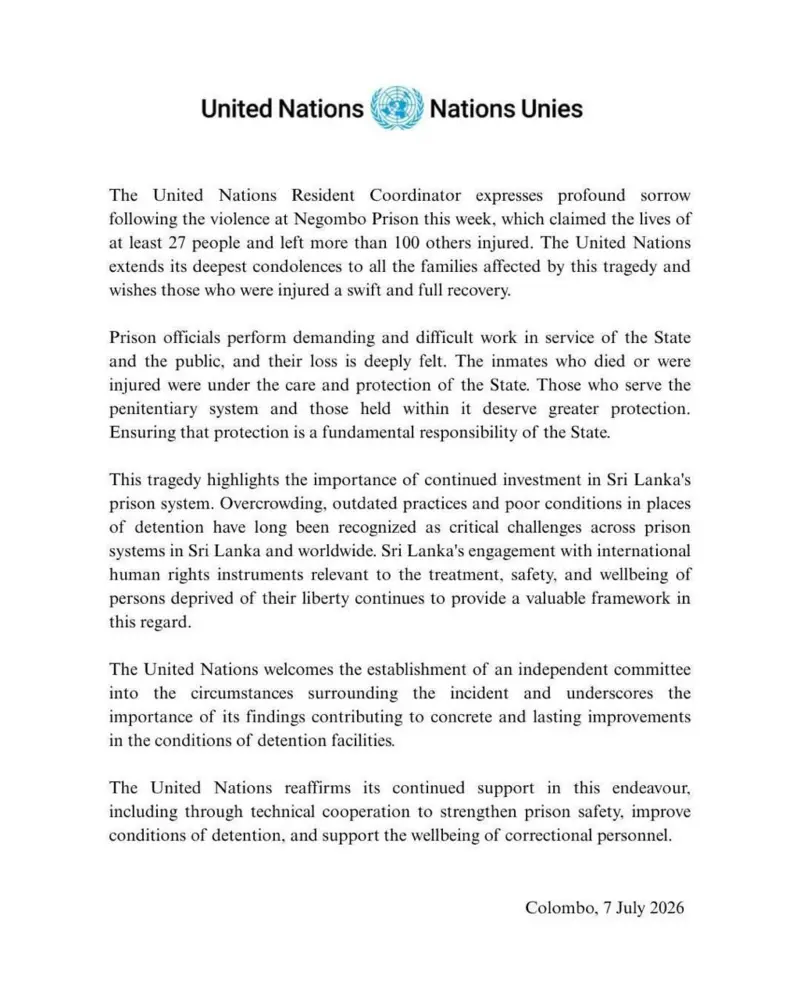
The United Nations issued a special statement on July 07 expressing condolences over the Negombo Prison incident.
The statement noted that prison officers perform a difficult public service.
It also stressed that prisoners remain under state custody. Therefore, both prison officers and prisoners must receive protection.
The UN emphasized that protecting both groups is a fundamental responsibility of the government.
The UN statement also said the clash had highlighted overcrowding, outdated practices and poor conditions in detention facilities.
It also welcomed the appointment of a committee to investigate the incident.
Human Rights Commission Begins Inquiry
Meanwhile, the Sri Lanka Human Rights Commission has launched an investigation into the matter.
Commissioner Nimal G. Punchihewa said complaints continue to arrive that prisoners transferred to other prisons are being harassed.
He said officials of the Human Rights Commission visited Agunukolapelessa Prison and Bogambara Prison on Wednesday, July 8, to examine the situation.
A separate team also visited Welikada Prison, he added.
“Officials are currently taking action to discuss with them how to prevent incidents and ensure that such situations do not escalate further, gathering information and taking necessary steps,” Punchihewa said.
The Negombo inmate deaths have now widened the crisis beyond the original prison unrest, drawing attention to transfers, custody conditions, alleged torture and the state’s duty to protect prisoners under its control.