By Dwayne Ferreira.
UAE Iran trade suspension follows accusations that Tehran launched two ballistic missiles as tensions rise across the Gulf and Hormuz.
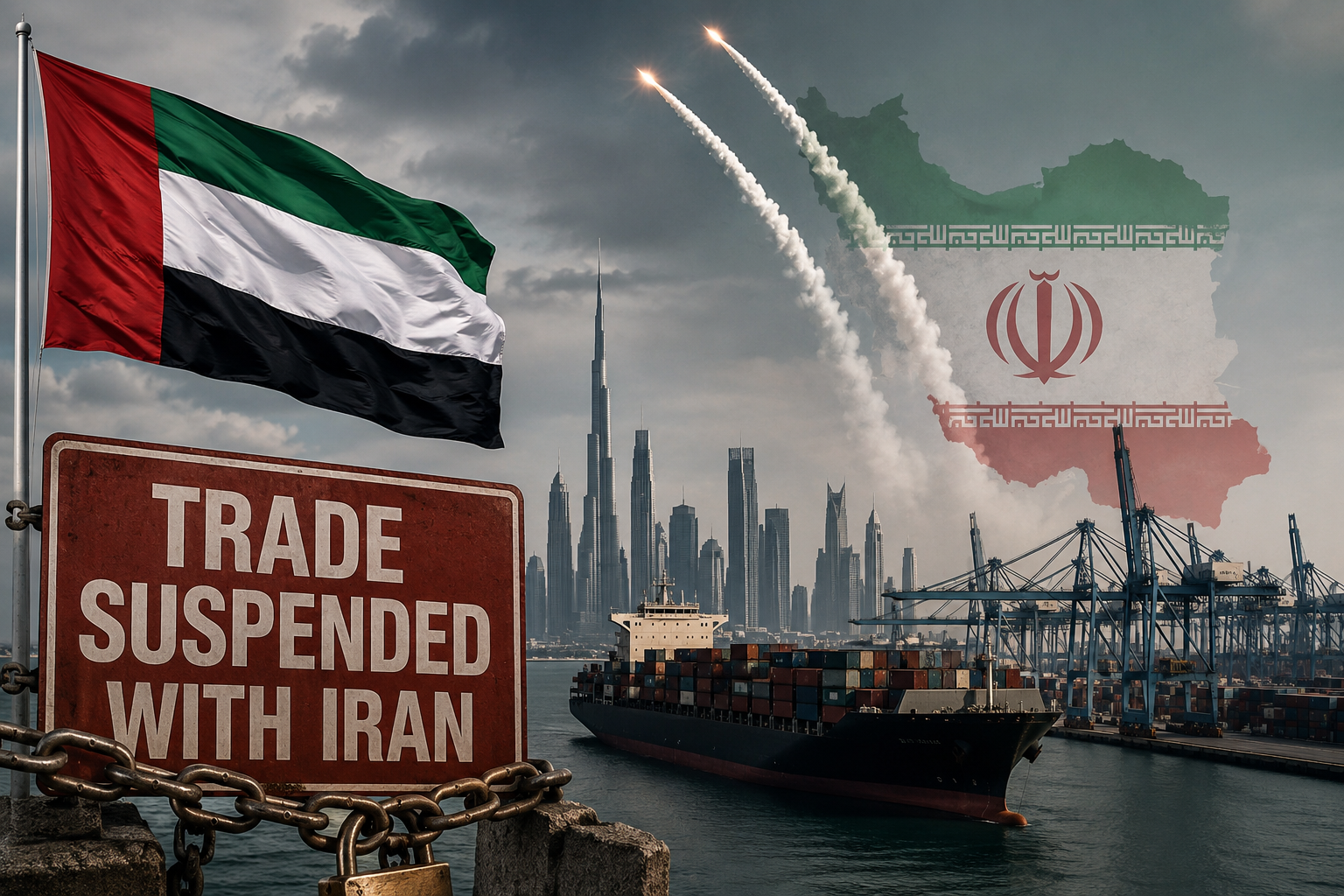
DUBAI, United Arab Emirates – The UAE Iran trade suspension has sharply escalated regional tensions after Abu Dhabi accused Tehran of launching two ballistic missiles toward maritime traffic.
The United Arab Emirates said it suspended all trade activities, commercial exchanges and financial transactions with Iran until further notice. The decision followed a UAE Defence Ministry announcement that it detected two ballistic missiles launched from Iran on Tuesday.
Emirati authorities said their assessment indicated that the missiles were aimed at maritime traffic. However, both fell into the sea and neither struck the UAE mainland.
Iran has rejected the allegation.

Iranian Foreign Ministry spokesman Esmaeil Baghaei called the UAE’s claims “baseless,” leaving Tehran and Abu Dhabi directly at odds over responsibility for the launches.
Residents across the UAE also received phone warnings about a possible missile threat. Authorities later sent another alert saying the situation was safe and normal activities could resume. Reuters reported that it was the first such warning issued to UAE residents in months.
UAE Iran Trade Suspension Targets a Critical Economic Link
The UAE’s response goes far beyond a routine diplomatic protest.
Afra Al Hameli, Director of the Strategic Communications Department at the UAE Ministry of Foreign Affairs, said the country had halted trade activities, commercial exchanges and financial transactions with Iran until further notice.
She linked the decision to regional escalations that threaten peace and security. At the same time, Abu Dhabi maintained that it remains committed to dialogue and cooperation aimed at supporting regional stability.
The economic consequences could be significant.
Dubai has historically served as one of Iran’s most important commercial and financial gateways, especially during periods when Tehran has faced heavy international sanctions. Reuters has described the emirate as one of Iran’s “most critical economic lifelines.”
Direct cargo shipping between Iran and the UAE had only resumed through Dubai’s Jebel Ali Port in late June. The UAE previously suspended direct shipping in early March, shortly after the war began.
The new restrictions therefore threaten to cut off a commercial route that Tehran had only recently regained.
Maritime Attacks Deepen UAE-Iran Tensions
The latest confrontation comes against the backdrop of the wider Middle East war, which began in February with joint U.S.-Israeli strikes against Iran.
The UAE was among the Gulf states heavily exposed during the opening months of the conflict. Iranian attacks on UAE territory later stopped in May. The last reported strike on Emirati soil hit the strategically important Fujairah port on May 4.
However, incidents involving UAE-linked shipping have continued.
The Abu Dhabi National Oil Company has said several of its vessels have faced missile and drone attacks while travelling through the Strait of Hormuz since the conflict began. Iran has not claimed responsibility for those attacks.
Only days before the latest missile incident, the UAE accused Iran of attacking an ADNOC vessel transiting the Strait of Hormuz. ADNOC said that incident caused no injuries.
Another maritime incident followed on Tuesday.
The Liberia-flagged bulk carrier Minoan Dignity was struck by an unidentified projectile while sailing out through the Strait of Hormuz.
The strike damaged the vessel’s engine room and caused a casualty involving its chief engineer, according to maritime security sources cited by Reuters. The Omani Coast Guard assisted the remaining crew.
Authorities have not publicly established who carried out that attack.
Strait of Hormuz Traffic Remains Severely Disrupted
The UAE Iran trade suspension comes at a particularly dangerous moment for the Strait of Hormuz, one of the world’s most important energy shipping routes.
Ship movements through the waterway remain far below normal levels.
Only six commodity vessels crossed the strait on Monday, according to Kpler data cited by Reuters. Before the war, more than 130 vessels passed through the waterway each day.
Some vessels may be travelling with their tracking transponders switched off, which means they would not appear in the available data.
Meanwhile, Washington and Tehran are publicly disputing whether the strait is effectively open.
U.S. President Donald Trump said Tuesday that Hormuz was “open and operating.” He also claimed that mines had been removed or destroyed.
Iran says the waterway remains closed.
Top Iranian negotiator Mohammad Baqer Qalibaf said reopening Hormuz depends on Washington meeting conditions contained in an interim agreement. Those demands include ending the blockade of Iranian ports, lifting oil sanctions, releasing frozen Iranian assets and ending military operations and threats.
US-Iran Diplomacy Stalls as Gulf Markets Fall
The timing of the UAE decision is also significant because hopes for a broader diplomatic settlement are fading.
A memorandum signed on June 17 created a 60-day period for the United States and Iran to negotiate a wider agreement. The proposed talks covered Tehran’s nuclear programme, U.S. sanctions and the conflict.
That deadline expired on Monday without a breakthrough.
Trump later said there were no talks or conversations with Iran taking place or scheduled. He also said he had no intention of extending the 60-day period.
Iran says it remains open to negotiations. However, Tehran has signalled that it will not accept an agreement while under military pressure.
The combination of stalled diplomacy, restricted shipping, attacks on vessels and the UAE’s move to sever commercial and financial dealings with Iran has increased fears of another escalation.
Investors have already responded.
Abu Dhabi’s main stock index fell 0.9% on Wednesday, while Dubai’s market declined 0.3%. Qatar’s index dropped 0.8% to its lowest level in more than a year as geopolitical uncertainty weighed on Gulf markets.
Oil prices also rose as traders assessed the renewed confrontation and uncertainty surrounding Hormuz. Brent crude traded near a three-week high on Wednesday as concerns over Middle Eastern supply routes returned.
The UAE’s decision could therefore have consequences far beyond its bilateral relationship with Iran.
One of Tehran’s most important economic gateways is now effectively closed while the principal maritime route carrying Gulf energy exports remains severely disrupted.
What began with allegations surrounding two missiles that fell into the sea has developed into a potentially significant economic confrontation between two major Gulf powers.