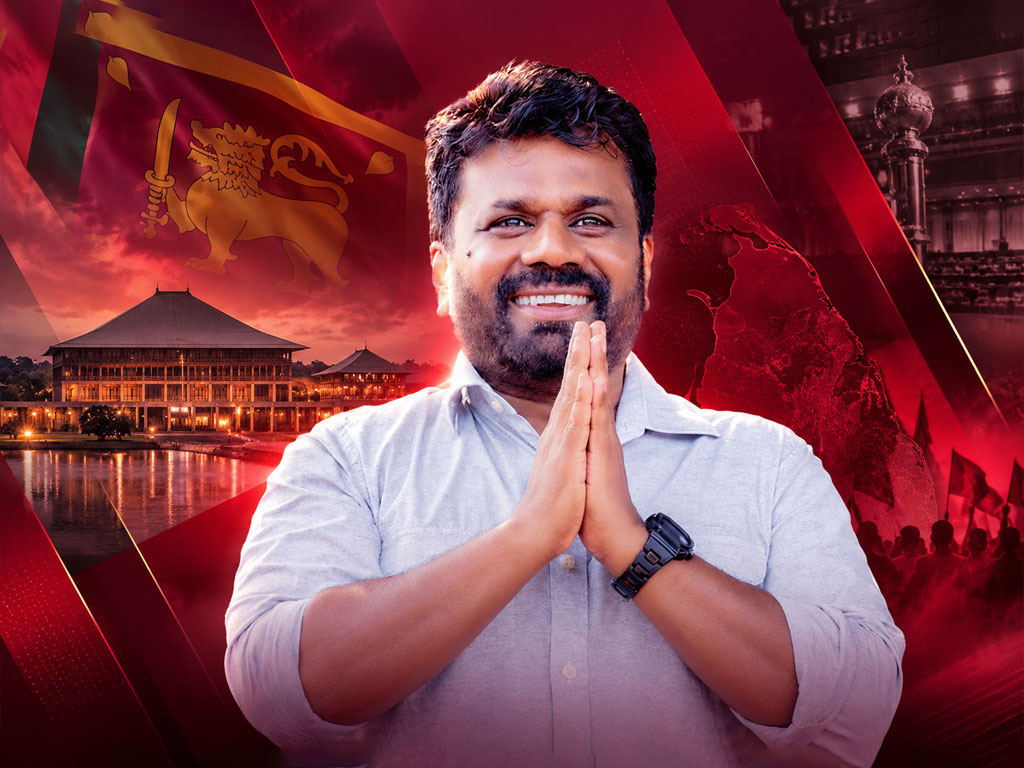
The Anura Kumara Buddhism debate has revived historical comparisons over the State, the Sangha, religious symbolism and political power.
COLOMBO — A strongly worded political commentary circulating among Buddhist nationalist circles has drawn parallels between President Anura Kumara Dissanayake’s Government and historical rulers accused of alienating the Buddha Sasana and the Maha Sangha, using episodes from Sri Lankan history to argue that political power has repeatedly weakened when rulers lost the support of Buddhist institutions.
The commentary presents a sweeping historical argument stretching from ancient kings to modern political movements. It portrays the relationship between political authority, Buddhism and the Sangha as central to the durability of governments in Sri Lanka.
Many of the examples cited are drawn from chronicles, political memory and contested historical interpretation. They should therefore be understood as part of the author’s political argument rather than as independently established proof that religious conflict inevitably causes political collapse.
The central claim is clear: leaders who disregard Buddhist institutions risk alienating a politically and culturally influential section of society.

Ancient Kings Used as Political Warnings
The commentary begins with King Kalantissa, presenting the episode as an example of a ruler who allegedly suffered severe consequences after ordering the execution of an innocent monk.
According to the traditional account cited by the author, the king acted after hearing allegations involving his queen and younger brother and ordered the monk killed by placing him in boiling oil.
The commentary interprets the subsequent flooding of the kingdom and the sacrifice of Viharamaha Devi to the sea as karmic consequences arising from the killing.
Such accounts belong to Sri Lanka’s religious and historical tradition and carry deep symbolic importance. They should not, however, be presented as empirically proven examples of divine or karmic punishment.
The author nevertheless uses the episode as the first of several warnings against rulers who confront Buddhist institutions.
Mahasen and the Maha Vihara
King Mahasen is presented as another example.
The source says he prohibited offerings to the Maha Vihara, forcing monks to leave, and later ordered the destruction of buildings belonging to the institution.
Materials from the demolished structures were said to have been used for the construction of Jethavanaramaya.
According to the commentary, opposition to the king intensified until his close associate, Minister Meghavannabhaya, prepared to confront him militarily.
Mahasen ultimately reversed course and restored the Maha Vihara.
The political lesson drawn by the author is that even powerful rulers could not indefinitely govern against the religious institutions commanding the loyalty of large sections of the population.
Rajasinghe I and the Politics of Religious Estrangement
The commentary next turns to Seethawaka Rajasinghe I.
It repeats a traditional narrative that the king, after seeking relief from the consequences of patricide, became hostile towards Buddhist monks when told that karmic consequences could not simply be removed.
The source goes on to claim that he turned against Buddhism, adopted Hindu practices, destroyed Buddhist texts and persecuted monks.
His eventual death and the collapse of the Seethawaka kingdom are then portrayed as consequences of that estrangement.
These claims belong to a long-standing historical narrative that has itself been the subject of interpretation and debate.
For the political argument being advanced, however, Rajasinghe is used as another symbol of what can happen when rulers become detached from the religious traditions of the majority.
Sri Wickrama Rajasinghe and the Fall of Kandy
The final king of the Kandyan Kingdom is similarly cited.
The commentary argues that Sri Wickrama Rajasinghe lost the confidence of both the Maha Sangha and the public after conflicts with senior monks and after episodes of political brutality, including the tragedy involving the Ehelepola family.
According to the author, the collapse of popular and clerical support left the king politically isolated and helped create conditions in which the British could take control of the Kandyan Kingdom.
The king was subsequently captured, removed from the country and exiled.
Here too, the commentary interprets political collapse through the lens of a ruler losing the support of the religious establishment and the wider population.
Sir John Kotelawala and the 1956 Election
Moving into modern politics, the article cites former Prime Minister Sir John Kotelawala.
It recalls remarks attributed to him that were viewed as dismissive of Buddhist monks who had entered political debate.
The source refers to the widely repeated statement that monks entering politics would be “tarred on the back” and argues that such rhetoric caused deep resentment among the Sangha.
The commentary links that hostility to the mobilisation of the Pancha Maha Balavegaya and the political transformation that culminated in the 1956 general election.
The United National Party suffered a devastating defeat at that election, winning only eight seats.
While election results cannot be reduced to a single cause, the role of Buddhist revivalism and organised clerical support in the political realignment of 1956 remains central to the interpretation advanced by the source.
JVP History Brought Into the Present Debate
The article then turns to the Janatha Vimukthi Peramuna and the violence of the 1987-89 period.
It accuses JVP-linked armed groups of attacks against Buddhist monks and religious institutions and portrays those events as part of a wider conflict between the movement and sections of the Buddhist establishment.
The source specifically refers to a bomb attack on the Sri Dalada Maligawa on February 8, 1989, and also names monks whom it says were killed during that era.
These are serious historical allegations and should not be broadened beyond what can be established by documentary evidence.
The commentary nevertheless uses that period to construct a direct political connection between the JVP’s past and current criticism of President Dissanayake’s administration.
President’s Jaffna Remarks Draw Criticism
The modern focus of the argument concerns statements attributed to President Dissanayake in Jaffna.
According to the source, the President criticised people who travel to Jaffna to observe sil while bypassing established Buddhist sacred sites elsewhere, suggesting that some such activity reflected communal hostility rather than genuine religious observance.
The commentary interprets those remarks as an insult to Buddhists visiting sites in the Northern Province, including the historic Tissa Vihara.
That interpretation is political and contested.
Criticism of how religion is used in communal politics does not automatically amount to criticism of Buddhism itself. Equally, religious observance at historically significant Buddhist sites cannot automatically be dismissed as political provocation.
That distinction is central to assessing the controversy fairly.
Trincomalee Statue Incident and Ministers’ Remarks
The commentary also cites the removal of a Buddha statue in Trincomalee as further evidence of what it describes as a deteriorating relationship between the Government and Buddhist institutions.
It additionally points to remarks attributed to ministers including Bimal Rathnayake and K.D. Lalkantha.
One statement highlighted by the source is that Sri Lanka should not be defined exclusively as a “Sinhala Buddhist state”.
Such statements can generate intense political reaction because they touch on competing ideas about constitutional identity, ethnicity, religion and citizenship.
There is an important distinction between arguing for an inclusive civic state and expressing hostility towards Buddhism. Political debate often collapses those two ideas, even though they are not necessarily the same.
Claims About Religious Networks Require Evidence
The source also raises suspicions about alleged links between senior Government figures and “Born Again” Christian groups.
No evidence establishing organised religious control over State institutions is provided in the material.
Such claims therefore require particular caution.
The religious beliefs or personal associations of individual office-holders do not by themselves establish institutional capture, improper influence or an organised campaign against another faith.
Any allegation of coordinated religious influence over Government would require specific evidence, identifiable decisions and verifiable institutional links.
Without that, suspicion should not be presented as fact.
Gnanasara Thero Case Intensifies Tensions
The latest controversy cited by the author concerns Ven. Galagoda Aththe Gnanasara Thero and the reported removal of his robe while in State custody.
The source argues that the handling of the monk could not have occurred without the knowledge of senior authorities and criticises the public explanations given by prison officials.
That assertion remains an allegation unless supported by documentary or official evidence showing direct political involvement.
The controversy nevertheless has considerable symbolic weight.
For many Buddhists, the robe represents the Sangha rather than merely the individual wearing it. Decisions involving an incarcerated monk can therefore take on political significance beyond ordinary prison administration.
The commentary says the Mahanayake Theros of the three Nikayas have expressed objections in writing and refers to a meeting between the Maha Sangha and the President scheduled for 1 p.m.
History as Political Argument, Not Proof
The article’s larger argument is that rulers who clash with Buddhist institutions eventually suffer political consequences.
History, however, rarely operates through such simple cause and effect.
Governments fall because of combinations of economic conditions, war, elite conflict, public dissatisfaction, electoral movements, foreign intervention, institutional weakness and political mistakes.
Religion may be one powerful factor among many.
The historical episodes invoked in the commentary therefore function more effectively as political warnings than as proof of a fixed law of history.
That distinction matters.
A government may legitimately disagree with Buddhist clergy on policy while still respecting Buddhism. Monks may criticise governments without automatically speaking for every Buddhist citizen. Political opponents may defend the Sangha without gaining exclusive ownership of Buddhist identity.
Buddhism and Political Authority Remain Closely Linked
What cannot be dismissed is the continuing political importance of Buddhism in Sri Lanka.
From the Kandyan era to the nationalist revival of the 20th century and contemporary constitutional debates, Buddhist institutions have remained deeply intertwined with questions of sovereignty, cultural identity and political legitimacy.
Figures such as Ven. Mihindu, Ven. Kudapola, Ven. Migettuwatte Gunananda and Ven. Wariyapola Sumangala continue to occupy powerful places in national memory.
Temples also remain important social and political centres across the country.
Any Government that ignores that reality risks misunderstanding a major component of Sri Lanka’s political culture.
At the same time, historical reverence cannot be used to place clergy above the law, to deny equal citizenship to other religious communities or to transform every disagreement with a monk into an attack on Buddhism.
The Real Test for AKD’s Government
The strongest question raised by the commentary is not whether President Dissanayake is destined to share the fate of ancient kings.
It is whether his Government can manage the relationship between the State and Buddhist institutions without deepening religious or political polarisation.
That requires restraint on all sides.
Government ministers should recognise the sensitivity surrounding Buddhist institutions and religious symbols. Clergy entering political debate should also expect their views to be scrutinised like those of other public actors.
Historical comparisons can illuminate political culture, but they become dangerous when used to claim that political defeat, suffering or death is an inevitable punishment for disagreement with a religion.
Sri Lanka’s history demonstrates the power of Buddhism in shaping political legitimacy.
It does not prove that governments rise and fall through supernatural punishment.
The more immediate political question is whether President Dissanayake and the Maha Sangha can manage their differences without turning a dispute over policy and religious symbolism into a wider confrontation over the character of the State.